 VIPSolutions
Act like a helpful tutor and exlain me :Consider a representative-agent real business cycle (RBC) model where the economy grows stochastically over an infinite horizon = 0,1,2, ... with agents forming beliefs through a learning process with imperfect information. The setup is described by the following structure: Preferences and Household Behavior Agents maximize expected lifetime utility: Eo YB u(C)- L229], 0
Question:
Act like a helpful tutor and exlain me :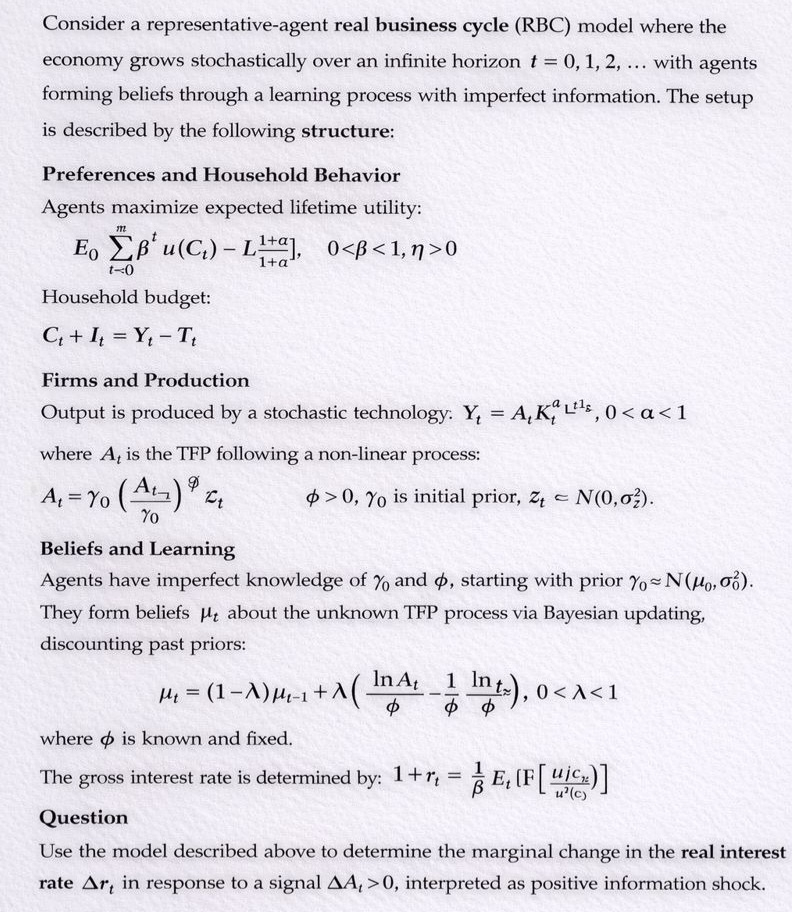 Consider a representative-agent real business cycle (RBC) model where the
economy grows stochastically over an infinite horizon = 0,1,2, ... with agents
forming beliefs through a learning process with imperfect information. The setup
is described by the following structure:
Preferences and Household Behavior
Agents maximize expected lifetime utility:
Eo YB u(C)- L229], 0
This is AI generated Response.
Asked by: Alok Kumar
Created at: 2026-02-03 07:49:58
Asked by: Alok Kumar
Created at: 2026-02-03 07:49:58
Final Answer:
Rendered
Raw Text
Did you like this answer?
# Explanation of the Real Business Cycle (RBC) Model with Learning
Let's break down the structure and components of this model step by step:
---
## 1. **Preferences and Household Behavior**
**Objective:**
Agents (households) maximize their expected lifetime utility:
\[
E_ \sum_{t=}^m \beta^t \, u(C_t) - L_t^{1+\alpha}/(1+\alpha)
\]
- **\( \beta \)**: Discount factor (\( < \beta < 1\)), how much future utility is valued.
- **\( u(C_t) \)**: Utility from consumption at time \( t \).
- **\( L_t \)**: Labor supplied at time \( t \).
- **\( \alpha \)**: Parameter for the disutility of labor.
- **\( \eta \)**: Elasticity parameter (given as \( \eta > \)).
**Budget Constraint:**
\[
C_t + I_t = Y_t - T_t
\]
- **\( C_t \)**: Consumption
- **\( I_t \)**: Investment
- **\( Y_t \)**: Output (income)
- **\( T_t \)**: Taxes
---
## 2. **Firms and Production**
Firms produce output using a stochastic (random) technology:
\[
Y_t = A_t K_t^\alpha L_t^{1-\alpha}
\]
- **\( Y_t \)**: Output
- **\( K_t \)**: Capital
- **\( L_t \)**: Labor
- **\( \alpha \)**: Output elasticity of capital (\( < \alpha < 1 \))
**TFP (Total Factor Productivity) process:**
\[
A_t = \gamma_ \left( \frac{A_{t-1}}{\gamma_} \right)^\phi z_t
\]
- **\( \gamma_ \)**: Initial prior for TFP process
- **\( \phi \)**: Persistence parameter (\( \phi > \))
- **\( z_t \)**: Random shock (\( z_t \sim N(, \sigma_z^2) \))
---
## 3. **Beliefs and Learning**
Agents **do not know** the true values of \( \gamma_ \) and \( \phi \) and must **learn** about them over time.
- They start with a prior belief: \( \gamma_ \sim N(\mu_, \sigma_^2) \)
- They **update beliefs** (\( \mu_t \)) using Bayesian updating:
\[
\mu_t = (1-\lambda)\mu_{t-1} + \lambda \left( \frac{\ln A_t}{\phi} - \frac{1}{\phi} \ln(\phi t z_t) \right)
\]
- **\( \lambda \)**: Learning rate (\( < \lambda < 1 \))
---
## 4. **Interest Rate Determination**
The **gross interest rate** is:
\[
1 + r_t = \frac{1}{\beta} E_t \left[ F \left( \frac{u'(c_{t+1})}{u'(c_t)} \right) \right]
\]
- This equation is a version of the **Euler equation**, linking the interest rate to expected marginal utility growth.
---
## 5. **Question: Marginal Change in the Real Interest Rate**
**Task:**
Determine how the **real interest rate** \( \Delta r_t \) changes in response to a **positive information shock** (\( \Delta A_t > \)), i.e., TFP (productivity) goes up unexpectedly.
---
## **How to Approach the Question**
### Step 1: **Effect of TFP Shock on Output and Consumption**
- \( \Delta A_t > \) increases output \( Y_t \).
- Higher output typically increases consumption \( C_t \) and/or investment \( I_t \).
### Step 2: **Effect on Marginal Utility**
- If consumption rises, **marginal utility** \( u'(C_t) \) falls (because utility functions are usually concave).
### Step 3: **Effect on Expected Marginal Utility Growth**
- The expectation \( E_t \left[ \frac{u'(C_{t+1})}{u'(C_t)} \right] \) will tend to **decrease** (since \( C_t \) is higher today).
### Step 4: **Interest Rate Response**
- From the interest rate equation:
\[
1 + r_t = \frac{1}{\beta} E_t \left[ F \left( \frac{u'(c_{t+1})}{u'(c_t)} \right) \right]
\]
- If expected marginal utility growth falls, the right side **increases**.
- Therefore, **the real interest rate \( r_t \) increases**.
### Step 5: **Role of Learning**
- If agents **learn** that productivity is higher, their expectations about future \( A_t \) and \( Y_t \) adjust upward.
- This reinforces the effect: higher expected growth, higher interest rates today.
---
## **Summary Table**
| **Shock** | **Output/Consumption** | **Marginal Utility** | **Expected Growth** | **Interest Rate** |
|----------------------|-----------------------|----------------------|---------------------|------------------------|
| \( \Delta A_t > \) | ↑ | ↓ | ↓ | ↑ (rises) |
---
## **Conclusion**
- **A positive shock to TFP (\( \Delta A_t > \)) increases the real interest rate \( r_t \) in this RBC model with learning.**
- This is because higher productivity boosts output and consumption, lowering marginal utility and raising the equilibrium real interest rate.
---
### **If you want to see the exact derivative or formula for \( \Delta r_t \), let me know!**
📢 Instructions:
- Ask anything relatd to above question only.
- For new Question goto :