 VIPSolutions
Act like a helpful tutor and exlain me :CHE 232 592026 Homework 3 Student Name: 1. Determine the product of the reaction below. X the box of the correct answer. oy excess HI ! I cd OL ee OU mu O(a) 0 (b) 0) 0) Oe) 2. Predicting Products/starting materials: Draw the structure of the major organic product(s) of each reaction in the boxes provided. Stereochemistry should be shown if applicable. 1)MeMgBr Ce 0 2) H0 Z > _ OH OH —= on DE! ZZ O— o 3] — Y 1.50Cl,, py POE 3. Synthesis: provide the reagents and intermediate needed to accomplish the following transformations. Bra, H20 . [ a > (achiral)
Question:
Act like a helpful tutor and exlain me :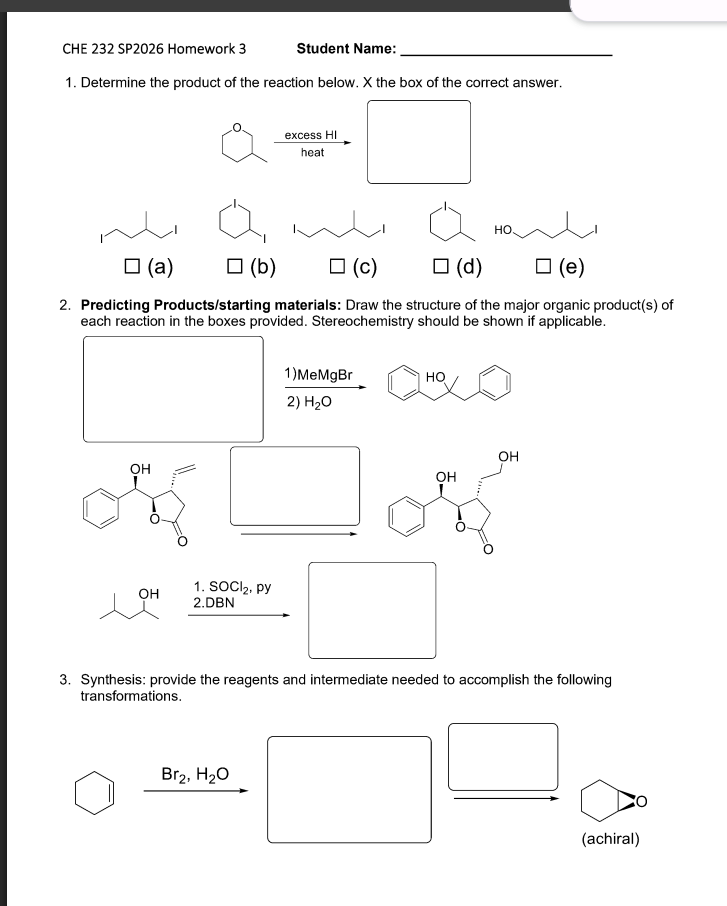 CHE 232 592026 Homework 3 Student Name:
1. Determine the product of the reaction below. X the box of the correct answer.
oy excess HI
! I
cd OL ee OU mu
O(a) 0 (b) 0) 0) Oe)
2. Predicting Products/starting materials: Draw the structure of the major organic product(s) of
each reaction in the boxes provided. Stereochemistry should be shown if applicable.
1)MeMgBr Ce 0
2) H0 Z >
_ OH
OH —= on
DE!
ZZ O— o
3] — Y
1.50Cl,, py
POE
3. Synthesis: provide the reagents and intermediate needed to accomplish the following
transformations.
Bra, H20 . [
a >
(achiral)
This is AI generated Response.
Asked by: Alok Kumar
Created at: 2026-01-31 06:47:11
Asked by: Alok Kumar
Created at: 2026-01-31 06:47:11
Final Answer:
Rendered
Raw Text
Did you like this answer?
Sure! Let's break down each question step by step:
---
## 1. **Determine the product of the reaction**
**Reaction:**
Cyclohexanone + excess HI, heat
### **Explanation:**
- **Cyclohexanone** is a six-membered ring with a ketone (C=O).
- **Excess HI (hydroiodic acid) and heat** is a reducing/cleaving condition. It reduces carbonyls and can cleave ethers.
- Here, HI will:
- Reduce the ketone to a hydrocarbon.
- Replace oxygens with iodines (by cleaving C–O bonds and forming C–I).
#### **Step-by-step Mechanism:**
1. The ketone is converted by HI into **1,1-diiodocyclohexane** (two iodines add to the same carbon).
2. Upon further heating, the cyclohexane ring can open, but mainly the diiodo structure forms.
#### **Correct Product:**
- The answer is **(a)**:
- 1,1-diiodohexane (six-membered ring with two I's on the same carbon).
---
## 2. **Predicting Products/Starting Materials**
### (A) **Grignard Reaction**
- **Reactants:** Benzaldehyde + MeMgBr (Grignard) → add H₂O
- **Mechanism:**
- Grignard reagent (MeMgBr) adds a methyl group to the carbonyl carbon.
- Acid workup gives a **secondary alcohol**.
- **Product:**
- Phenyl group attached to a carbon with an OH and a methyl (CH₃) and a hydrogen.
### (B) **Lactone Hydrolysis**
- **Reactant:** a lactone with a phenyl and OH group.
- **Product:**
- After hydrolysis, you get a dihydroxy acid (ring opened, OH groups on both ends).
### (C) **Alcohol to Alkyl Chloride**
- **Reactant:** 2-butanol
- **Reagents:** SOCl₂ (thionyl chloride), pyridine, DBN
- **Mechanism:**
- SOCl₂ converts alcohol to alkyl chloride.
- **Product:**
- 2-chlorobutane (substitute OH for Cl).
---
## 3. **Synthesis: Benzene to Epoxide**
### Step 1: **Bromination**
- **Reactant:** Benzene
- **Reagents:** Br₂, H₂O
- **Product:** Bromobenzene (Br added to benzene ring).
### Step 2: **Epoxidation**
- **Intermediate:** You need to convert bromobenzene to cyclohexene, then epoxidize.
- **Common steps:**
1. Birch reduction (to cyclohexene)
2. Epoxidation (using mCPBA, for example)
- **Final Product:** Cyclohexene oxide (an achiral epoxide).
---
## **Summary Table**
| Step | Reaction/Intermediate | Product |
|------|----------------------|---------|
| 1 | Cyclohexanone + HI | (a) 1,1-Diiodocyclohexane |
| 2A | Benzaldehyde + MeMgBr | Secondary alcohol (Ph-CH(OH)-Me) |
| 2B | Lactone hydrolysis | Dihydroxy acid |
| 2C | 2-butanol + SOCl₂ | 2-chlorobutane |
| 3 | Benzene → Epoxide | Cyclohexene oxide (achiral) |
---
If you'd like, I can draw structures for each step as well! Let me know if you need any clarifications.
📢 Instructions:
- Ask anything relatd to above question only.
- For new Question goto :