 VIPSolutions
Act like a helpful tutor and exlain me :Chapter 3 (30 points) The stepped shaft shown must rotate at a frequency of 60 Hz. Knowing that the radius of the fillet is r — C* mm and the allowable shearing stress is D* MPa: a) determine the maximum power that can be transmitted. G= 77.2 GPa, b) if the rotational speed is 50 I1z, the maximum allowable power transmitted will be: LOWER THE SAME HIGHER (please underline the correct response on your page) T 60 mm 18 i WT] es 17 30 mm | bs \[< t Lo! Dn x = 15 A ) ANT : \ K 14 ACR 13 a NEES Sg A re oT w LL LT] 0 005 0.10 015 020 025 0.30 rid
Question:
Act like a helpful tutor and exlain me :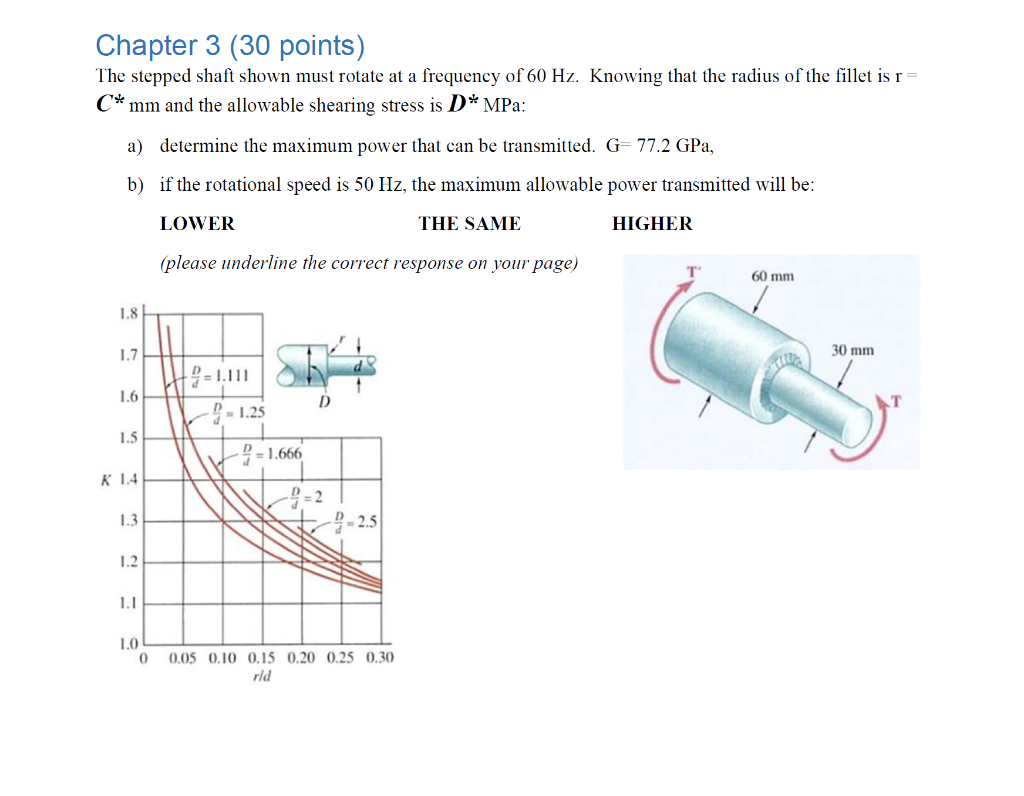 Chapter 3 (30 points)
The stepped shaft shown must rotate at a frequency of 60 Hz. Knowing that the radius of the fillet is r —
C* mm and the allowable shearing stress is D* MPa:
a) determine the maximum power that can be transmitted. G= 77.2 GPa,
b) if the rotational speed is 50 I1z, the maximum allowable power transmitted will be:
LOWER THE SAME HIGHER
(please underline the correct response on your page) T
60 mm
18 i
WT] es
17 30 mm
| bs
\[< t
Lo! Dn x
=
15 A )
ANT :
\
K 14 ACR
13 a
NEES Sg
A
re
oT
w LL LT]
0 005 0.10 015 020 025 0.30
rid
This is AI generated Response.
Asked by: manish kumar
Created at: 2025-09-12 20:45:20
Asked by: manish kumar
Created at: 2025-09-12 20:45:20
Final Answer:
Rendered
Raw Text
Did you like this answer?
# Explanation of the Problem
This problem is about finding the **maximum power** transmitted by a **stepped shaft** subjected to a maximum allowable shearing stress, and understanding how this changes with frequency (speed).
Let's break it down step by step:
---
## **Given Data**
- **Fillet radius:** \( r = C \) mm (C is a variable/constant)
- **Allowable shearing stress:** \( \tau_{max} = D \) MPa (D is a variable/constant)
- **Shaft dimensions:** Large diameter \( D = 60 \) mm, small diameter \( d = 30 \) mm
- **Modulus of rigidity:** \( G = 77.2 \) GPa
- **Rotational frequency:** \( f = 60 \) Hz (for part a), \( f = 50 \) Hz (for part b)
- **Stress concentration chart:** Provided (for K)
---
## **Step 1: Find the Maximum Torque**
The shaft will fail where the **maximum shear stress** is highest, usually at the fillet (change in diameter).
### **Shear Stress with Stress Concentration**
\[
\tau_{max} = K_t \cdot \frac{T \cdot r_{outer}}{J}
\]
Where:
- \( K_t \) = stress concentration factor (from the chart, depends on \( r/d \) and \( D/d \))
- \( T \) = torque
- \( r_{outer} \) = outer radius at the small diameter (\( d/2 \))
- \( J \) = polar moment of inertia for the small shaft (\( J = \frac{\pi}{32} d^4 \) for a solid shaft)
### **Solving for Maximum Torque**
Rearrange for \( T \):
\[
\tau_{max} = K_t \cdot \frac{T \cdot (d/2)}{J}
\implies T_{max} = \frac{\tau_{max} \cdot J}{K_t \cdot (d/2)}
\]
Substitute \( J \):
\[
T_{max} = \frac{\tau_{max} \cdot \frac{\pi}{32} d^4}{K_t \cdot (d/2)}
= \frac{\tau_{max} \cdot \pi d^3}{16 K_t}
\]
---
## **Step 2: Find the Stress Concentration Factor \( K_t \)**
From the chart:
- Find \( r/d \) (with \( r = C \), \( d = 30 \) mm)
- Find \( D/d \) (with \( D = 60 \), \( d = 30 \), so \( D/d = 2 \))
- Enter the chart with these values to get \( K_t \).
---
## **Step 3: Find the Maximum Power**
Power transmitted by a rotating shaft:
\[
P = T \cdot \omega
\]
Where:
- \( T \) = maximum torque (from above)
- \( \omega \) = angular speed \( = 2\pi f \)
So,
\[
P_{max} = T_{max} \cdot 2\pi f
\]
---
## **Step 4: Effect of Rotational Speed**
For part **b**:
- If \( f \) changes from 60 Hz to 50 Hz, \( P_{max} \) will change **proportionally** (since max torque is limited by material, not by speed).
\[
P_{max} \propto f
\]
So, **if speed decreases, max allowable power decreases**.
---
## **Summary / Answers**
### a) **Maximum Power Calculation**
1. **Find \( K_t \)** from the chart using given \( r/d \) and \( D/d \).
2. **Compute \( T_{max} \):**
\[
T_{max} = \frac{\tau_{max} \cdot \pi d^3}{16 K_t}
\]
3. **Compute \( P_{max} \):**
\[
P_{max} = T_{max} \cdot 2\pi f
\]
### b) **Effect of Frequency**
- **At lower frequency (50 Hz), the maximum power is:**
- **LOWER**, because power is proportional to rotational speed.
---
## **Key Steps to Solve**
1. Find \( K_t \) from the chart using \( r/d \) and \( D/d \).
2. Plug values into the torque equation.
3. Use the new torque to find power at the required frequency.
---
### **Let me know if you'd like to see a full sample calculation with numbers!**
📢 Instructions:
- Ask anything relatd to above question only.
- For new Question goto :