Act like a helpful tutor and exlain me :Chapter 1 — System Modeling
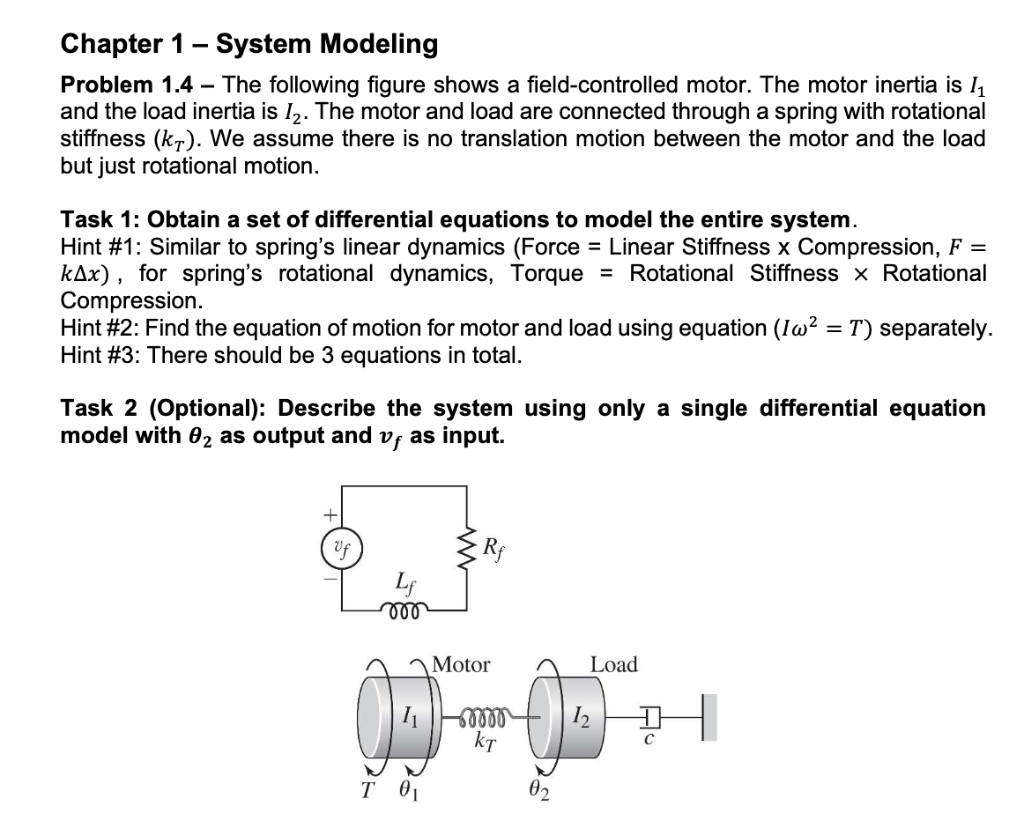
Problem 1.4 — The following figure shows a field-controlled motor. The motor inertia is I;
and the load inertia is I,. The motor and load are connected through a spring with rotational
stiffness (kr). We assume there is no translation motion between the motor and the load
but just rotational motion.
Task 1: Obtain a set of differential equations to model the entire system.
Hint #1: Similar to spring's linear dynamics (Force = Linear Stiffness x Compression, F =
kAx) , for spring's rotational dynamics, Torque = Rotational Stiffness x Rotational
Compression.
Hint #2: Find the equation of motion for motor and load using equation (Iw? = T) separately.
Hint #3: There should be 3 equations in total.
Task 2 (Optional): Describe the system using only a single differential equation
model with 8; as output and vy as input.
+
0, Ry
hr I
000
Motor Load
1 | oom so +]
kr c
T 0 0,
Question:
Act like a helpful tutor and exlain me :Chapter 1 — System Modeling
Problem 1.4 — The following figure shows a field-controlled motor. The motor inertia is I;
and the load inertia is I,. The motor and load are connected through a spring with rotational
stiffness (kr). We assume there is no translation motion between the motor and the load
but just rotational motion.
Task 1: Obtain a set of differential equations to model the entire system.
Hint #1: Similar to spring's linear dynamics (Force = Linear Stiffness x Compression, F =
kAx) , for spring's rotational dynamics, Torque = Rotational Stiffness x Rotational
Compression.
Hint #2: Find the equation of motion for motor and load using equation (Iw? = T) separately.
Hint #3: There should be 3 equations in total.
Task 2 (Optional): Describe the system using only a single differential equation
model with 8; as output and vy as input.
+
0, Ry
hr I
000
Motor Load
1 | oom so +]
kr c
T 0 0,
This is AI generated Response.
Asked by: Alok Kumar
Created at: 2026-01-26 04:17:00
Final Answer:
RenderedRaw Text
Did you like this answer?
# Explanation of 1.4 – System Modeling
Let's break down the **system modeling** and guide you through setting up the differential equations step by step.
---
## **Understanding the System**
You have:
- **Field-controlled motor** (with inertia \( I_1 \))
- **Load** (with inertia \( I_2 \))
- **Rotational spring** (with stiffness \( k_T \)) connecting motor and load
- Input: Field voltage (\( v_f \))
- Output: Load angular position (\( \theta_2 \))
- **No translational motion**—only rotational
### **Key Variables**
- \( \theta_1 \): Angular position of the motor
- \( \theta_2 \): Angular position of the load
- \( v_f \): Field voltage input to the motor
---
## **Task 1: Obtain Set of Differential Equations**
### **Step 1: Electrical Dynamics (Field Circuit)**
From the circuit:
\[
v_f = R_f i_f + L_f \frac{di_f}{dt}
\]
Where:
- \( R_f \): Field resistance
- \( L_f \): Field inductance
- \( i_f \): Field current
### **Step 2: Mechanical Dynamics (Motor and Load)**
#### **A. Motor (Inertia \( I_1 \))**
- **Equation of motion**: \( I_1 \ddot{\theta}_1 = T - T_s \)
- \( T \): Torque produced by the motor (proportional to field current, \( i_f \))
- \( T_s \): Torque due to the spring
- **Spring torque** (like spring force):
\[
T_s = k_T (\theta_1 - \theta_2)
\]
- **Motor torque**: \( T = K_f i_f \), with \( K_f \) as the torque constant
So,
\[
I_1 \ddot{\theta}_1 = K_f i_f - k_T (\theta_1 - \theta_2)
\]
#### **B. Load (Inertia \( I_2 \))**
- **Equation of motion**: \( I_2 \ddot{\theta}_2 = T_s \) (assuming no damping or external load torque)
So,
\[
I_2 \ddot{\theta}_2 = k_T (\theta_1 - \theta_2)
\]
---
### **Summary of Differential Equations**
1. **Field Circuit:**
\[
v_f = R_f i_f + L_f \frac{di_f}{dt}
\]
2. **Motor:**
\[
I_1 \ddot{\theta}_1 = K_f i_f - k_T (\theta_1 - \theta_2)
\]
3. **Load:**
\[
I_2 \ddot{\theta}_2 = k_T (\theta_1 - \theta_2)
\]
---
## **Task 2 (Optional): Single Differential Equation (with \( \theta_2 \) as Output, \( v_f \) as Input)**
### **Goal**: Express everything in terms of \( \theta_2 \) and \( v_f \).
**Outline of Steps:**
1. Express \( i_f \) from the field circuit equation.
2. Relate \( \theta_1 \) to \( \theta_2 \) using the load and motor equations.
3. Substitute back to eliminate intermediate variables.
#### **Step-by-step Outline**
1. **From load equation:**
\( I_2 \ddot{\theta}_2 = k_T (\theta_1 - \theta_2) \)
\( \Rightarrow \theta_1 = \theta_2 + \frac{I_2}{k_T} \ddot{\theta}_2 \)
2. **Substitute \( \theta_1 \) into motor equation:**
\( I_1 \ddot{\theta}_1 = K_f i_f - k_T (\theta_1 - \theta_2) \)
But \( (\theta_1 - \theta_2) = \frac{I_2}{k_T} \ddot{\theta}_2 \)
3. **Combine and substitute \( i_f \) from field circuit equation.**
This leads to a **third-order** single differential equation relating \( \theta_2 \) and \( v_f \).
---
## **Summary Table**
| Equation Type | Equation |
|-------------------|--------------------------------------------------------------------------|
| Field Circuit | \( v_f = R_f i_f + L_f \frac{di_f}{dt} \) |
| Motor | \( I_1 \ddot{\theta}_1 = K_f i_f - k_T (\theta_1 - \theta_2) \) |
| Load | \( I_2 \ddot{\theta}_2 = k_T (\theta_1 - \theta_2) \) |
---
### **Diagram Reference**
- \( v_f \) is the input voltage, \( \theta_2 \) is the output (load position).
---
## **Summary**
- **Task 1**: Three equations—one for the field circuit, one for the motor, and one for the load.
- **Task 2**: Combine the equations to relate \( v_f \) (input) to \( \theta_2 \) (output) by eliminating intermediate variables.
Let me know if you want to see the single combined equation for Task 2 worked out explicitly!
VIPSolutions focuses on clear, step‑by‑step explanations so you can learn quickly. Whether you need an AI‑generated walkthrough or a short hint to get unstuck, each solution is organized for fast reading and easy review later.
Search similar questions, compare approaches, and bookmark the best answers for revision. Our goal is simple: quick, reliable study help that feels natural—not noisy.
 VIPSolutions
 Chapter 1 — System Modeling
Problem 1.4 — The following figure shows a field-controlled motor. The motor inertia is I;
and the load inertia is I,. The motor and load are connected through a spring with rotational
stiffness (kr). We assume there is no translation motion between the motor and the load
but just rotational motion.
Task 1: Obtain a set of differential equations to model the entire system.
Hint #1: Similar to spring's linear dynamics (Force = Linear Stiffness x Compression, F =
kAx) , for spring's rotational dynamics, Torque = Rotational Stiffness x Rotational
Compression.
Hint #2: Find the equation of motion for motor and load using equation (Iw? = T) separately.
Hint #3: There should be 3 equations in total.
Task 2 (Optional): Describe the system using only a single differential equation
model with 8; as output and vy as input.
+
0, Ry
hr I
000
Motor Load
1 | oom so +]
kr c
T 0 0,