 VIPSolutions
Act like a helpful tutor and exlain me :Austria Transition state (minus the partial charges) Hu i 20. NE H pT ~y H H H | | ol . _ Ng—H iN N: yy — .0r es) uw H uw Ny Click here for pK, table
Question:
Act like a helpful tutor and exlain me :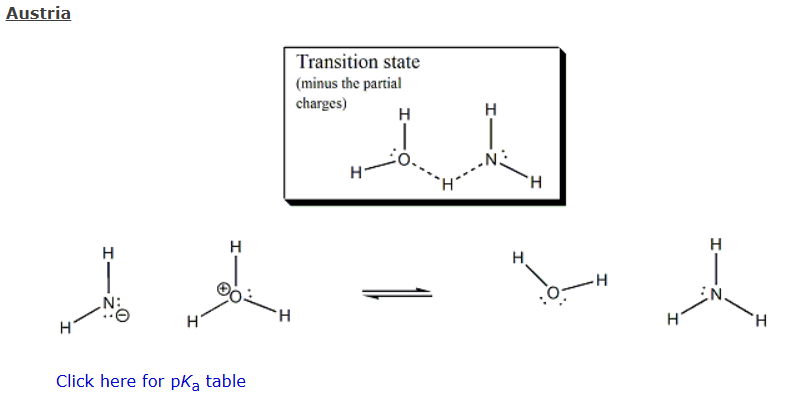 Austria
Transition state
(minus the partial
charges) Hu i
20. NE
H pT ~y
H H H |
| ol . _ Ng—H iN
N: yy — .0r
es) uw H uw Ny
Click here for pK, table
This is AI generated Response.
Asked by: Alok Kumar
Created at: 2026-01-29 07:20:06
Asked by: Alok Kumar
Created at: 2026-01-29 07:20:06
Final Answer:
Rendered
Raw Text
Did you like this answer?
# Explanation of the Reaction Mechanism
Let's break down what's happening in the image step by step:
---
## 1. **Reactants**
- **Left Side:**
- **Ammonia (NH₃, with a lone pair)**
- **Hydronium ion (H₃O⁺, with a positive charge)**
---
## 2. **Transition State**
- The **transition state** box shows the key moment during the reaction:
- A **proton (H⁺)** is being transferred from the hydronium ion (H₃O⁺) to ammonia (NH₃).
- Dashed lines indicate **bond breaking and forming**:
- The N atom from ammonia is starting to form a bond with an H from hydronium.
- The O atom from hydronium is starting to lose its bond to that same H.
---
## 3. **Products**
- **Right Side:**
- **Water (H₂O)**
- **Ammonium ion (NH₄⁺, with a positive charge)**
- Ammonia has accepted a proton to become ammonium.
- Hydronium has lost a proton to become water.
---
## 4. **Summary of the Reaction**
This is a classic **acid-base reaction**:
\[
\ce{NH3 + H3O+ <=> NH4+ + H2O}
\]
- **Ammonia (NH₃)** acts as a **base** (proton acceptor).
- **Hydronium (H₃O⁺)** acts as an **acid** (proton donor).
---
## 5. **Mechanism Details**
- **Before the arrow:** NH₃ has a lone pair and H₃O⁺ is ready to donate an H⁺.
- **Transition state:** The proton is in transit. Both N and O are partially bonded to the transferring H.
- **After the arrow:** NH₄⁺ (ammonium) and H₂O (water) are formed.
---
## 6. **Key Concepts**
- **Proton transfer** is central to acid-base reactions.
- The **transition state** represents the highest energy point during the transfer.
- The **curved arrows** (not shown here, but implied) would go:
- From the lone pair on N to the H on hydronium.
- From the O-H bond in hydronium to the O atom.
---
If you have the **pKₐ table**, you can use it to predict the direction of equilibrium based on acid/base strength.
---
### Let me know if you'd like to see electron-pushing arrows or more details about pKₐ!
📢 Instructions:
- Ask anything relatd to above question only.
- For new Question goto :