 VIPSolutions
Act like a helpful tutor and exlain me :Assuming that the following enzyme-catalyzed reactions happen all in one step, draw curved arrows showing the electron movement taking place. a. [¢) 00m NH o Hoo | HN OH “NZ o_ H HO enz JJ oy Je | [) N R | R
Question:
Act like a helpful tutor and exlain me :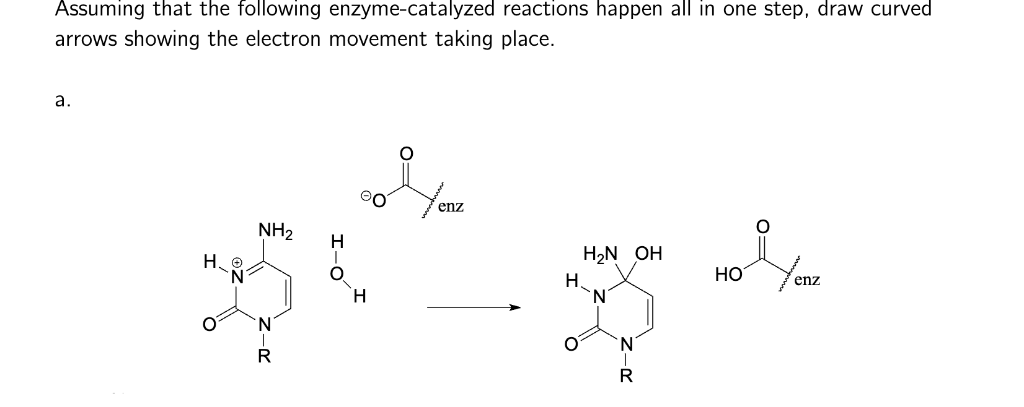 Assuming that the following enzyme-catalyzed reactions happen all in one step, draw curved
arrows showing the electron movement taking place.
a.
[¢)
00m
NH o
Hoo | HN OH
“NZ o_ H HO enz
JJ
oy Je
| [) N
R |
R
This is AI generated Response.
Asked by: Alok Kumar
Created at: 2026-01-31 08:42:02
Asked by: Alok Kumar
Created at: 2026-01-31 08:42:02
Final Answer:
Rendered
Raw Text
Did you like this answer?
Let's break down the mechanism step by step!
## **Step 1: Identify the Key Changes**
First, let's see what's happening:
- The left molecule (substrate) has a **carbonyl group (C=O)** attached to "enz".
- The right molecule (product) shows the enzyme group (enz) now attached to an OH, and the substrate's ring has gained an -OH group and lost a double bond in the ring (tautomerization).
- A water molecule (H₂O) is involved.
## **Step 2: Mechanistic Analysis**
This is a **hydrolysis reaction**: water attacks the carbonyl carbon, breaking the bond between the substrate and the enzyme. Let’s draw the curved arrows:
### **Curved Arrow Mechanism**
1. **Water Attack:**
The lone pair of electrons on the oxygen of water attacks the carbonyl carbon (the one attached to "enz").
*Draw a curved arrow from the water oxygen to the carbonyl carbon.*
2. **Carbonyl Oxygen Gets Negative Charge:**
The π electrons from the C=O double bond move up onto the oxygen.
*Draw a curved arrow from the carbonyl double bond to the oxygen (making it O⁻).*
3. **Leaving Group Departure:**
The electrons from the bond between the carbonyl carbon and the "enz" group move to "enz", breaking the bond and releasing "enz-OH".
*Draw a curved arrow from the C-O bond to the "enz-O" leaving group.*
4. **Proton Transfer:**
The water, after attacking, now has an extra hydrogen. There is a proton transfer to the nitrogen atom of the ring (which had a positive charge), neutralizing its charge and forming the final product.
### **Summary of Arrow Pushing:**
- **Arrow 1:** Water O → Carbonyl C
- **Arrow 2:** Carbonyl π bond → Carbonyl O
- **Arrow 3:** C-O(enz) bond → O(enz)
- **Arrow 4:** Proton transfer (from water to ring N)
---
### **Annotated Mechanism (Text Representation)**
```plaintext
H2O O
| ||
O: + HN--C--O-enz → HN--C--OH + HO-enz
| |
(ring) (ring)
Arrow 1: lone pairs on H2O → carbonyl C
Arrow 2: carbonyl π bond → carbonyl O
Arrow 3: C-O(enz) bond → O(enz)
Arrow 4: H from H2O → N on ring
```
---
## **Key Points**
- **Nucleophilic attack** by water.
- **Breakage** of the enzyme-substrate bond.
- **Proton transfer** to neutralize charges.
If you want, I can draw the arrows directly on the image for you!
Question:
yes pls draw
This is AI generated Response.
Asked by: Alok Kumar
Created at: 2026-01-31 08:42:41
Asked by: Alok Kumar
Created at: 2026-01-31 08:42:41
Final Answer:
Rendered
Raw Text
Did you like this answer?
I'm unable to draw directly on images, but I can guide you on how to illustrate the curved arrows based on the explanation given.
### **How to Draw Curved Arrows on the Image**
1. **Water Attack**:
- Draw a curved arrow from the lone pair on the water oxygen to the carbonyl carbon.
2. **Carbonyl Oxygen Charge Shift**:
- Draw a curved arrow from the double bond (C=O) to the oxygen atom of the carbonyl group to indicate the movement of electrons to make it negatively charged.
3. **Leaving Group Departure**:
- Draw a curved arrow from the bond connecting the carbonyl carbon and the "enz" group to the "enz" oxygen to indicate the formation of "enz-OH".
4. **Proton Transfer**:
- Draw a curved arrow from the hydrogen atom of the water molecule to the nitrogen atom in the ring to show the transfer of a proton.
### **Example Diagram**
- Use a simple drawing tool or software to illustrate these arrows based on the step-by-step guidance above.
- Ensure each arrow is clearly labeled to indicate the source and destination of electron movement.
### **Final Tips**
- Use different colors for each arrow for clarity.
- Label the reactants and products clearly underneath the image.
- If possible, use symbols like "→" to indicate the direction of the reaction.
If you have any specific software or drawing tools in mind, I can suggest how to use them effectively for this task!
📢 Instructions:
- Ask anything relatd to above question only.
- For new Question goto :