 VIPSolutions
Act like a helpful tutor and exlain me : (answer in humanised style without using bullet points)4. A pressure [@) vs. composition (za) liquid-vapor phase diagram of a rs binary system (A+B) is shown in Fig.1. This diagram corresponds to a constant temperature (T°), with z denotes the overall mole fraction of A among all the phases in the system. (a)[4pts]Please draw the corresponding temperature vs. composition (za) ki IN diagram at p=pmay of Fig.1. Specify the phase(s) in each region of your dia; Y ; Cr. that this binary system i in fai. equilibrium at za=0.5, with the temperature of T fo pressure of pmax | How many phases are in equilibrium at such condition? : =
Question:
Act like a helpful tutor and exlain me :
(answer in humanised style without using bullet points)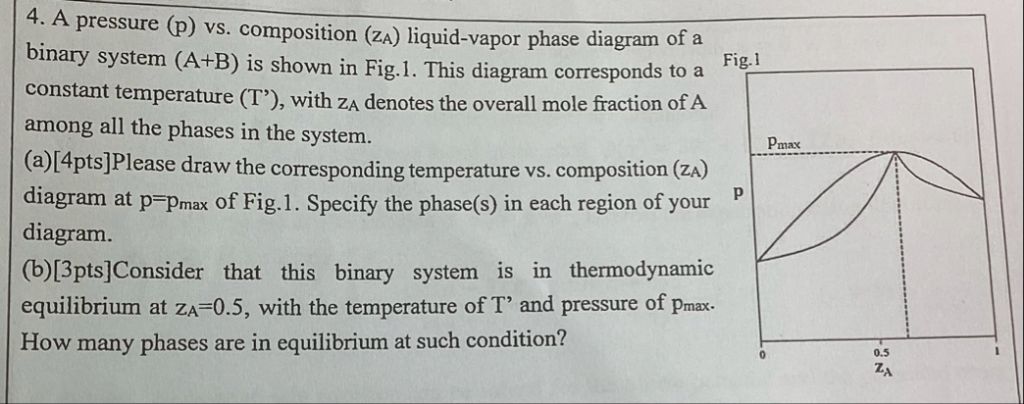 4. A pressure [@) vs. composition (za) liquid-vapor phase diagram of a rs
binary system (A+B) is shown in Fig.1. This diagram corresponds to a
constant temperature (T°), with z denotes the overall mole fraction of A
among all the phases in the system.
(a)[4pts]Please draw the corresponding temperature vs. composition (za) ki IN
diagram at p=pmay of Fig.1. Specify the phase(s) in each region of your
dia; Y ;
Cr. that this binary system i in fai.
equilibrium at za=0.5, with the temperature of T fo pressure of pmax |
How many phases are in equilibrium at such condition? : =
This is AI generated Response.
Asked by: singaluri krishna kumari
Created at: 2026-01-13 09:01:15
Asked by: singaluri krishna kumari
Created at: 2026-01-13 09:01:15
Final Answer:
Rendered
Raw Text
Did you like this answer?
Sure! Let's walk through the questions step by step and clarify what they're asking, along with how you should approach each part.
---
### Part (a): Drawing the Corresponding T vs. Composition Diagram
You are given a pressure (p) vs. composition (z_A) phase diagram at a constant temperature (T'). The curve shows the phase boundaries for a binary system (A+B). Now, you are asked to draw the **temperature (T) vs. composition (z_A)** diagram at a **constant pressure** (specifically at \( p = p_{max} \)).
Here's how you should think about this:
At \( p_{max} \), you're essentially slicing the original diagram horizontally at the line labeled \( p_{max} \). For each composition \( z_A \), you would look at what temperature the phase boundaries would be. Generally, the shape of the T vs. z_A diagram is similar to the p vs. z_A diagram, but "flipped" in the sense that where there was a peak in the p-z_A diagram, there will be a minimum in the T-z_A diagram (because increasing temperature at constant pressure promotes vaporization, whereas increasing pressure at constant temperature promotes condensation).
So, you would draw a T vs. z_A diagram with a "valley" or a "double-dome" shape, with the lowest point at \( z_A \approx .5 \). The regions outside this dome (on the left and right) correspond to single-phase regions (either all liquid or all vapor), while the region inside the dome is a two-phase (liquid + vapor) region.
For the phases:
- **Outside the dome** (higher or lower \( z_A \)): single phase (either all liquid or all vapor, depending on which side).
- **Inside the dome**: two phases coexist (liquid + vapor).
---
### Part (b): Phases in Equilibrium at \( z_A = .5, T', p_{max} \)
At \( z_A = .5 \), \( T = T' \), and \( p = p_{max} \), you are exactly at the top of the dome in the diagram (the maximum point). At this point, you are at the boundary between the single-phase region and the two-phase region.
However, at the maximum (or minimum in the T-z_A diagram), this point usually represents the **critical point**, where the distinction between liquid and vapor disappears. So, at this specific condition, there is only **one phase in equilibrium**—the fluid is at its critical composition, temperature, and pressure.
---
### Summary
For (a), draw a T vs. z_A diagram shaped like a valley or dome, label the single-phase and two-phase regions.
For (b), at \( z_A = .5 \), \( T' \), \( p_{max} \), there is **one phase in equilibrium** at the critical point.
If you need help drawing the diagrams or want a more detailed explanation of any step, let me know!
📢 Instructions:
- Ask anything relatd to above question only.
- For new Question goto :