 VIPSolutions
Act like a helpful tutor and exlain me :Amine sch. The de chien of sis sc have & wide spc of chem so PC Peres BEES eh, et pl heen of l ie ss tk ed KuRUB KR postive chagd ie him 174 CDE scone chm 74 TBENVC moped she chimp 12 RECHEE oid TIT commodo 2 id chars eso of mi hi Tha comm crtonmtcd chins TUN ote fund h cn eof cme, hoe con re er cd re colt 2 ow ele wae ne Tole 12 ck [13 et slit ws iid Co yn pens ” tend ns ed eof prec. re hen od i tr, ly fd es TUL co form ie rome de shin cond cecil fn xc yT soca sts of spas in gycopcims ft: sec Cage 1 im enibook |
Question:
Act like a helpful tutor and exlain me :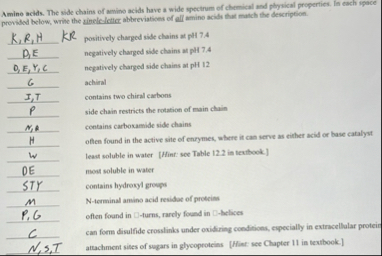 Amine sch. The de chien of sis sc have & wide spc of chem so PC Peres BEES
eh, et pl heen of l ie ss tk ed
KuRUB KR postive chagd ie him 174
CDE scone chm 74
TBENVC moped she chimp 12
RECHEE oid
TIT commodo
2 id chars eso of mi hi
Tha comm crtonmtcd chins
TUN ote fund h cn eof cme, hoe con re er cd re colt
2 ow ele wae ne Tole 12 ck
[13 et slit ws
iid Co yn pens
” tend ns ed eof prec.
re hen od i tr, ly fd es
TUL co form ie rome de shin cond cecil fn xc
yT soca sts of spas in gycopcims ft: sec Cage 1 im enibook |
This is AI generated Response.
Asked by: Alok Kumar
Created at: 2026-01-31 06:31:48
Asked by: Alok Kumar
Created at: 2026-01-31 06:31:48
Final Answer:
Rendered
Raw Text
Did you like this answer?
Certainly! Let's walk through each description and match it to the **correct amino acid(s)** based on their side chain properties.
---
## **1. Positively charged side chains at pH 7.4**
**Answer:** K, R, H
- **K** (Lysine), **R** (Arginine), **H** (Histidine)
- These amino acids have side chains that are positively charged (basic) under physiological pH.
---
## **2. Negatively charged side chains at pH 7.4**
**Answer:** D, E
- **D** (Aspartate), **E** (Glutamate)
- These have carboxylate groups in their side chains, giving them a negative charge at pH 7.4.
---
## **3. Negatively charged side chains at pH 12**
**Answer:** C, Y
- **C** (Cysteine), **Y** (Tyrosine)
- At very high pH, the side chains of cysteine and tyrosine can lose a proton and become negatively charged.
---
## **4. Achiral**
**Answer:** G
- **G** (Glycine)
- Glycine’s side chain is a hydrogen atom, so it is not chiral (it does not have four different groups attached to its alpha carbon).
---
## **5. Contains two chiral carbons**
**Answer:** I, T
- **I** (Isoleucine), **T** (Threonine)
- These amino acids have two chiral centers.
---
## **6. Side chain restricts the rotation of main chain**
**Answer:** P
- **P** (Proline)
- Proline’s side chain forms a ring with the backbone, restricting rotation.
---
## **7. Contains carboxamide side chains**
**Answer:** N, Q
- **N** (Asparagine), **Q** (Glutamine)
- Both have carboxamide (-CONH₂) groups in their side chains.
---
## **8. Often found in the active site of enzymes, where it can serve as either acid or base catalyst**
**Answer:** H
- **H** (Histidine)
- Histidine's side chain can act as both a proton donor and acceptor near physiological pH.
---
## **9. Least soluble in water**
**Answer:** F, W, Y
- **F** (Phenylalanine), **W** (Tryptophan), **Y** (Tyrosine)
- These have large aromatic side chains, making them less soluble in water.
---
## **10. Most soluble in water**
**Answer:** D, E
- **D** (Aspartate), **E** (Glutamate)
- Their side chains are charged and hydrophilic, making them highly soluble.
---
## **11. Contains hydroxyl groups**
**Answer:** S, T, Y
- **S** (Serine), **T** (Threonine), **Y** (Tyrosine)
- These side chains contain -OH (hydroxyl) groups.
---
## **12. N-terminal amino acid residue of proteins**
**Answer:** M
- **M** (Methionine)
- Methionine is almost always the first amino acid in newly synthesized proteins.
---
## **13. Often found in β-turns, rarely found in α-helices**
**Answer:** G, P
- **G** (Glycine), **P** (Proline)
- Both disrupt α-helices and are common in turns.
---
## **14. Can form disulfide crosslinks under oxidizing conditions, especially in extracellular proteins**
**Answer:** C
- **C** (Cysteine)
- Cysteine forms disulfide bonds (S-S) important for structural stability.
---
## **15. Attachment sites of sugars in glycoproteins**
**Answer:** N, S, T
- **N** (Asparagine): N-linked glycosylation
- **S** (Serine), **T** (Threonine): O-linked glycosylation
---
### **Summary Table**
| Description | Amino Acid(s) |
|-------------------------------------------------------------------------------|-----------------------|
| Positively charged at pH 7.4 | K, R, H |
| Negatively charged at pH 7.4 | D, E |
| Negatively charged at pH 12 | C, Y |
| Achiral | G |
| Contains two chiral carbons | I, T |
| Side chain restricts rotation of main chain | P |
| Contains carboxamide side chains | N, Q |
| Often found in active site (acid/base catalyst) | H |
| Least soluble in water | F, W, Y |
| Most soluble in water | D, E |
| Contains hydroxyl groups | S, T, Y |
| N-terminal amino acid residue of proteins | M |
| Often in β-turns, rarely in α-helices | G, P |
| Can form disulfide crosslinks | C |
| Attachment sites of sugars in glycoproteins | N, S, T |
Let me know if you need clarification or more details on any point!
📢 Instructions:
- Ask anything relatd to above question only.
- For new Question goto :