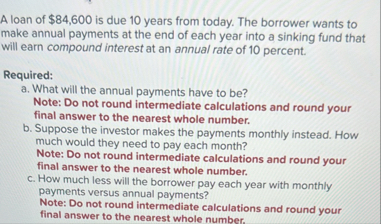
Act like a helpful tutor and exlain me :Aloan of $84,600 is due 10 years from today. The borrower wants to
make annual payments a the end of each year into a sinking fund that
will ear compound interestat an annual rate of 10 percent,
Required:
3. What willthe annual payments have to be?
Note: Do not round intermediate calculations and round your
final answer to the nearest whole number.
Suppose the investor makes the payments monthly instead. How
much would they need to pay each month?
Note: Do not round intermediate calculations and round your
final answer to the nearest whole number.
How much less wil the borrower pay each year with monty
Payments versus annual payments?
Note: Do not round intermediate calculations and round your
final answer 10 the nearest whots ets
Question:
Act like a helpful tutor and exlain me :Aloan of $84,600 is due 10 years from today. The borrower wants to
make annual payments a the end of each year into a sinking fund that
will ear compound interestat an annual rate of 10 percent,
Required:
3. What willthe annual payments have to be?
Note: Do not round intermediate calculations and round your
final answer to the nearest whole number.
Suppose the investor makes the payments monthly instead. How
much would they need to pay each month?
Note: Do not round intermediate calculations and round your
final answer to the nearest whole number.
How much less wil the borrower pay each year with monty
Payments versus annual payments?
Note: Do not round intermediate calculations and round your
final answer 10 the nearest whots ets
This is AI generated Response.
Asked by: Alok Kumar
Created at: 2026-02-03 09:36:11
Final Answer:
RenderedRaw Text
Did you like this answer?
Let's solve the problem step by step:
---
## Given:
- **Future Value (FV):** \$84,600 (amount due in 10 years)
- **Number of years (n):** 10
- **Annual interest rate (r):** 10% (compound interest)
- **Payments:**
- Part (a): **Annual** at the end of each year
- Part (b): **Monthly** at the end of each month
---
## a. **What will the annual payments have to be?**
We use the **future value of an ordinary annuity** formula:
\[
FV = PMT \times \frac{(1 + r)^n - 1}{r}
\]
Where:
- \( FV \) = Future Value (\$84,600)
- \( PMT \) = Annual payment (what we want to find)
- \( r \) = Interest rate per period (10% = .10)
- \( n \) = Number of periods (10 years)
**Rearrange to solve for \( PMT \):**
\[
PMT = \frac{FV \times r}{(1 + r)^n - 1}
\]
**Plug in the values:**
\[
PMT = \frac{84,600 \times .10}{(1.10)^{10} - 1}
\]
Calculate \( (1.10)^{10} \):
\[
(1.10)^{10} = 2.5937424601
\]
So,
\[
PMT = \frac{84,600 \times .10}{2.5937424601 - 1}
\]
\[
PMT = \frac{8,460}{1.5937424601}
\]
\[
PMT = 5,310.01
\]
**Final Answer (rounded to nearest whole number):**
\[
\boxed{5,310}
\]
---
## b. **If payments are made monthly, how much would they need to pay each month?**
Now, payments are monthly, so:
- \( n = 10 \times 12 = 120 \) months
- \( r = 10\%/12 = .10/12 = .008333 \) per month
Formula (future value of an ordinary annuity):
\[
FV = PMT \times \frac{(1 + r)^n - 1}{r}
\]
\[
PMT = \frac{FV \times r}{(1 + r)^n - 1}
\]
Plug in the values:
\[
(1 + r)^n = (1.008333)^{120} = 2.70704
\]
\[
PMT = \frac{84,600 \times .008333}{2.70704 - 1}
\]
\[
PMT = \frac{705.00}{1.70704}
\]
\[
PMT = 412.97
\]
**Final Answer (rounded to nearest whole number):**
\[
\boxed{413}
\]
---
## c. **How much less will the borrower pay each year with monthly payments versus annual payments?**
Calculate **total payment per year** for both cases:
- **Annual payments:** \( 5,310 \) per year
- **Monthly payments:** \( 413 \times 12 = 4,956 \) per year
**Difference:**
\[
5,310 - 4,956 = 354
\]
**Final Answer:**
\[
\boxed{354}
\]
---
## **Summary Table**
| Payment Type | Payment Amount | Total per Year |
|--------------|----------------|---------------|
| Annual | \$5,310 | \$5,310 |
| Monthly | \$413 | \$4,956 |
**Borrower pays \$354 less per year with monthly payments.**
---
If you need a more detailed explanation or breakdown of calculations, let me know!
VIPSolutions focuses on clear, step‑by‑step explanations so you can learn quickly. Whether you need an AI‑generated walkthrough or a short hint to get unstuck, each solution is organized for fast reading and easy review later.
Search similar questions, compare approaches, and bookmark the best answers for revision. Our goal is simple: quick, reliable study help that feels natural—not noisy.
 VIPSolutions
 Aloan of $84,600 is due 10 years from today. The borrower wants to
make annual payments a the end of each year into a sinking fund that
will ear compound interestat an annual rate of 10 percent,
Required:
3. What willthe annual payments have to be?
Note: Do not round intermediate calculations and round your
final answer to the nearest whole number.
Suppose the investor makes the payments monthly instead. How
much would they need to pay each month?
Note: Do not round intermediate calculations and round your
final answer to the nearest whole number.
How much less wil the borrower pay each year with monty
Payments versus annual payments?
Note: Do not round intermediate calculations and round your
final answer 10 the nearest whots ets