 VIPSolutions
Act like a helpful tutor and exlain me : Act like a helpful tutor and exlain me :‘Abolowsqure tube hs a hegt srw deri 42 so a cis of The er To er bs ean | 4 Height Wall (mm) (mm) J Width __ (mm) i rs
Question:
Act like a helpful tutor and exlain me :
Act like a helpful tutor and exlain me :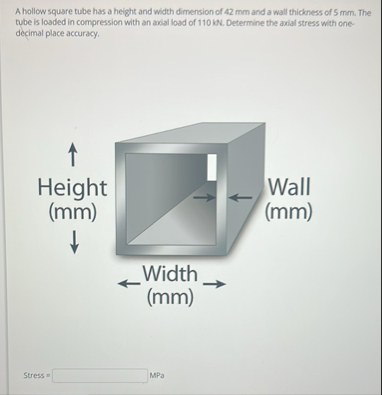 ‘Abolowsqure tube hs a hegt srw deri 42 so a cis of The
er To er bs ean
| 4
Height Wall
(mm) (mm)
J
Width __
(mm)
i rs
This is AI generated Response.
Asked by: Alok Kumar
Created at: 2026-01-27 04:42:02
Asked by: Alok Kumar
Created at: 2026-01-27 04:42:02
Final Answer:
Rendered
Raw Text
Did you like this answer?
## Problem Breakdown
Let's break down the problem step by step:
**Given:**
- Hollow square tube
- Height = 42 mm
- Width = 42 mm
- Wall thickness = 5 mm
- Axial load = 110 kN (compression)
- Find: Axial stress (to one decimal place) in MPa
---
## Step 1: Find the Cross-Sectional Area
The **axial stress** is calculated as:
\[
\text{Stress} = \frac{\text{Force}}{\text{Area}}
\]
For a hollow square tube:
- **Outer dimension:** \( a = 42 \) mm
- **Wall thickness:** \( t = 5 \) mm
- **Inner dimension:** \( a_{in} = a - 2t = 42 - 2 \times 5 = 32 \) mm
### **Area Calculation**
\[
\text{Area} = (\text{outer area}) - (\text{inner area})
\]
\[
= a^2 - (a_{in})^2
\]
\[
= 42^2 - 32^2
\]
\[
= 1764 - 1024 = 740 \text{ mm}^2
\]
---
## Step 2: Convert Load to Newtons
Given: \( 110 \) kN \( = 110,000 \) N
---
## Step 3: Calculate Axial Stress
\[
\text{Stress} = \frac{F}{A}
\]
\[
= \frac{110,000 \text{ N}}{740 \text{ mm}^2}
\]
- 1 MPa = 1 N/mm², so the units are already correct.
\[
\text{Stress} = \frac{110,000}{740} \approx 148.6 \text{ MPa}
\]
---
## Step 4: **Final Answer**
\[
\boxed{148.6 \text{ MPa}}
\]
---
### **Summary Table**
| Quantity | Value |
|----------------|----------------|
| Outer side | 42 mm |
| Inner side | 32 mm |
| Area | 740 mm² |
| Load | 110,000 N |
| Axial Stress | 148.6 MPa |
---
### **Explanation**
The stress in a hollow square tube under axial load is found by dividing the load by the area of material that resists the load (the "walls" of the tube). We subtract the area of the hollow part from the total square to get this effective area.
If you have more questions about this calculation, let me know!
📢 Instructions:
- Ask anything relatd to above question only.
- For new Question goto :