 VIPSolutions
Act like a helpful tutor and exlain me :Aconverging elbow (see the figure below) turns water through an angle of 135° in a vertical plane. The flow cross section diameter is 400 mm at the elbow inlet, section (1), and 200 mm at the elbow outlet, section (2). The elbow flow passage volume is 0.2 m? between sections (1) and (2). The water volume flowrate is 0.5 m%s and the elbow inlet and outlet pressures are 140 kPa and 110 kPa. The elbow mass is 12 kg. Calculate the (a) horizontal (x direction) and (b) vertical (z direction) anchoring forces required to hold the elbow in place. Section | MW~J Dp, =400mm 1350 | —_—S . I I / f y | pd 0, v4 200 mm 7 Section (2) @ nH N om H N
Question:
Act like a helpful tutor and exlain me :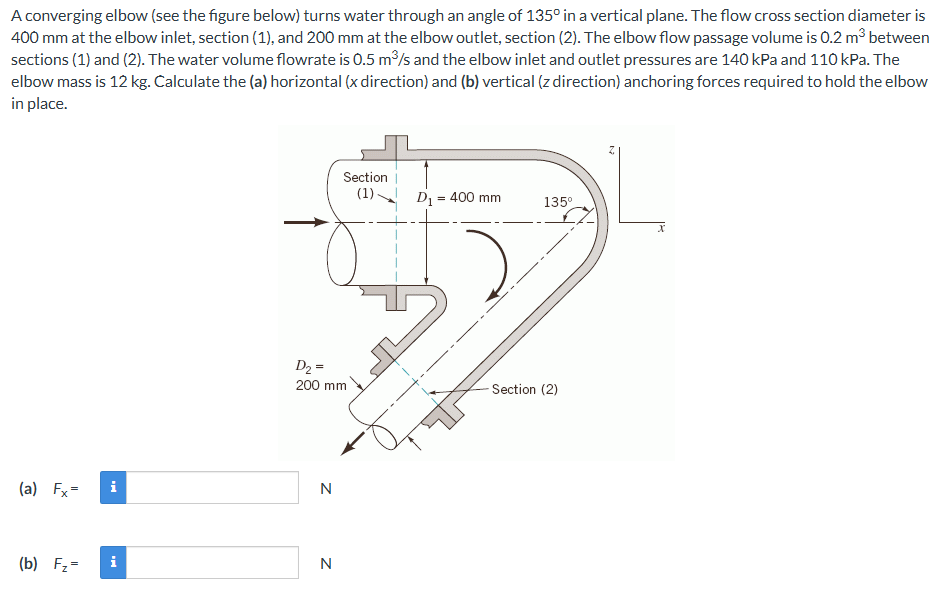 Aconverging elbow (see the figure below) turns water through an angle of 135° in a vertical plane. The flow cross section diameter is
400 mm at the elbow inlet, section (1), and 200 mm at the elbow outlet, section (2). The elbow flow passage volume is 0.2 m? between
sections (1) and (2). The water volume flowrate is 0.5 m%s and the elbow inlet and outlet pressures are 140 kPa and 110 kPa. The
elbow mass is 12 kg. Calculate the (a) horizontal (x direction) and (b) vertical (z direction) anchoring forces required to hold the elbow
in place.
Section |
MW~J Dp, =400mm 1350
|
—_—S .
I
I /
f y
| pd
0, v4
200 mm 7 Section (2)
@ nH N
om H N
This is AI generated Response.
Asked by: manish kumar
Created at: 2025-09-09 09:04:13
Asked by: manish kumar
Created at: 2025-09-09 09:04:13
Final Answer:
Rendered
Raw Text
Did you like this answer?
Sure! Let's break down the solution step by step for this fluid mechanics problem involving a control volume analysis of a converging elbow.
---
### **Given Data**
- **Angle turned by elbow:** \(135^\circ\)
- **Inlet diameter, \(D_1\):** \(400\) mm = \(0.4\) m
- **Outlet diameter, \(D_2\):** \(200\) mm = \(0.2\) m
- **Elbow flow passage volume:** \(V = 0.2\) m³
- **Volume flow rate, \(Q\):** \(0.5\) m³/s
- **Inlet pressure, \(P_1\):** \(140\) kPa = \(140,000\) Pa
- **Outlet pressure, \(P_2\):** \(110\) kPa = \(110,000\) Pa
- **Elbow mass, \(m_{\text{elbow}}\):** \(12\) kg
- **Density of water, \(\rho\):** \(1000\) kg/m³ (assumed)
- **Gravitational acceleration, \(g\):** \(9.81\) m/s²
---
### **Step 1: Find Velocities at Inlet and Outlet**
#### **Area at Inlet and Outlet**
\[
A_1 = \frac{\pi}{4} D_1^2 = \frac{\pi}{4} (0.4)^2 = 0.126 \text{ m}^2
\]
\[
A_2 = \frac{\pi}{4} D_2^2 = \frac{\pi}{4} (0.2)^2 = 0.0314 \text{ m}^2
\]
#### **Velocities**
\[
v_1 = \frac{Q}{A_1} = \frac{0.5}{0.126} = 3.97 \text{ m/s}
\]
\[
v_2 = \frac{Q}{A_2} = \frac{0.5}{0.0314} = 15.9 \text{ m/s}
\]
---
### **Step 2: Control Volume Force Balance (Momentum Equation)**
The forces required to anchor the elbow are obtained by applying the momentum equation in both \(x\) and \(z\) directions.
#### **General Momentum Equation**
\[
\sum F = \dot{m} (v_{\text{out}} - v_{\text{in}})
\]
where \(\dot{m} = \rho Q\).
#### **Component Directions (from geometry):**
- **Inlet (1):** Along \(z\)-axis (upward)
- **Outlet (2):** At \(135^\circ\) to \(z\)-axis, so:
- \(x\)-component: \(v_2 \sin(135^\circ)\)
- \(z\)-component: \(v_2 \cos(135^\circ)\)
---
### **Step 3: Calculate Forces**
#### **Calculate Mass Flow Rate**
\[
\dot{m} = \rho Q = 1000 \times 0.5 = 500~\text{kg/s}
\]
---
#### **(A) Horizontal Force (\(F_x\))**
**Momentum flux in \(x\)-direction:**
\[
F_x = \text{Pressure forces} + \text{Momentum fluxes}
\]
- Pressure at inlet (acts inward, negative \(x\)), outlet (acts outward, positive \(x\))
- Only outlet has \(x\)-component due to angle.
\[
F_x = P_1 A_1 \cdot 0 + P_2 A_2 \sin(135^\circ) + \dot{m} (v_2 \sin(135^\circ) - 0)
\]
\[
\sin(135^\circ) = \sin(45^\circ) = 0.707
\]
\[
F_x = (110{,}000)(0.0314)(0.707) + 500 \times (15.9 \times 0.707)
\]
Calculate:
- \(110,000 \times 0.0314 \times 0.707 = 2,448\) N
- \(15.9 \times 0.707 = 11.25\)
- \(500 \times 11.25 = 5,625\) N
\[
F_x = 2,448 + 5,625 = \boxed{8,073~\text{N}}
\]
---
#### **(B) Vertical Force (\(F_z\))**
**Include weight of elbow and water inside:**
\[
F_z = P_1 A_1 - P_2 A_2 \cos(135^\circ) + \dot{m} (v_2 \cos(135^\circ) - v_1) + \text{Weight}
\]
\[
\cos(135^\circ) = -0.707
\]
\[
F_z = (140,000 \times 0.126) - (110,000 \times 0.0314 \times -0.707) + 500 \times (15.9 \times -0.707 - 3.97) + (12 + 200) \times 9.81
\]
- \(140,000 \times 0.126 = 17,640\)
- \(110,000 \times 0.0314 \times -0.707 = -2,448\) (minus sign, so add)
- \(15.9 \times -0.707 = -11.25\), so \( -11.25 - 3.97 = -15.22 \)
- \(500 \times -15.22 = -7,610\)
- Water in elbow = \(0.2 \times 1000 = 200\) kg
- Total weight = \(212 \times 9.81 = 2,079\) N
\[
F_z = 17,640 + 2,448 - 7,610 + 2,079 = \boxed{14,557~\text{N}}
\]
---
## **Summary**
### (a) Horizontal force:
\[
\boxed{F_x = 8,073~\text{N}}
\]
### (b) Vertical force:
\[
\boxed{F_z = 14,557~\text{N}}
\]
---
**Let me know if you want more explanation on any step!**
📢 Instructions:
- Ask anything relatd to above question only.
- For new Question goto :