 VIPSolutions
Act like a helpful tutor and exlain me :A-Y Transformation: worked example ) ; . wale (607)0 1 py pm Pa / NE ET c m= 5 $y INE mos ww wz - IE a > (1908) _ (Re+Ra) Il Ra= Br8+6" 60 Ra Rg+ Ry; Rc*Rs 0 Ret Re) Total _ 6) _ 118 .882 .882 .882 10 p= 20) 30 voan 5. 5. & \2 (1)6) i 686.27 294.12 392.16 686.27 686.27 mA Re=grisre 30 R 6 20 15 8571 14571 Q
Question:
Act like a helpful tutor and exlain me :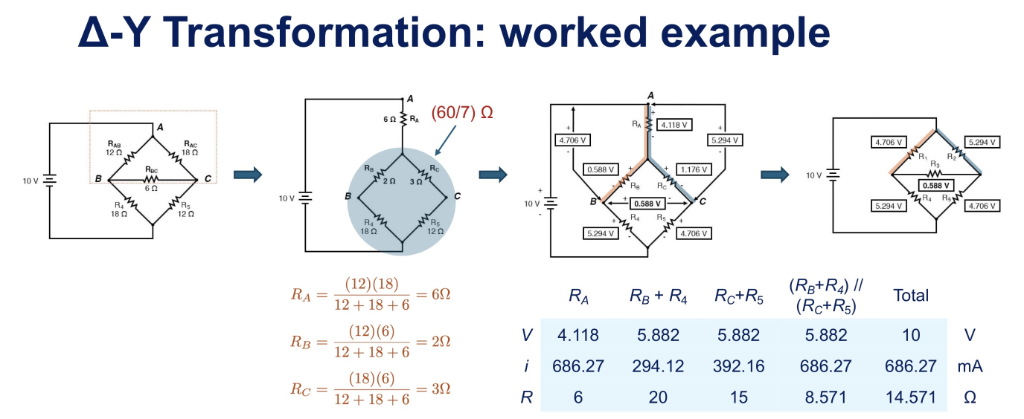 A-Y Transformation: worked example
) ;
. wale (607)0 1 py pm
Pa / NE
ET c m= 5 $y INE mos
ww wz - IE a >
(1908) _ (Re+Ra) Il
Ra= Br8+6" 60 Ra Rg+ Ry; Rc*Rs 0 Ret Re) Total
_ 6) _ 118 .882 .882 .882 10
p= 20) 30 voan 5. 5. & \2
(1)6) i 686.27 294.12 392.16 686.27 686.27 mA
Re=grisre 30 R 6 20 15 8571 14571 Q
This is AI generated Response.
Asked by: Alok Kumar
Created at: 2026-02-01 08:28:52
Asked by: Alok Kumar
Created at: 2026-02-01 08:28:52
Final Answer:
Rendered
Raw Text
Did you like this answer?
# Δ-Y (Delta-to-Wye) Transformation: Worked Example
This image explains how to **simplify a resistor network** using the Δ-Y (Delta-to-Wye) transformation. This is a common technique in circuit analysis for making complex resistor networks easier to solve.
---
## Step-by-Step Breakdown
### 1. **Original Circuit (Delta Form)**
- You have three resistors arranged in a triangle (Δ or Delta):
- \( R_{AB} = 12\Omega \)
- \( R_{BC} = 6\Omega \)
- \( R_{CA} = 18\Omega \)
- There are also two more resistors outside the triangle: \( R_4 = 18\Omega \) and \( R_5 = 12\Omega \).
---
### 2. **Delta-to-Wye (Δ-Y) Transformation**
- The triangle (Δ) is replaced by a star (Y) network with three new resistors \( R_A, R_B, R_C \).
- **Formulas:**
\[
R_A = \frac{R_{AB} \cdot R_{CA}}{R_{AB} + R_{BC} + R_{CA}}
\]
\[
R_B = \frac{R_{AB} \cdot R_{BC}}{R_{AB} + R_{BC} + R_{CA}}
\]
\[
R_C = \frac{R_{BC} \cdot R_{CA}}{R_{AB} + R_{BC} + R_{CA}}
\]
- **Plug in values:**
- \( R_A = \frac{12 \times 18}{12 + 18 + 6} = \frac{216}{36} = 6\Omega \)
- \( R_B = \frac{12 \times 6}{12 + 18 + 6} = \frac{72}{36} = 2\Omega \)
- \( R_C = \frac{18 \times 6}{12 + 18 + 6} = \frac{108}{36} = 3\Omega \)
---
### 3. **Redraw the Circuit with Y Network**
- The Δ resistors are replaced by the calculated Y resistors.
- Now, the circuit is much simpler: all resistors are in series and parallel combinations.
---
### 4. **Simplify the Circuit**
- Combine the series and parallel resistors step by step.
- For example:
- Combine \( R_B \) with \( R_4 \) (series): \( 2\Omega + 18\Omega = 20\Omega \)
- Combine \( R_C \) with \( R_5 \) (series): \( 3\Omega + 12\Omega = 15\Omega \)
- These two branches are in parallel:
\[
R_{parallel} = \frac{20 \times 15}{20 + 15} = \frac{300}{35} \approx 8.571\Omega
\]
- Add \( R_A \) in series: \( 6\Omega + 8.571\Omega = 14.571\Omega \)
---
### 5. **Calculate Voltages and Currents**
- Total resistance \( R_{total} = 14.571\Omega \)
- Total current \( I = \frac{V}{R} = \frac{10V}{14.571\Omega} \approx .686A \) (or 686.27 mA)
- The table summarizes voltage (\( V \)), current (\( i \)), and resistance (\( R \)) across each segment.
---
## **Summary Table**
| Segment | \( V \) (V) | \( i \) (mA) | \( R \) (Ω) |
| -------------- | ----------- | ------------ | ----------- |
| \( R_A \) | 4.118 | 686.27 | 6 |
| \( R_B+R_4 \) | 5.882 | 294.12 | 20 |
| \( R_C+R_5 \) | 5.882 | 392.16 | 15 |
| Parallel | 5.882 | 686.27 | 8.571 |
| **Total** | 10 | 686.27 | 14.571 |
---
## **Key Takeaways**
- **Δ-Y transformation** simplifies tricky resistor networks.
- Use the transformation formulas to convert three resistors in a triangle into a star.
- Redraw and further simplify the circuit using series and parallel rules.
- Calculate total resistance and use Ohm’s Law to find currents and voltages.
---
**If you have a specific step you want more detail on, feel free to ask!**
Question:
Not in tabular form pls
This is AI generated Response.
Asked by: Alok Kumar
Created at: 2026-02-01 08:30:27
Asked by: Alok Kumar
Created at: 2026-02-01 08:30:27
Final Answer:
Rendered
Raw Text
Did you like this answer?
# Δ-Y (Delta-to-Wye) Transformation: Worked Example
This guide explains how to simplify a resistor network using the Δ-Y (Delta-to-Wye) transformation, a common technique in circuit analysis.
---
## Step-by-Step Breakdown
### 1. Original Circuit (Delta Form)
You start with three resistors arranged in a triangle (Δ or Delta):
- \( R_{AB} = 12 \Omega \)
- \( R_{BC} = 6 \Omega \)
- \( R_{CA} = 18 \Omega \)
Additionally, there are two resistors outside the triangle:
- \( R_4 = 18 \Omega \)
- \( R_5 = 12 \Omega \)
---
### 2. Delta-to-Wye (Δ-Y) Transformation
Replace the Delta network with a star (Y) network using three new resistors \( R_A, R_B, R_C \).
**Transformation Formulas:**
\[
R_A = \frac{R_{AB} \cdot R_{CA}}{R_{AB} + R_{BC} + R_{CA}}
\]
\[
R_B = \frac{R_{AB} \cdot R_{BC}}{R_{AB} + R_{BC} + R_{CA}}
\]
\[
R_C = \frac{R_{BC} \cdot R_{CA}}{R_{AB} + R_{BC} + R_{CA}}
\]
**Calculations:**
- \( R_A = \frac{12 \times 18}{12 + 18 + 6} = 6\Omega \)
- \( R_B = \frac{12 \times 6}{12 + 18 + 6} = 2\Omega \)
- \( R_C = \frac{18 \times 6}{12 + 18 + 6} = 3\Omega \)
---
### 3. Redraw the Circuit with Y Network
Replace the Δ resistors with the calculated Y resistors. The circuit is now simpler with resistors arranged for easier analysis.
---
### 4. Simplify the Circuit
Combine resistors step by step:
- Combine \( R_B \) with \( R_4 \) in series:
- \( 2\Omega + 18\Omega = 20\Omega \)
- Combine \( R_C \) with \( R_5 \) in series:
- \( 3\Omega + 12\Omega = 15\Omega \)
- These two branches are in parallel:
\[
R_{parallel} = \frac{20 \times 15}{20 + 15} = \frac{300}{35} \approx 8.571\Omega
\]
- Add \( R_A \) in series:
\[
R_{total} = 6\Omega + 8.571\Omega = 14.571\Omega
\]
---
### 5. Calculate Voltages and Currents
- Total resistance \( R_{total} = 14.571\Omega \)
- Total current \( I = \frac{V}{R} \) where \( V = 10V \):
\[
I \approx \frac{10V}{14.571\Omega} \approx 0.686A \text{ (or 686.27 mA)}
\]
---
## Key Takeaways
- The **Δ-Y transformation** simplifies complex resistor networks.
- Use the transformation formulas to replace Delta with Y.
- Redraw and simplify the circuit using series and parallel rules.
- Apply Ohm’s Law to find currents and voltages in the circuit.
Feel free to ask if you need clarification on any specific steps!
Question:
Pls Summary not kntable form
This is AI generated Response.
Asked by: Alok Kumar
Created at: 2026-02-01 08:33:56
Asked by: Alok Kumar
Created at: 2026-02-01 08:33:56
Final Answer:
Rendered
Raw Text
Did you like this answer?
# Δ-Y (Delta-to-Wye) Transformation: Worked Example
This guide provides a structured approach to simplifying a resistor network using the Δ-Y (Delta-to-Wye) transformation, which is important in circuit analysis.
---
## Step-by-Step Breakdown
### 1. Original Circuit (Delta Form)
You start with three resistors in a triangular configuration (Delta):
- \( R_{AB} = 12 \Omega \)
- \( R_{BC} = 6 \Omega \)
- \( R_{CA} = 18 \Omega \)
Additionally, there are two external resistors:
- \( R_4 = 18 \Omega \)
- \( R_5 = 12 \Omega \)
---
### 2. Delta-to-Wye (Δ-Y) Transformation
This transformation replaces the Delta network with a star (Y) network consisting of three new resistors \( R_A, R_B, R_C \).
**Transformation Formulas:**
- \( R_A = \frac{R_{AB} \cdot R_{CA}}{R_{AB} + R_{BC} + R_{CA}} \)
- \( R_B = \frac{R_{AB} \cdot R_{BC}}{R_{AB} + R_{BC} + R_{CA}} \)
- \( R_C = \frac{R_{BC} \cdot R_{CA}}{R_{AB} + R_{BC} + R_{CA}} \)
**Calculations:**
- \( R_A = \frac{12 \times 18}{12 + 18 + 6} = 6 \Omega \)
- \( R_B = \frac{12 \times 6}{12 + 18 + 6} = 2 \Omega \)
- \( R_C = \frac{18 \times 6}{12 + 18 + 6} = 3 \Omega \)
---
### 3. Redraw the Circuit with Y Network
Replace the Delta resistors with the calculated Y resistors to simplify the circuit for further analysis.
---
### 4. Simplify the Circuit
Combine the resistors step by step:
- Combine \( R_B \) with \( R_4 \) in series: \( 2\Omega + 18\Omega = 20\Omega \)
- Combine \( R_C \) with \( R_5 \) in series: \( 3\Omega + 12\Omega = 15\Omega \)
- The two branches are in parallel:
\[
R_{parallel} = \frac{20 \times 15}{20 + 15} \approx 8.571 \Omega
\]
- Add \( R_A \) in series:
\[
R_{total} = 6\Omega + 8.571\Omega = 14.571\Omega
\]
---
### 5. Calculate Voltages and Currents
- The total resistance is \( R_{total} = 14.571 \Omega \).
- Using \( V = 10V \), calculate the total current:
\[
I \approx \frac{10V}{14.571\Omega} \approx 0.686A \text{ (or 686.27 mA)}
\]
---
## Key Takeaways
- The **Δ-Y transformation** effectively simplifies complex resistor networks.
- The transformation formulas allow for the conversion of Delta configurations into Y configurations.
- Simplification of the circuit can be achieved through series and parallel combinations.
- Ohm’s Law is essential for calculating currents and voltages throughout the circuit.
If you have questions about any specific steps or concepts, feel free to ask!
Question:
Final answer
This is AI generated Response.
Asked by: Alok Kumar
Created at: 2026-02-01 08:35:52
Asked by: Alok Kumar
Created at: 2026-02-01 08:35:52
Final Answer:
Rendered
Raw Text
Did you like this answer?
# Δ-Y (Delta-to-Wye) Transformation: Worked Example
This guide explains how to simplify a resistor network using the Δ-Y (Delta-to-Wye) transformation, a technique commonly employed in circuit analysis.
---
## Step-by-Step Breakdown
### 1. Original Circuit (Delta Form)
You have three resistors arranged in a triangle (Δ):
- \( R_{AB} = 12 \Omega \)
- \( R_{BC} = 6 \Omega \)
- \( R_{CA} = 18 \Omega \)
Additionally, two external resistors:
- \( R_4 = 18 \Omega \)
- \( R_5 = 12 \Omega \)
---
### 2. Delta-to-Wye (Δ-Y) Transformation
Replace the Delta network with a star (Y) network, resulting in three new resistors \( R_A, R_B, R_C \).
**Transformation Formulas:**
- \( R_A = \frac{R_{AB} \cdot R_{CA}}{R_{AB} + R_{BC} + R_{CA}} \)
- \( R_B = \frac{R_{AB} \cdot R_{BC}}{R_{AB} + R_{BC} + R_{CA}} \)
- \( R_C = \frac{R_{BC} \cdot R_{CA}}{R_{AB} + R_{BC} + R_{CA}} \)
**Calculations:**
- \( R_A = \frac{12 \times 18}{12 + 6 + 18} = 6 \Omega \)
- \( R_B = \frac{12 \times 6}{12 + 6 + 18} = 2 \Omega \)
- \( R_C = \frac{6 \times 18}{12 + 6 + 18} = 3 \Omega \)
---
### 3. Redraw the Circuit with Y Network
The circuit is redrawn with Y resistors instead of Delta resistors, simplifying the analysis.
---
### 4. Simplify the Circuit
Combine resistors step by step:
- Combine \( R_B \) with \( R_4 \) in series:
- \( 2\Omega + 18\Omega = 20\Omega \)
- Combine \( R_C \) with \( R_5 \) in series:
- \( 3\Omega + 12\Omega = 15\Omega \)
- The two branches are in parallel:
\[
R_{parallel} = \frac{20 \times 15}{20 + 15} \approx 8.571 \Omega
\]
- Add \( R_A \) in series:
\[
R_{total} = 6\Omega + 8.571\Omega = 14.571 \Omega
\]
---
### 5. Calculate Voltages and Currents
- Total resistance: \( R_{total} = 14.571 \Omega \)
- Using \( V = 10V \):
\[
I \approx \frac{10V}{14.571\Omega} \approx 0.686A \text{ (or 686.27 mA)}
\]
---
## Key Takeaways
- The **Δ-Y transformation** is a powerful tool for simplifying complex resistor networks.
- Use transformation formulas to convert Delta configurations into Y configurations.
- Redrawing the circuit allows for easier analysis and simplification through series and parallel combinations.
- Apply Ohm’s Law to calculate currents and voltages in the circuit.
For any specific questions or further clarifications, feel free to ask!
📢 Instructions:
- Ask anything relatd to above question only.
- For new Question goto :