 VIPSolutions
Act like a helpful tutor and exlain me :A student proposes the following step in a synthesis: o. H ~ oH or + cHy—oH OH HO o 1s this reaction possible? If so, draw the mechanism below. If not, check the box under the drawing area instead. | g © © 0 oo i ~~ © AddRemove sep BEE
Question:
Act like a helpful tutor and exlain me :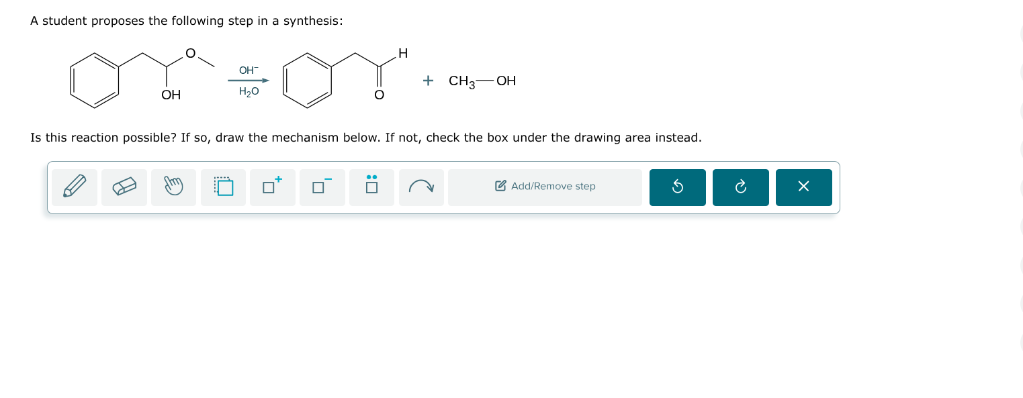 A student proposes the following step in a synthesis:
o. H
~ oH
or + cHy—oH
OH HO o
1s this reaction possible? If so, draw the mechanism below. If not, check the box under the drawing area instead.
| g © © 0 oo i ~~ © AddRemove sep BEE
This is AI generated Response.
Asked by: Alok Kumar
Created at: 2026-02-01 05:41:53
Asked by: Alok Kumar
Created at: 2026-02-01 05:41:53
Final Answer:
Rendered
Raw Text
Did you like this answer?
Let's break down what's happening in this proposed reaction.
---
## The Reaction
**Starting material:**
- A compound with an ester (–COO–) group and a benzyl alcohol (–CH₂OH).
**Reagents:**
- Hydroxide ion (OH⁻), water (H₂O)
**Proposed products:**
- Benzaldehyde (an aromatic aldehyde)
- Methanol (CH₃OH)
---
## What Type of Reaction Is This?
This looks like a **base-catalyzed ester hydrolysis** (also called **saponification**), but the starting material is not a typical ester—it's a **benzyl alcohol benzoate**.
---
## Mechanistic Analysis
### 1. **Ester Hydrolysis (Saponification)**
Under **basic conditions**, esters are hydrolyzed to carboxylate anions and alcohols:
\[
\text{R-COOR}' + \text{OH}^- \rightarrow \text{R-COO}^- + \text{R}'\text{OH}
\]
But in your proposed reaction, the products are **benzaldehyde** (an aldehyde) and **methanol**, **not** a carboxylate and an alcohol.
### 2. **Can an Ester Be Directly Converted to an Aldehyde in Base?**
**No**. Under basic conditions, esters hydrolyze to carboxylates, not aldehydes. The conversion of an ester to an aldehyde typically requires a **reducing agent** (like DIBAL-H), not base.
### 3. **What's Actually Happening?**
If you did saponification on methyl benzoate, you would get **benzoate anion** and **methanol**, NOT benzaldehyde.
---
## **Conclusion**
**This reaction is NOT possible as shown.**
- Under these conditions, you cannot make an aldehyde from an ester.
- You would get a carboxylate salt (benzoate) and methanol.
---
### **Summary Table**
| Starting Material | Reagents | Expected Products (Real) | Proposed Products (Incorrect) |
|---------------------|---------------|-----------------------------|-------------------------------|
| Benzyl benzoate | OH⁻/H₂O | Benzoate ion + methanol | Benzaldehyde + methanol |
---
**Box to check:**
> The reaction as shown is **not possible** under the given conditions.
Let me know if you want to see the real mechanism for base-catalyzed ester hydrolysis!
📢 Instructions:
- Ask anything relatd to above question only.
- For new Question goto :