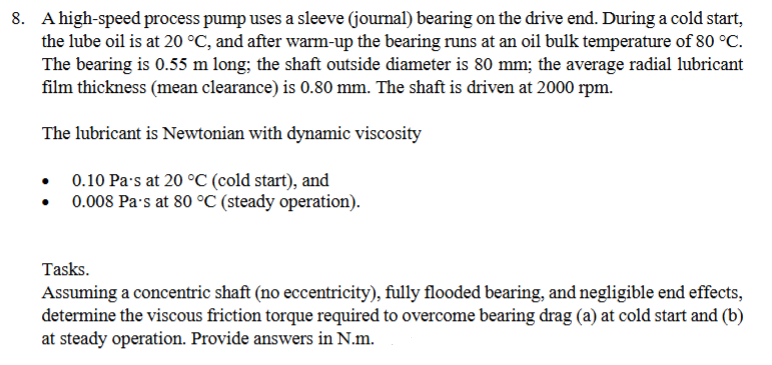
Act like a helpful tutor and exlain me :8. A high-speed process pump uses a sleeve (journal) bearing on the drive end. During a cold start,
the lube oil is at 20 °C, and after warm-up the bearing runs at an oil bulk temperature of 80 °C.
The bearing is 0.55 m long; the shaft outside diameter is 80 mm; the average radial lubricant
film thickness (mean clearance) is 0.80 mm. The shaft is driven at 2000 rpm.
The lubricant is Newtonian with dynamic viscosity
«0.10 Pas at 20 °C (cold start), and
«0.008 Pa's at 80 °C (steady operation).
Tasks.
Assuming a concentric shaft (no eccentricity), fully flooded bearing, and negligible end effects,
determine the viscous friction torque required to overcome bearing drag (a) at cold start and (b)
at steady operation. Provide answers in N.m.
Question:
Act like a helpful tutor and exlain me :8. A high-speed process pump uses a sleeve (journal) bearing on the drive end. During a cold start,
the lube oil is at 20 °C, and after warm-up the bearing runs at an oil bulk temperature of 80 °C.
The bearing is 0.55 m long; the shaft outside diameter is 80 mm; the average radial lubricant
film thickness (mean clearance) is 0.80 mm. The shaft is driven at 2000 rpm.
The lubricant is Newtonian with dynamic viscosity
«0.10 Pas at 20 °C (cold start), and
«0.008 Pa's at 80 °C (steady operation).
Tasks.
Assuming a concentric shaft (no eccentricity), fully flooded bearing, and negligible end effects,
determine the viscous friction torque required to overcome bearing drag (a) at cold start and (b)
at steady operation. Provide answers in N.m.
This is AI generated Response.
Asked by: manish kumar
Created at: 2025-09-13 09:27:54
Final Answer:
RenderedRaw Text
Did you like this answer?
Let's break down the problem and solve step by step.
---
## **Known Data**
- **Length of bearing, \( L \) = 0.55 m**
- **Shaft diameter, \( d \) = 80 \text{ mm} = 0.08 \text{ m}**
- **Mean clearance (lubricant film thickness), \( h \) = 0.80 \text{ mm} = 0.0008 \text{ m}**
- **Shaft speed, \( N \) = 2000 \text{ rpm}**
- **Dynamic viscosity, \( \mu \):**
- **Cold start (20°C): \( 0.10 \text{ Pa}\cdot\text{s} \)**
- **Steady (80°C): \( 0.008 \text{ Pa}\cdot\text{s} \)**
---
## **Step 1: Convert RPM to Angular Velocity**
\[
\omega = 2\pi N / 60
\]
\[
\omega = 2\pi \times 2000 / 60 = 209.44~\text{rad/s}
\]
---
## **Step 2: Formula for Viscous Friction Torque (Concentric Shaft)**
For a concentric shaft in a sleeve bearing, the viscous friction torque (\( T \)) is:
\[
T = \frac{\mu \cdot L \cdot d^3 \cdot \omega}{4h}
\]
Where:
- \( \mu \) = viscosity (Pa·s)
- \( L \) = length of bearing (m)
- \( d \) = shaft diameter (m)
- \( \omega \) = angular velocity (rad/s)
- \( h \) = lubricant film thickness (m)
---
## **Step 3: Plug in Values**
### **A. Cold Start (\( \mu = 0.10 \) Pa·s)**
\[
T_{cold} = \frac{0.10 \times 0.55 \times (0.08)^3 \times 209.44}{4 \times 0.0008}
\]
Calculate step by step:
- \( (0.08)^3 = 0.000512 \)
- Numerator: \( 0.10 \times 0.55 \times 0.000512 \times 209.44 = 0.005893 \)
- Denominator: \( 4 \times 0.0008 = 0.0032 \)
So,
\[
T_{cold} = \frac{0.005893}{0.0032} = 1.842 \text{ Nm}
\]
---
### **B. Steady Operation (\( \mu = 0.008 \) Pa·s)**
\[
T_{steady} = \frac{0.008 \times 0.55 \times (0.08)^3 \times 209.44}{4 \times 0.0008}
\]
\[
T_{steady} = \frac{0.0004715}{0.0032} = 0.147 \text{ Nm}
\]
---
## **Step 4: Final Answers**
### **Viscous Friction Torque**
- **Cold start (20°C):** \( \boxed{1.84~\text{Nm}} \)
- **Steady operation (80°C):** \( \boxed{0.15~\text{Nm}} \)
---
### **Summary Table**
| Condition | Viscosity (Pa·s) | Torque (Nm) |
|---------------------|------------------|-------------|
| Cold start (20°C) | 0.10 | 1.84 |
| Steady (80°C) | 0.008 | 0.15 |
---
**Let me know if you need the derivation of the formula or have any other questions!**
VIPSolutions focuses on clear, step‑by‑step explanations so you can learn quickly. Whether you need an AI‑generated walkthrough or a short hint to get unstuck, each solution is organized for fast reading and easy review later.
Search similar questions, compare approaches, and bookmark the best answers for revision. Our goal is simple: quick, reliable study help that feels natural—not noisy.
 VIPSolutions
 8. A high-speed process pump uses a sleeve (journal) bearing on the drive end. During a cold start,
the lube oil is at 20 °C, and after warm-up the bearing runs at an oil bulk temperature of 80 °C.
The bearing is 0.55 m long; the shaft outside diameter is 80 mm; the average radial lubricant
film thickness (mean clearance) is 0.80 mm. The shaft is driven at 2000 rpm.
The lubricant is Newtonian with dynamic viscosity
«0.10 Pas at 20 °C (cold start), and
«0.008 Pa's at 80 °C (steady operation).
Tasks.
Assuming a concentric shaft (no eccentricity), fully flooded bearing, and negligible end effects,
determine the viscous friction torque required to overcome bearing drag (a) at cold start and (b)
at steady operation. Provide answers in N.m.