 VIPSolutions
Act like a helpful tutor and exlain me :8. [0/1 Points] DETAILS || MYNOTES || PREVIOUSANSWERS || ASKYOURTEACHER raw the major organic product, Hint: the nucieophil s tethered to the electrophile ome [ Pe frog rt Marvin 1s Gre]
Question:
Act like a helpful tutor and exlain me :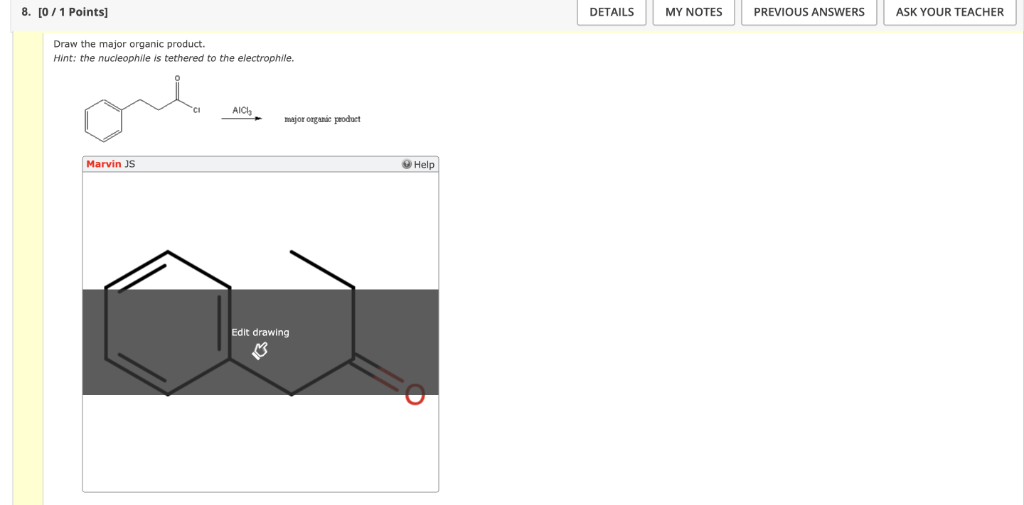 8. [0/1 Points] DETAILS || MYNOTES || PREVIOUSANSWERS || ASKYOURTEACHER
raw the major organic product,
Hint: the nucieophil s tethered to the electrophile
ome
[ Pe frog rt
Marvin 1s Gre]
This is AI generated Response.
Asked by: Alok Kumar
Created at: 2026-02-01 05:59:30
Asked by: Alok Kumar
Created at: 2026-02-01 05:59:30
Final Answer:
Rendered
Raw Text
Did you like this answer?
# Explanation of the Reaction
Let's break down what's happening in this reaction step-by-step.
---
## 1. **Recognizing the Reaction Type**
- **Reactants:**
- You have a benzene ring attached to a chain with a chlorine atom (–CH₂CH₂Cl).
- The reaction uses **AlCl₃** as a catalyst.
- **Hints:**
- The nucleophile is tethered to the electrophile.
- This is a classic **Friedel–Crafts alkylation/acylation** scenario.
---
## 2. **Mechanism Details**
### **Step 1: Generation of the Electrophile**
- The chlorine atom reacts with AlCl₃ to form a **carbocation** on the chain:
\[
\text{Ph-CH}_2\text{-CH}_2\text{-Cl} + \text{AlCl}_3 \rightarrow \text{Ph-CH}_2\text{-CH}_2^+ + \text{AlCl}_4^-
\]
### **Step 2: Intramolecular Attack (Cyclization)**
- The **benzene ring acts as the nucleophile**, attacking the carbocation.
- Because the nucleophile (benzene) is tethered to the electrophile (carbocation), an **intramolecular Friedel–Crafts alkylation** occurs.
### **Step 3: Ring Formation**
- The attack forms a **new six-membered ring** fused to the benzene ring, resulting in a **tetrahydronaphthalene** (1,2,3,4-tetrahydronaphthalene) structure.
---
## 3. **Drawing the Product**
- You start with a phenyl group and a two-carbon chain (ethyl group) ending in a carbocation.
- The ortho position on the benzene attacks the carbocation, making a **six-membered ring fused to the benzene ring**.
### **Product Structure**
- The major organic product is **tetrahydronaphthalene (tetralin)**.
---
## 4. **Summary Table**
| Step | Key Event | Result |
|------|-------------------------------------|------------------------------------------|
| 1 | Cl leaves with AlCl₃ | Carbocation on ethyl chain |
| 2 | Benzene attacks carbocation (ortho) | Six-membered ring is formed (cyclization)|
| 3 | Aromaticity restored, ring fused | Tetrahydronaphthalene (tetralin) |
---
## 5. **Visual Aid**
Here's a simplified reaction scheme:
Benzene–CH₂CH₂Cl + AlCl₃
→ **Tetralin** (1,2,3,4-tetrahydronaphthalene)
```
____ ____
/ \ / \
| | | |
\____/ \____/
| \
CH2-CH2-Cl → /-\
|
(tetralin)
```
---
## **Key Takeaway**
This is an **intramolecular Friedel–Crafts alkylation**, forming a fused bicyclic ring system (tetralin).
If you have any more questions about the mechanism or need help drawing it, let me know!
📢 Instructions:
- Ask anything relatd to above question only.
- For new Question goto :