 VIPSolutions
Act like a helpful tutor and exlain me :7.30 Unburned hydrocarbons, UHC, and nitric oxide, NO, are formed as products of combustion in aircraft gas turbine engines. They lead to burner inefficiency, as they still possess heating value. Consider the combustion of NO, at ref- erence temperature and pressure, to estimate the heating value of NO, in the following stoichiometric reaction: NO +140, —» NO,
Question:
Act like a helpful tutor and exlain me :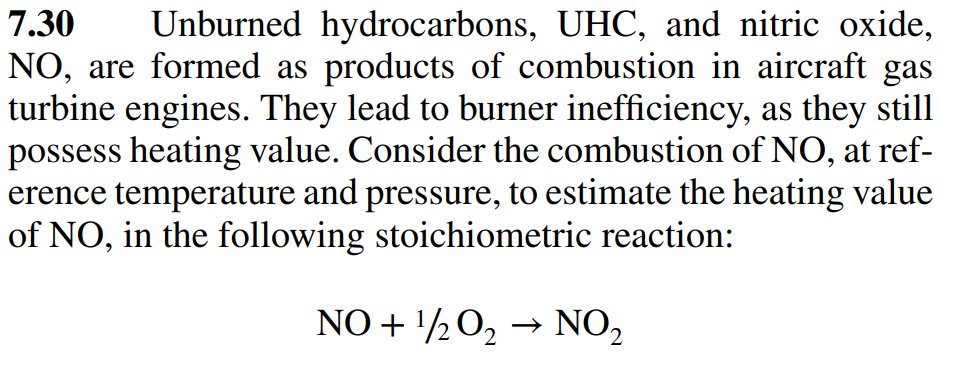 7.30 Unburned hydrocarbons, UHC, and nitric oxide,
NO, are formed as products of combustion in aircraft gas
turbine engines. They lead to burner inefficiency, as they still
possess heating value. Consider the combustion of NO, at ref-
erence temperature and pressure, to estimate the heating value
of NO, in the following stoichiometric reaction:
NO +140, —» NO,
This is AI generated Response.
Asked by: Francis
Created at: 2026-01-10 03:18:50
Asked by: Francis
Created at: 2026-01-10 03:18:50
Final Answer:
Rendered
Raw Text
Did you like this answer?
Certainly! Let’s break down and **explain problem step by**:
---
**1.**
- ** Engines** produceunburned hydrocarbons (UHC)** and **nitric oxide (NO)** as byproducts.
- These byproducts still contain **energy** (heating value) that isn’t fully utilized, causing **inefficiency**.
---
## **2. The Reaction**
You are given the **combustion reaction of NO**:
\[
\text{NO} + \frac{1}{2} \text{O}_2 \rightarrow \text{NO}_2
\]
- **NO (Nitric Oxide)** reacts with oxygen to form **NO₂ (Nitrogen Dioxide)**.
---
## **3. What is Heating Value?**
- The **heating value** (or enthalpy of combustion) tells us **how much energy is released** when a substance is fully combusted.
- For NO, it’s the energy released when NO is converted to NO₂ by reacting with O₂.
---
## **4. How to Estimate the Heating Value**
### **A. Use Standard Enthalpies of Formation (\(\Delta H_f^\circ\))**
- For a chemical reaction, the **enthalpy change** (\(\Delta H_{rxn}\)) is:
\[
\Delta H_{rxn} = \sum (\Delta H_f^\circ \text{ of products}) - \sum (\Delta H_f^\circ \text{ of reactants})
\]
### **B. Find the Standard Enthalpies of Formation**
Typical values at 298 K (room temp):
- \(\Delta H_f^\circ(\text{NO}) = +90.25 \ \mathrm{kJ/mol}\)
- \(\Delta H_f^\circ(\text{O}_2) = \ \mathrm{kJ/mol}\) (elemental form)
- \(\Delta H_f^\circ(\text{NO}_2) = +33.18 \ \mathrm{kJ/mol}\)
### **C. Plug Into the Reaction**
\[
\text{NO} + \frac{1}{2} \text{O}_2 \rightarrow \text{NO}_2
\]
So,
- **Products:** 1 mol NO₂
- **Reactants:** 1 mol NO, .5 mol O₂
\[
\Delta H_{rxn} = [\Delta H_f^\circ(\text{NO}_2)] - [\Delta H_f^\circ(\text{NO}) + .5 \times \Delta H_f^\circ(\text{O}_2)]
\]
Plug in the values:
\[
\Delta H_{rxn} = [33.18] - [90.25 + ] = 33.18 - 90.25 = -57.07 \ \mathrm{kJ/mol}
\]
---
## **5. Interpretation**
- The **negative sign** means energy is **released**: this is the **heating value** of NO when combusted to NO₂.
- **Magnitude:** About **57 kJ per mole** of NO combusted.
---
## **6. Why is This Important?**
- If NO leaves the burner unreacted, this **energy is wasted**—it could have contributed to engine output!
---
## **Summary Table**
| Reaction | \(\Delta H_{rxn}\) (kJ/mol) |
|------------------------------------|-----------------------------|
| NO + ½ O₂ → NO₂ | -57.07 |
---
## **Key Points to Remember**
- **Heating value of NO**: About **57 kJ/mol** (exothermic, released as heat).
- Wasted NO in exhaust means **lost energy** and **inefficiency**.
---
### **Ask if you want to see:**
- A step-by-step calculation
- Further explanation on enthalpy of formation
- How this relates to engine efficiency
Let me know how you’d like to proceed!
📢 Instructions:
- Ask anything relatd to above question only.
- For new Question goto :