 VIPSolutions
Act like a helpful tutor and exlain me :7.29 Air composition at room temperature is approxi- mated by 21% O, and 79% N, by volume, or by mole frac- tions, i.e., one mole of air is composed of 0.210, +0.79N, Strong shocks are, however, formed when aircraft fly at super- sonic/hypersonic Mach numbers. The composition of air thus changes as a sudden compression is encountered through a shock. At 6000 K and one atmospheric pressure, one mole of air assumes the following equilibrium composition: 0.18N+0310+0.51N, Calculate (a) the molecular weight of air in the new mixture, MW,,, in kg/kmol (b) the fuel-to-air ratio for the stoichiometric combus- tion of hydrogen in air (at 6000 K)
Question:
Act like a helpful tutor and exlain me :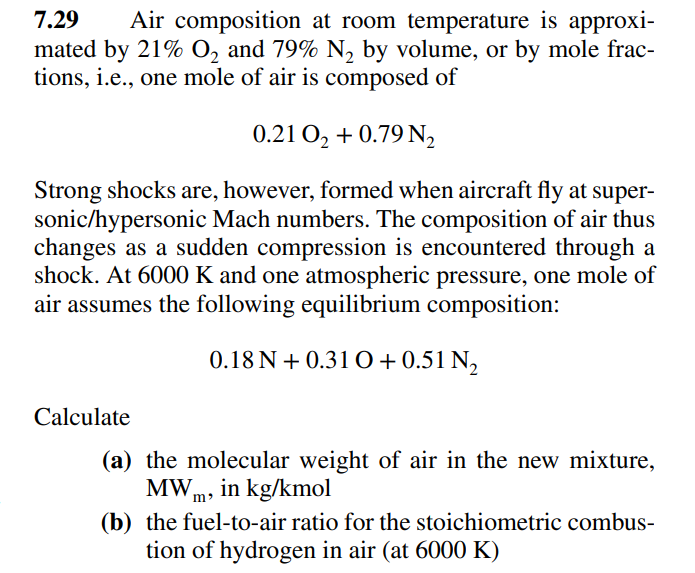 7.29 Air composition at room temperature is approxi-
mated by 21% O, and 79% N, by volume, or by mole frac-
tions, i.e., one mole of air is composed of
0.210, +0.79N,
Strong shocks are, however, formed when aircraft fly at super-
sonic/hypersonic Mach numbers. The composition of air thus
changes as a sudden compression is encountered through a
shock. At 6000 K and one atmospheric pressure, one mole of
air assumes the following equilibrium composition:
0.18N+0310+0.51N,
Calculate
(a) the molecular weight of air in the new mixture,
MW,,, in kg/kmol
(b) the fuel-to-air ratio for the stoichiometric combus-
tion of hydrogen in air (at 6000 K)
This is AI generated Response.
Asked by: Francis
Created at: 2026-01-10 03:17:14
Asked by: Francis
Created at: 2026-01-10 03:17:14
Final Answer:
Rendered
Raw Text
Did you like this answer?
Let's break down the problem step by step:
---
## **Given Data**
At **600 K** and 1 atm, **1 mole of air** has the following composition:
- \(.18\) N (atomic nitrogen)
- \(.31\) O (atomic oxygen)
- \(.51\) N₂ (molecular nitrogen)
### **Atomic/Molecular Weights (kg/kmol)**
- N: 14
- O: 16
- N₂: 28
---
## **Part (a): Molecular Weight of Air in New Mixture**
The **molecular weight** (\( MW_m \)) is the sum of the mole fractions multiplied by the molecular weight of each component:
\[
MW_m = \sum_{i} (n_i \times MW_i)
\]
where \( n_i \) = number of moles of component \( i \) per 1 mole of air, and \( MW_i \) = molecular weight of component \( i \).
Let's plug in the values:
\[
MW_m = (.18 \times 14) + (.31 \times 16) + (.51 \times 28)
\]
Calculate each term:
- \(.18 \times 14 = 2.52\)
- \(.31 \times 16 = 4.96\)
- \(.51 \times 28 = 14.28\)
Add them up:
\[
MW_m = 2.52 + 4.96 + 14.28 = \boxed{21.76 \ \text{kg/kmol}}
\]
---
## **Part (b): Fuel-to-Air Ratio for Stoichiometric Combustion of Hydrogen**
### **Step 1: Combustion Reaction with 600 K Air**
Hydrogen (\(H_2\)) reacts with oxygen to form water:
\[
2H_2 + O_2 \rightarrow 2H_2O
\]
But at **600 K**, air contains:
- Atomic O (.31 mol)
- Atomic N (.18 mol)
- N₂ (.51 mol)
### **Step 2: Available Oxygen Atoms**
Each **O atom** can form half an \(O_2\) molecule, but here, we use **atomic oxygen** for combustion.
To combust **1 mol H₂**:
\[
H_2 + \frac{1}{2} O_2 \rightarrow H_2O
\]
1 mol H₂ needs **1 mol O atoms** (since \(O_2\) is 2 O atoms).
So, for **1 mol of air**:
- **Available O atoms = .31 mol**
Thus, **.31 mol H₂** can be completely combusted with the O atoms in 1 mol air.
### **Step 3: Fuel-to-Air Ratio**
- **Fuel (H₂) required per 1 mol air** = .31 mol
- **Fuel mass:** \(.31 \ \text{mol} \times 2 \ \text{kg/kmol} = .62 \ \text{kg/kmol}\)
- **Air mass:** \(1 \ \text{mol} \times 21.76 \ \text{kg/kmol} = 21.76 \ \text{kg/kmol}\)
\[
\text{Fuel-to-Air Ratio} = \frac{\text{Fuel mass}}{\text{Air mass}} = \frac{.62}{21.76} = \boxed{.0285}
\]
---
## **Summary of Answers**
### (a) Molecular weight of air at 600 K:
\[
\boxed{21.76 \ \text{kg/kmol}}
\]
### (b) Stoichiometric fuel-to-air ratio (hydrogen/air, 600 K):
\[
\boxed{.0285}
\]
---
Let me know if you'd like a more detailed explanation or have questions about the steps!
📢 Instructions:
- Ask anything relatd to above question only.
- For new Question goto :