This is AI generated Response.
Asked by: manish kumar
Created at: 2025-09-08 14:36:36
Final Answer:
RenderedRaw Text
Did you like this answer?
Absolutely, let's break down and explain the question step by step!
---
## **The Problem Overview**
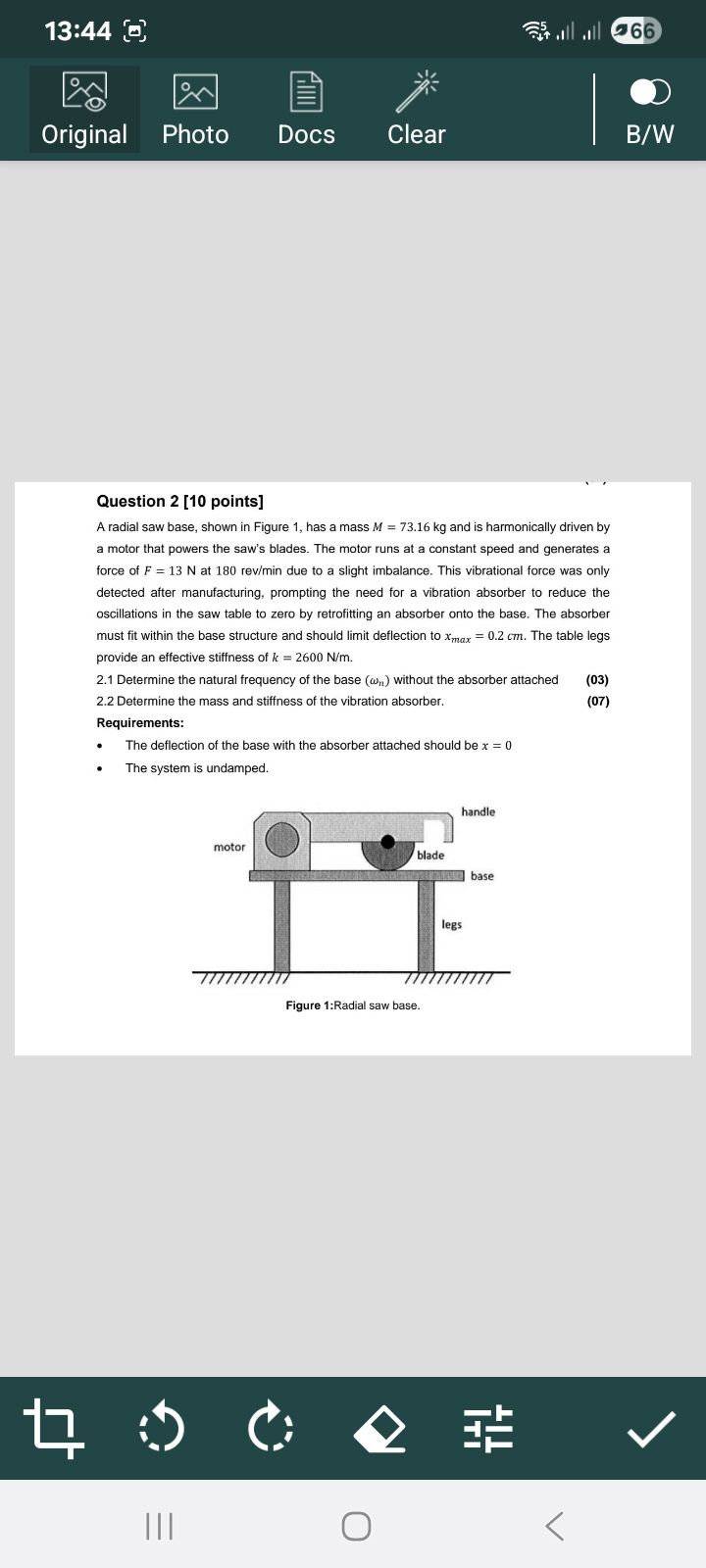
You have a radial saw base with:
- **Mass, \( M = 73.16 \) kg**
- Driven by a motor that causes it to vibrate due to imbalance.
- The motor applies a **force, \( F = 13 \) N** at **180 rev/min**.
- The base is supported by table legs with a **stiffness, \( k = 2600 \) N/m**.
- **Maximum allowed deflection** is \( x_{max} = 0.2 \) cm (convert to meters: 0.002 m).
- **Goal:** Add a vibration absorber to eliminate oscillations (deflection = 0 at operating speed).
- **System is undamped.**
---
## **Questions to Solve**
1. **Natural frequency of the base (\( \omega_n \)) without absorber**
2. **Determine the mass and stiffness of the vibration absorber**
---
### **Step 1: Natural Frequency of the Base (Undamped System)**
The formula for natural frequency (\( \omega_n \)) of a mass-spring system is:
\[
\omega_n = \sqrt{\frac{k}{M}}
\]
Where:
- \( k = 2600 \) N/m (stiffness)
- \( M = 73.16 \) kg (mass)
**Plug in the values:**
\[
\omega_n = \sqrt{\frac{2600}{73.16}}
\]
\[
\omega_n = \sqrt{35.53} \approx 5.96 \ \text{rad/s}
\]
---
### **Step 2: Vibration Absorber Design**
#### **a) Find the excitation frequency**
The **motor speed** is **180 rev/min**. Convert this to radians per second:
\[
\text{Frequency in Hz} = \frac{180}{60} = 3 \ \text{Hz}
\]
\[
\omega = 2\pi f = 2\pi \times 3 = 6\pi \approx 18.85 \ \text{rad/s}
\]
#### **b) Principle of Vibration Absorber**
A vibration absorber is a small mass-spring system attached to the main system. To eliminate the vibration at the excitation frequency, **the absorber's natural frequency should be equal to the excitation frequency**:
\[
\omega_a = \omega
\]
\[
\omega_a = \sqrt{\frac{k_a}{m_a}} = 18.85 \ \text{rad/s}
\]
You have **two unknowns**: absorber mass (\( m_a \)), and absorber stiffness (\( k_a \)). You can choose \( m_a \) first, then solve for \( k_a \):
\[
k_a = m_a \omega^2
\]
#### **c) Deflection Requirement**
The **requirement is that deflection of the base = 0** with absorber attached. This is achieved by tuning the absorber's natural frequency to exactly match the excitation frequency.
---
### **Summary of Steps**
**1. Calculate natural frequency of the base:**
\[
\omega_n = \sqrt{\frac{k}{M}}
\]
**2. Calculate excitation frequency:**
\[
f = 3 \ \text{Hz}
\]
\[
\omega = 18.85 \ \text{rad/s}
\]
**3. Choose absorber mass (\( m_a \)), calculate absorber stiffness (\( k_a \)):**
\[
k_a = m_a \omega^2
\]
**4. To get exact values:**
Usually, \( m_a \) is chosen as a small fraction of \( M \) (e.g., 5-15%), but you can set it as a variable or check if the deflection limit gives you a minimum \( m_a \).
---
### **If You Need to Calculate Minimum Absorber Mass:**
If you want **zero deflection** at the operating frequency, the mass and stiffness of the absorber are related by the tuning condition. You can select \( m_a \) (e.g., 5 kg, 10 kg), then compute \( k_a \).
---
## **Let Me Know**
Would you like to see the full calculation with a chosen value for \( m_a \), or do you want to know more about the theory behind vibration absorbers? Let me know how detailed you want the explanation!
VIPSolutions focuses on clear, step‑by‑step explanations so you can learn quickly. Whether you need an AI‑generated walkthrough or a short hint to get unstuck, each solution is organized for fast reading and easy review later.
Search similar questions, compare approaches, and bookmark the best answers for revision. Our goal is simple: quick, reliable study help that feels natural—not noisy.
 VIPSolutions
 44 B =
13:44 & cI > 66)
WN 5 1 Sie
Zo / ®
Original Photo Docs Clear B/W
Question 2 [10 points]
A radial saw base, shown in Figure 1, has a mass 1 = 73.16 kg and is harmonically civen by
a motor that powers the saws blades. The lor uns at a constant speed and generates a
force of F = 13 N at 180 rev/min due to a slight imbalance. This vibrational force was only
detected after manufacturing, prompting the need for a vibration absorber to reduce the
oscillations in the saw table to zero by retrofitting an absorber onto the base. The absorber
‘must fit within the base structure and should limit deflection (0 Xpyq, = 0.2 cm. The table legs.
provid an effective tfness of k = 2600 Nm
2.1 Determine the natural frequency of the base (w,) without the absorber attached ~~ (03)
2.2 Determine the mass and stiffness of the vibration absorber. (07)
Requirements:
* The deflection of the base with the absorber attached should be x = 0
+ The systems uncamped
handle
Tp TEER TAT bose
{+
| |.
|
|
Figure Racial saw base
LD EG © FE Vv
ho i -—