 VIPSolutions
Act like a helpful tutor and exlain me :4. The uniform bar of mass 12kg is supported by a spring as shown in Fig. 5(a). A disc of mass 4kg and radius 0.085 m is fixed to the bar at its free end. Calculate the natural frequency of free vibration of the system. — pee re} La Wiser 1520 N/m Mass 3 kg * : 034m 051m r Figure for Q.5(s) $ RAN,
Question:
Act like a helpful tutor and exlain me :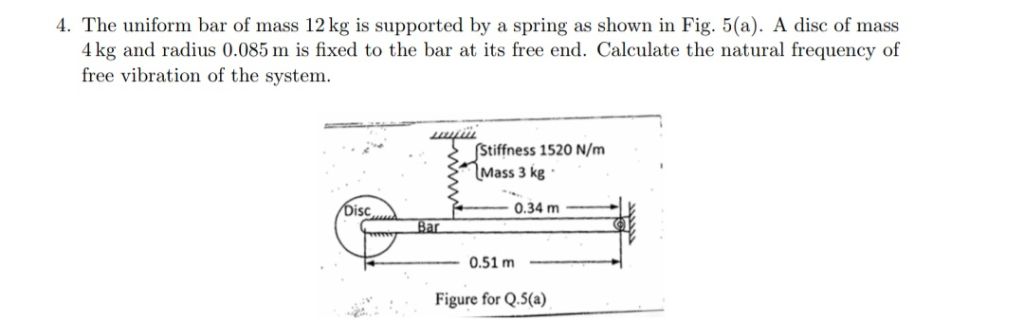 4. The uniform bar of mass 12kg is supported by a spring as shown in Fig. 5(a). A disc of mass
4kg and radius 0.085 m is fixed to the bar at its free end. Calculate the natural frequency of
free vibration of the system.
— pee re}
La Wiser 1520 N/m
Mass 3 kg * :
034m
051m
r Figure for Q.5(s)
$ RAN,
This is AI generated Response.
Asked by: manish kumar
Created at: 2025-09-07 20:08:52
Asked by: manish kumar
Created at: 2025-09-07 20:08:52
Final Answer:
Rendered
Raw Text
Did you like this answer?
Let's break down the problem and solve it step by step!
### **Step 1: Understanding the System**
- **Bar:** Mass = 12 kg, length = 0.51 m (from the figure)
- **Disc:** Mass = 4 kg, radius = 0.085 m, attached at the end of the bar
- **Spring:** Stiffness \( k = 1520 \) N/m, attached at distance 0.34 m from pivot
- **Assume:** Oscillation is about the pivot (left end). Ignore the 3 kg mass because it's not connected to the bar (according to the figure).
### **Step 2: Calculating the Equivalent Mass Moment of Inertia (\( I \))**
#### **For the Bar (about the pivot):**
A uniform bar pivoted at one end:
\[
I_{\text{bar}} = \frac{1}{3} m L^2
\]
- \( m = 12 \) kg
- \( L = 0.51 \) m
\[
I_{\text{bar}} = \frac{1}{3} \times 12 \times (0.51)^2 = 1.02 \text{ kg} \cdot \text{m}^2
\]
#### **For the Disc (using parallel axis theorem):**
\[
I_{\text{disc}} = I_{\text{center}} + m d^2
\]
- \( I_{\text{center}} = \frac{1}{2} m r^2 \)
- \( m = 4 \) kg, \( r = 0.085 \) m
- \( d = 0.51 \) m (distance from pivot to disc center)
\[
I_{\text{disc}} = \frac{1}{2} \times 4 \times (0.085)^2 + 4 \times (0.51)^2
\]
\[
= 2 \times 0.007225 + 4 \times 0.2601
\]
\[
= 0.01445 + 1.0404
\]
\[
= 1.05485 \text{ kg} \cdot \text{m}^2
\]
#### **Total Moment of Inertia:**
\[
I_{\text{total}} = I_{\text{bar}} + I_{\text{disc}} = 1.02 + 1.05485 = 2.07485 \text{ kg} \cdot \text{m}^2
\]
---
### **Step 3: Calculating the Restoring Torque by the Spring**
The spring is attached at 0.34 m from the pivot. For a small angular displacement \( \theta \):
- Vertical displacement at spring = \( x = 0.34 \theta \)
- Restoring force by spring = \( F = k x = k \cdot 0.34 \theta \)
- Restoring torque = \( F \cdot 0.34 = k \cdot (0.34)^2 \theta \)
So,
\[
\text{Restoring torque} = k a^2 \theta
\]
where \( a = 0.34 \) m
---
### **Step 4: Setting Up the Equation of Motion**
\[
I \cdot \ddot{\theta} + k a^2 \theta = 0
\]
This is a standard form for angular simple harmonic motion, so:
\[
\omega_n = \sqrt{\frac{k a^2}{I}}
\]
where:
- \( k = 1520 \) N/m
- \( a = 0.34 \) m
- \( I = 2.07485 \) kg·m²
---
### **Step 5: Calculating the Natural Frequency**
\[
\omega_n = \sqrt{ \frac{1520 \times (0.34)^2}{2.07485} }
\]
\[
= \sqrt{ \frac{1520 \times 0.1156}{2.07485} }
\]
\[
= \sqrt{ \frac{175.712}{2.07485} }
\]
\[
= \sqrt{84.75}
\]
\[
= 9.21 \text{ rad/s}
\]
**Natural frequency in Hz:**
\[
f_n = \frac{\omega_n}{2\pi} = \frac{9.21}{2\pi} \approx 1.47 \text{ Hz}
\]
---
## **Summary/Final Answer**
**The natural frequency of free vibration of the system is approximately:**
\[
\boxed{1.47 \text{ Hz}}
\]
If you have any step you don't understand, please ask for clarification!
📢 Instructions:
- Ask anything relatd to above question only.
- For new Question goto :