 VIPSolutions
Act like a helpful tutor and exlain me :4 Ph econ Loe Fuasg 4 ow fi id " A) iF + closed SUT . he en CENT cc ae wo wl Fem” sow os alt ; v £ & = 800 oan 3 7 (SO OY Ww . arpudggrct Mo= 12 g i : aclftnaot Eo : free 3 Ze OSH 20 9 oot aL penive (eadleeeed form I2 eguebna inteamy fand XY. 2. Dente Lm 2g waka enpih ; IE cove vg 74 —(m Seprena Grurthen vale) fo Lid eget in'v dncorne , ending eR 4 pre Rover od. Congpede real mubtepuer Lom naduced fon pole hm et Fy ee by Qo Condit . ( I] He por) eqee dod valet s of Y el p \ A a; Le fe aig ph ALAA 9 malignty 5 fia phitey A fpandng ful AfaRUR I i ¢ Natio ie 9¢ ebbing “ri phd of end\vakd ve X
Question:
Act like a helpful tutor and exlain me :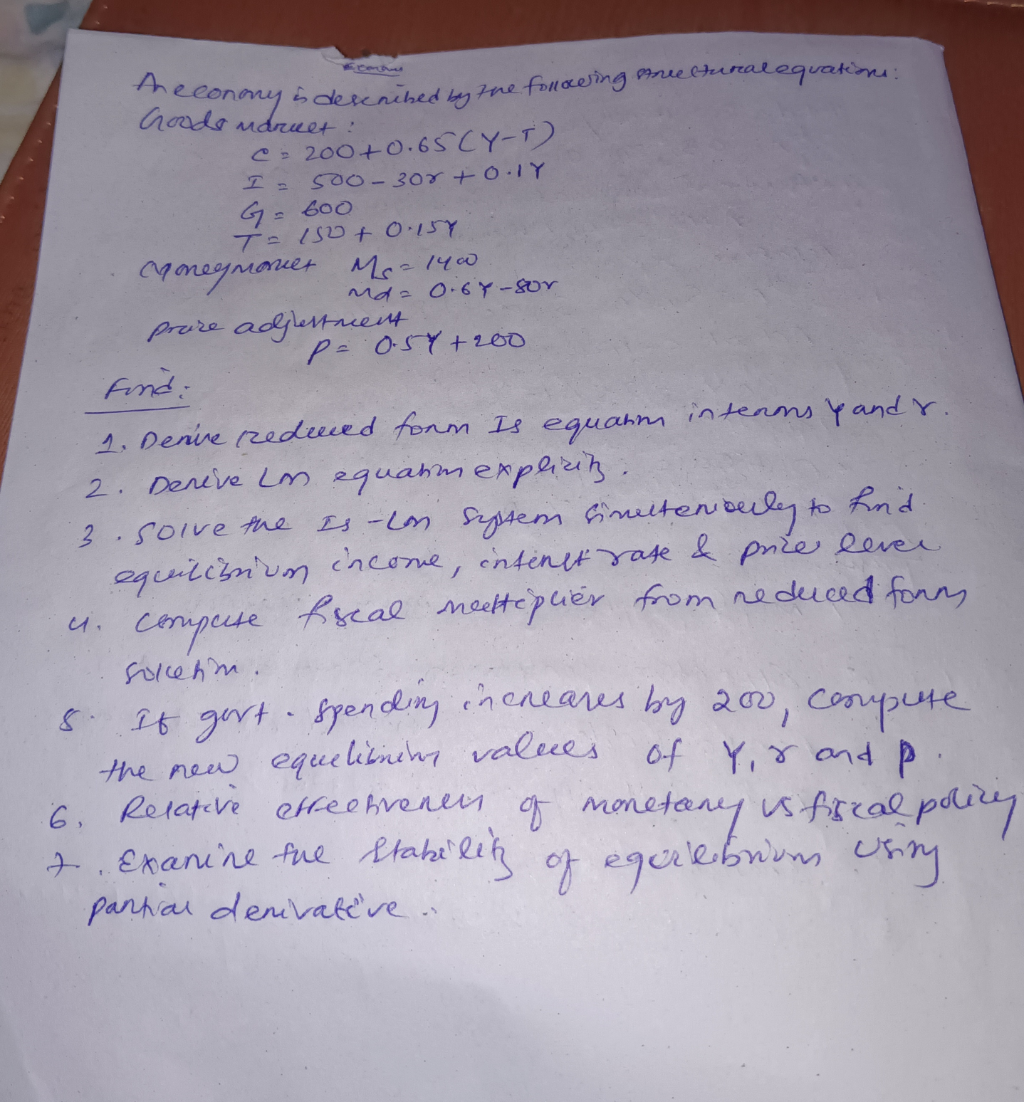 4 Ph econ Loe Fuasg 4 ow fi id
" A) iF + closed SUT . he en
CENT cc ae wo
wl Fem” sow os alt ; v £
& = 800 oan 3
7 (SO OY Ww
. arpudggrct Mo= 12 g i
: aclftnaot Eo :
free 3
Ze OSH 20 9
oot
aL penive (eadleeeed form I2 eguebna inteamy fand XY.
2. Dente Lm 2g waka enpih ;
IE cove vg 74 —(m Seprena Grurthen vale) fo Lid
eget in'v dncorne , ending eR 4 pre Rover
od. Congpede real mubtepuer Lom naduced fon
pole hm
et Fy ee by Qo Condit
. ( I]
He por) eqee dod valet s of Y el p
\ A
a; Le fe aig ph ALAA 9 malignty 5 fia phitey
A fpandng ful AfaRUR I i
¢ Natio ie 9¢ ebbing “ri
phd of end\vakd ve X
This is AI generated Response.
Asked by: Alok Kumar
Created at: 2026-02-02 06:56:14
Asked by: Alok Kumar
Created at: 2026-02-02 06:56:14
Final Answer:
Rendered
Raw Text
Did you like this answer?
Sure! Let’s break down your macroeconomics homework step by step and explain how to approach each part. You’re given a set of equations describing an economy and asked for IS-LM analysis.
---
## **Given Equations**
**Goods Market**
- \( C = 200 + .65(Y - T) \)
*(Consumption as a function of disposable income)*
- \( I = 500 - 30r + .1Y \)
*(Investment as a function of interest rate and income)*
- \( G = 800 \)
*(Government spending)*
- \( T = 150 + .15Y \)
*(Taxes as a function of income)*
**Money Market**
- \( M_s = 140 \)
*(Money supply)*
- \( M_d = .64Y - 80r \)
*(Money demand as a function of income and interest rate)*
**Price Adjustment**
- \( P = .5Y + 200 \)
*(Price level as a function of income)*
---
## **Tasks Explained**
### 1. **Derive Reduced Form IS Equation in terms of \( Y \) and \( r \)**
The **IS curve** comes from equilibrium in the **goods market**:
**Aggregate demand = Aggregate output:**
\[
Y = C + I + G
\]
Plug in the equations for \( C \), \( I \), and \( G \):
\[
Y = [200 + .65(Y - T)] + [500 - 30r + .1Y] + 800
\]
Remember \( T = 150 + .15Y \):
\[
C = 200 + .65(Y - (150 + .15Y)) \\
= 200 + .65(Y - 150 - .15Y) \\
= 200 + .65(.85Y - 150) \\
= 200 + .5525Y - 97.5 \\
= 102.5 + .5525Y
\]
So the IS equation becomes:
\[
Y = [102.5 + .5525Y] + [500 - 30r + .1Y] + 800
\]
Combine like terms:
\[
Y = 102.5 + .5525Y + 500 - 30r + .1Y + 800
\]
\[
Y = (102.5 + 500 + 800) + (.5525Y + .1Y) - 30r
\]
\[
Y = 1402.5 + .6525Y - 30r
\]
Bring all terms with \( Y \) to one side:
\[
Y - .6525Y = 1402.5 - 30r
\]
\[
.3475Y = 1402.5 - 30r
\]
\[
Y = \frac{1402.5 - 30r}{.3475}
\]
This is the reduced form IS equation.
---
### 2. **Derive LM Equation Explicitly**
The **LM curve** comes from equilibrium in the **money market**:
\[
M_s = M_d
\]
Plug in the values:
\[
140 = .64Y - 80r
\]
Solve for \( Y \):
\[
.64Y - 80r = 140
\]
\[
.64Y = 140 + 80r
\]
\[
Y = \frac{140 + 80r}{.64}
\]
That's the explicit LM equation.
---
### 3. **Solve IS-LM System Simultaneously (for \( Y \), \( r \), \( P \))**
Set the two equations equal (since both are \( Y \) in terms of \( r \)):
\[
\frac{1402.5 - 30r}{.3475} = \frac{140 + 80r}{.64}
\]
Now solve for \( r \):
1. Cross-multiply:
\[
.64(1402.5 - 30r) = .3475(140 + 80r)
\]
2. Expand:
\[
897.6 - 19.2r = 485.5 + 27.8r
\]
3. Collect \( r \) terms:
\[
897.6 - 485.5 = 27.8r + 19.2r
\]
\[
412.1 = 47r
\]
\[
r = \frac{412.1}{47} \approx 8.77
\]
Substitute \( r \) back into either equation to get \( Y \):
\[
Y = \frac{1402.5 - 30(8.77)}{.3475}
\]
\[
Y \approx \frac{1402.5 - 263.1}{.3475} \approx \frac{1139.4}{.3475} \approx 3278.6
\]
Now, use the price equation:
\[
P = .5Y + 200 \\
P = .5 \times 3278.6 + 200 \approx 1639.3 + 200 = 1839.3
\]
---
### 4. **Compute Fiscal Multiplier from Reduced Form**
The **fiscal multiplier** is the change in \( Y \) from a change in \( G \):
From IS:
\[
Y = \frac{1402.5 - 30r}{.3475}
\]
If \( G \) increases by 1, the numerator increases by 1, so:
\[
\frac{\partial Y}{\partial G} = \frac{1}{.3475} \approx 2.88
\]
---
### 5. **If \( G \) increases by 200, Compute New Equilibrium**
Add 200 to \( G \), so numerator in IS becomes:
\[
Y = \frac{1402.5 + 200 - 30r}{.3475}
= \frac{1602.5 - 30r}{.3475}
\]
Repeat step 3 with this new numerator.
---
### 6. **Relative Effectiveness: Monetary vs Fiscal Policy**
- Fiscal policy shifts IS curve (affects output more if LM is flatter)
- Monetary policy shifts LM curve (affects output more if IS is flatter)
- Compare the coefficients: If IS is steeper, monetary policy is more effective; if LM is steeper, fiscal policy is more effective.
---
### 7. **Examine Stability Using Partial Derivatives**
Check the partial derivatives of \( Y \) with respect to \( r \) in both IS and LM curves:
- IS: \( \frac{\partial Y}{\partial r} = -\frac{30}{.3475} \)
- LM: \( \frac{\partial Y}{\partial r} = \frac{80}{.64} \)
If the system's Jacobian determinant is positive, equilibrium is stable.
---
## **Summary Table**
| Step | What To Do | Equation Used | Key Result/Tip |
|------|------------------------------|------------------------|-------------------------------|
| 1 | IS Curve | Solve for \( Y \) | \( Y = \frac{1402.5-30r}{.3475} \) |
| 2 | LM Curve | Solve for \( Y \) | \( Y = \frac{140+80r}{.64} \) |
| 3 | Equilibrium \((Y, r, P)\) | Solve IS-LM together | \( Y \approx 3278.6, r \approx 8.77, P \approx 1839.3 \) |
| 4 | Fiscal Multiplier | \(\frac{\partial Y}{\partial G}\) | \( \approx 2.88 \) |
| 5 | \( G \) increases by 200 | Update IS numerator | Recalculate \( Y, r, P \) |
| 6 | Policy Effectiveness | Compare slope values | Steeper curve = less effective |
| 7 | Stability | Partial derivatives | Positive Jacobian = stable |
---
If you need **step-by-step calculations or numerical answers for steps 5-7**, let me know!
📢 Instructions:
- Ask anything relatd to above question only.
- For new Question goto :