 VIPSolutions
Act like a helpful tutor and exlain me :4. (Markov Chains - Tough) A Markov chain has transition matrix 0 1 0 1 1 P=|4 0} 010 1. Is the chain irreducible? 2. Find the stationary distribution, f it exists. 3. Is the chain ergodic?
Question:
Act like a helpful tutor and exlain me :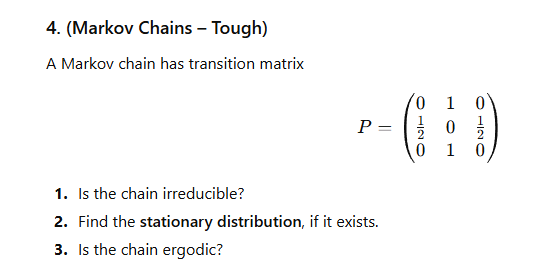 4. (Markov Chains - Tough)
A Markov chain has transition matrix
0 1 0
1 1
P=|4 0}
010
1. Is the chain irreducible?
2. Find the stationary distribution, f it exists.
3. Is the chain ergodic?
This is AI generated Response.
Asked by: Alok Kumar
Created at: 2026-02-02 09:51:31
Asked by: Alok Kumar
Created at: 2026-02-02 09:51:31
Final Answer:
Rendered
Raw Text
Did you like this answer?
Let's go through each part step by step:
---
## 1. **Is the chain irreducible?**
A Markov chain is **irreducible** if it is possible to get from any state to any other state (possibly in multiple steps).
Given the transition matrix:
\[
P = \begin{pmatrix}
& 1 & \\
\frac{1}{2} & & \frac{1}{2} \\
& 1 &
\end{pmatrix}
\]
Let's label the states as 1, 2, 3:
- **From 1:** Can go to 2 (in 1 step), from 2 to 1 (in 1 step), so can return.
- **From 1 to 3:** From 1 → 2 (step 1), then 2 → 3 (step 2), so possible in 2 steps.
- **From 3 to 1:** 3 → 2 (step 1), then 2 → 1 (step 2), possible in 2 steps.
- **Any pair can reach each other in at most 2 steps.**
**Conclusion:**
**Yes, the chain is irreducible.**
---
## 2. **Find the stationary distribution, if it exists.**
The **stationary distribution** \(\pi = (\pi_1, \pi_2, \pi_3)\) satisfies:
\[
\pi P = \pi
\]
and \(\pi_1 + \pi_2 + \pi_3 = 1\).
Set up the equations:
\[
\begin{align*}
\pi_1 &= \cdot \pi_1 + \frac{1}{2} \pi_2 + \cdot \pi_3 = \frac{1}{2}\pi_2 \\
\pi_2 &= 1 \cdot \pi_1 + \cdot \pi_2 + 1 \cdot \pi_3 = \pi_1 + \pi_3 \\
\pi_3 &= \cdot \pi_1 + \frac{1}{2} \pi_2 + \cdot \pi_3 = \frac{1}{2}\pi_2 \\
\end{align*}
\]
Notice that \(\pi_1 = \pi_3\).
Also, \(\pi_2 = \pi_1 + \pi_3 = 2\pi_1\).
Now, normalization:
\[
\pi_1 + \pi_2 + \pi_3 = 1 \\
\pi_1 + 2\pi_1 + \pi_1 = 1 \\
4\pi_1 = 1 \implies \pi_1 = \frac{1}{4}
\]
So,
\[
\pi_1 = \pi_3 = \frac{1}{4},\ \pi_2 = \frac{1}{2}
\]
**Stationary distribution:**
\[
\boxed{\left(\frac{1}{4},\, \frac{1}{2},\, \frac{1}{4} \right)}
\]
---
## 3. **Is the chain ergodic?**
A Markov chain is **ergodic** if it is both irreducible and aperiodic.
- We already showed it is **irreducible**.
- **Aperiodicity:** Look at the period of state 2, for example. You can only return to state 2 in an even number of steps (since it goes 2 → 1 or 3 → 2). The period is 2. The same for states 1 and 3. So, all states have period 2.
**Conclusion:**
**The chain is *not* ergodic, because it is not aperiodic (it is periodic with period 2).**
---
## **Summary Table**
| Property | Answer |
|---------------------|----------------------------------------------------------------------------|
| Irreducible? | Yes |
| Stationary Dist.? | \(\left(\frac{1}{4},\, \frac{1}{2},\, \frac{1}{4} \right)\) |
| Ergodic? | No, because it is periodic (period 2), not aperiodic |
📢 Instructions:
- Ask anything relatd to above question only.
- For new Question goto :