 VIPSolutions
Act like a helpful tutor and exlain me :3 i v B- = First four-month period of the year production volume ata facility was 252 9401, and’ 4 J ‘second four-month period of the year production volume was 752771. as. 5 it Extrapolate what the production volume for the third four-month period of the year oul Be be, using the values above. zi © Thedecrease from volume 1 tovolume 21s not consistent, and is due to vacations dur ie 4 “a summer. | 4 2) F La
Question:
Act like a helpful tutor and exlain me :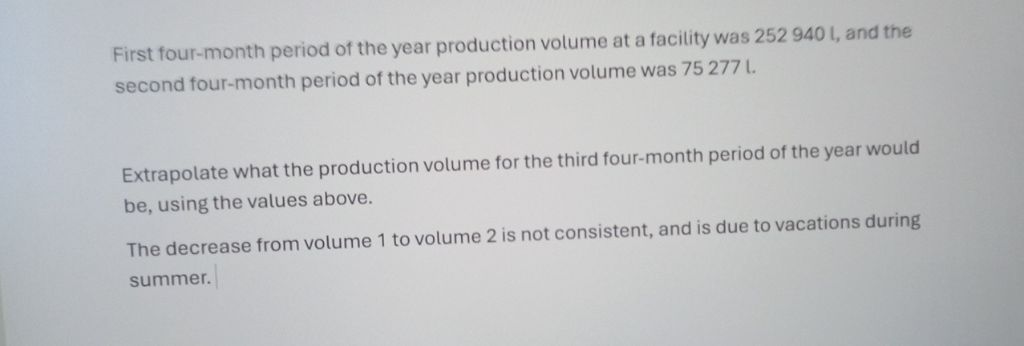 3
i v B-
= First four-month period of the year production volume ata facility was 252 9401, and’ 4
J ‘second four-month period of the year production volume was 752771. as.
5 it Extrapolate what the production volume for the third four-month period of the year oul
Be be, using the values above. zi
© Thedecrease from volume 1 tovolume 21s not consistent, and is due to vacations dur
ie 4
“a summer. | 4
2) F
La
This is AI generated Response.
Asked by: manish kumar
Created at: 2025-09-09 18:53:26
Asked by: manish kumar
Created at: 2025-09-09 18:53:26
Final Answer:
Rendered
Raw Text
Did you like this answer?
Certainly! Let's break down the problem and approach the extrapolation step by step.
---
## **Given Data**
- **First 4-month period production:** 252,940 L
- **Second 4-month period production:** 75,277 L
- **Reason for drop:** Vacations during summer (so the drop is not a regular trend).
---
## **What is being asked?**
**Extrapolate** the production volume for the **third 4-month period** of the year, using the above values.
---
## **Step-by-Step Explanation**
### **1. Analyze the Trend**
- The production drops sharply from the first to the second period.
- The text says this drop is **not consistent** and is due to summer vacations—so we shouldn’t expect the third period to keep dropping at the same rate.
---
### **2. Possible Approaches**
#### **A. Assume Production Returns to Normal**
Since the drop is due to vacations and not a new trend, it is reasonable to assume that production in the third period might return to the level of the first period (252,940 L).
#### **B. Calculate an Average (Not Recommended Here)**
If we averaged the two periods, it would give a middle value, but since the drop is due to a special circumstance, this is less accurate.
#### **C. Use the First Period Value**
Because the vacation impact is over, production could return to its "normal" value.
---
## **Conclusion/Extrapolated Value**
**The best estimate for the third four-month period production** is likely to be close to the first period:
**≈ 252,940 L**
---
### **Summary Table**
| Period | Production Volume (L) | Notes |
|---------------------|----------------------|------------------------------------|
| 1st (Jan-Apr) | 252,940 | Normal production |
| 2nd (May-Aug) | 75,277 | Drop due to summer vacations |
| 3rd (Sep-Dec) | **252,940 (estimated)** | Likely return to normal production |
---
## **Key Point**
- **The drop in period 2 is not a trend but a one-time effect.**
- **Extrapolate period 3 using period 1’s value.**
---
**If you have more context (e.g., historical data), you could refine this estimate!**
📢 Instructions:
- Ask anything relatd to above question only.
- For new Question goto :