 VIPSolutions
Act like a helpful tutor and exlain me :3.32 ‘The four-digit notation system (Miller-Bravais indi- ces) introduced for planes in the hexagonal system can also be used for describing crystal directions. In a hexagonal unit cell, sketch the (a) [T2T0] (b) [2TT0] | (¢) [1130] directions.
Question:
Act like a helpful tutor and exlain me :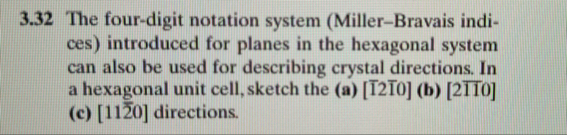 3.32 ‘The four-digit notation system (Miller-Bravais indi-
ces) introduced for planes in the hexagonal system
can also be used for describing crystal directions. In
a hexagonal unit cell, sketch the (a) [T2T0] (b) [2TT0]
| (¢) [1130] directions.
This is AI generated Response.
Asked by: Alok Kumar
Created at: 2026-01-27 05:07:47
Asked by: Alok Kumar
Created at: 2026-01-27 05:07:47
Final Answer:
Rendered
Raw Text
Did you like this answer?
## Explanation: Miller–Bravais Indices for Hexagonal Directions
The Miller–Bravais system is a **four-index notation** used for describing directions and planes in hexagonal crystal systems. The indices are written as \([uvtw]\) for directions, where:
- \(u, v, t\) are the indices along the three **a-axes** (120° apart in the basal plane)
- \(w\) is the index along the **c-axis** (vertical axis)
The relation between the indices is:
\[ u + v + t = \]
---
### The Hexagonal Unit Cell Axes
- **a₁, a₂, a₃**: Three axes in the basal (horizontal) plane, 120° apart.
- **c**: Vertical axis, perpendicular to the basal plane.
---
### (a) \([ \overline{1} 2 \overline{1} ]\) Direction
- \(u = -1\), \(v = 2\), \(t = -1\), \(w = \)
- This direction lies **in the basal plane** (since \(w = \)), no component along the \(c\)-axis.
#### How to sketch:
1. **Start at the origin.**
2. Move \(-1\) unit along \(a_1\) (opposite direction of \(a_1\)).
3. Move \(+2\) units along \(a_2\).
4. Move \(-1\) unit along \(a_3\) (opposite direction of \(a_3\)).
5. No movement along \(c\).
---
### (b) \([2\ \overline{1}\ \overline{1}\ ]\) Direction
- \(u = 2\), \(v = -1\), \(t = -1\), \(w = \)
- Also in basal plane.
#### How to sketch:
1. **Start at the origin.**
2. Move \(+2\) units along \(a_1\).
3. Move \(-1\) unit along \(a_2\) (opposite direction).
4. Move \(-1\) unit along \(a_3\).
5. No movement along \(c\).
---
### (c) \([ 11\overline{2} ]\) Direction
- \(u = 1\), \(v = 1\), \(t = -2\), \(w = \)
- Again, basal plane.
#### How to sketch:
1. **Start at the origin.**
2. Move \(+1\) unit along \(a_1\).
3. Move \(+1\) unit along \(a_2\).
4. Move \(-2\) units along \(a_3\).
5. No movement along \(c\).
---
## Visual Guide
Here’s a basic diagram of the **hexagonal basal plane**:
```
a2
/
/
*-----* a1
/ /
*-----*
a3
```
For each direction, use the given coefficients to move along each axis from the origin.
---
## **Summary Table**
| Direction | a₁ | a₂ | a₃ | c | In basal plane? |
|----------------------------|-----|-----|-----|-----|-----------------|
| \([ \overline{1} 2 \overline{1} ]\) | -1 | 2 | -1 | | Yes |
| \([ 2\ \overline{1}\ \overline{1}\ ]\) | 2 | -1 | -1 | | Yes |
| \([ 11\overline{2} ]\) | 1 | 1 | -2 | | Yes |
---
## **Tips**
- All these directions are **in the basal plane** because \(w = \).
- In practice, you can translate the origin to any lattice point to sketch the direction as an arrow.
- The **direction vector** is proportional to the indices [u v t w].
---
If you want a **hand-drawn sketch** or a more visual explanation, let me know!
📢 Instructions:
- Ask anything relatd to above question only.
- For new Question goto :