 VIPSolutions
Act like a helpful tutor and exlain me :2 Bees (again) [16 Points] The bees are planing another swarm on an airplane. This time, they are looking to improve their aerodynamic performance. Thus, they rented time in a wind tunnel to perform testing. We will simplify the problem so that the calculations are easier and work in two dimensions in Cartesian zy coordinates. The wind tunnel has half height & = 0.1 m. The wind tunnel depth (in the z-direction) is 2h. At the wind tunnel test section inflow, the velocity is uniform Vi = 10 i ms~" and the gage pressure is pi = 200 Pa. At the test section outflow the velocity profile is no longer uniform and it is given by = ayi, for y>0 Vm =q = [] —ayi, for y K [8 — Ra = —o | _— IA = ——
Question:
Act like a helpful tutor and exlain me :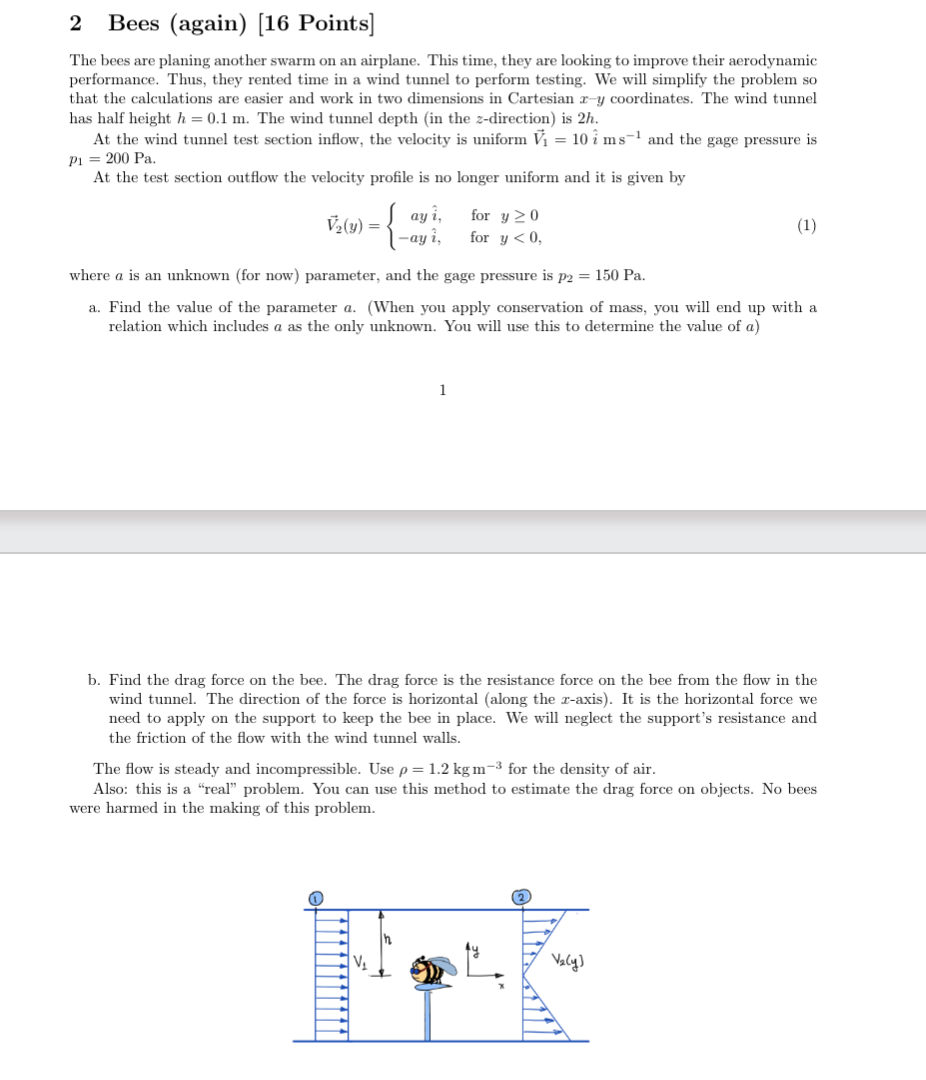 2 Bees (again) [16 Points]
The bees are planing another swarm on an airplane. This time, they are looking to improve their aerodynamic
performance. Thus, they rented time in a wind tunnel to perform testing. We will simplify the problem so
that the calculations are easier and work in two dimensions in Cartesian zy coordinates. The wind tunnel
has half height & = 0.1 m. The wind tunnel depth (in the z-direction) is 2h.
At the wind tunnel test section inflow, the velocity is uniform Vi = 10 i ms~" and the gage pressure is
pi = 200 Pa.
At the test section outflow the velocity profile is no longer uniform and it is given by
= ayi, for y>0
Vm =q = []
—ayi, for y K
[8
— Ra
= —o
| _— IA
= ——
This is AI generated Response.
Asked by: John
Created at: 2025-10-15 20:13:57
Asked by: John
Created at: 2025-10-15 20:13:57
Final Answer:
Rendered
Raw Text
Did you like this answer?
# Bees (again) [16 Points] — Wind Tunnel Drag Problem
This problem is about applying fluid mechanics to find the drag force on a bee in a wind tunnel, using conservation of mass and momentum. Let’s break it down step by step.
---
## **Given Data**
- **Wind tunnel half-height:** \( h = .1 \) m
(Total height is \( 2h = .2 \) m)
- **Inlet velocity:** \( V_1 = 10 \) m/s (uniform)
- **Inlet gage pressure:** \( p_1 = 200 \) Pa
- **Outlet (test section) pressure:** \( p_2 = 150 \) Pa
- **Outlet velocity profile:**
\[
\vec{V}_2(y) =
\begin{cases}
a y \, \hat{i}, & y \geq \\
-a y \, \hat{i}, & y <
\end{cases}
\]
- **Density of air:** \( \rho = 1.2 \) kg/m³
---
## **A. Find the value of parameter \(a\) (Conservation of Mass)**
### **Step 1: Write the Conservation of Mass (Continuity Equation)**
For steady, incompressible flow:
\[
\text{Mass in} = \text{Mass out}
\]
Or, for a control volume:
\[
\int_{A_1} \rho V_1 \, dA = \int_{A_2} \rho V_2(y) \, dA
\]
Since the z-direction depth is constant, let’s consider a unit depth (\(1\,\text{m}\)):
- **Inlet area**: \( A_1 = 2h \times 1 = .2 \) m²
- **Outlet area**: \( A_2 = 2h \times 1 = .2 \) m²
#### **Inlet Mass Flow Rate**
\[
\dot{m}_1 = \rho V_1 A_1 = \rho V_1 (2h \cdot 1)
\]
#### **Outlet Mass Flow Rate**
\[
\dot{m}_2 = \rho \int_{-h}^{h} V_2(y) \, dy
\]
Given \(V_2(y)\) is odd-symmetric, break it into two parts:
\[
\int_{-h}^{h} V_2(y) \, dy = \int_{-h}^ (-a y) \, dy + \int_^{h} (a y) \, dy
\]
Calculate each part:
- \( \int_{-h}^ (-a y) dy = -a \int_{-h}^ y dy = -a \left[ \frac{y^2}{2} \right]_{-h}^ = -a \left( - \frac{h^2}{2}\right) = a \frac{h^2}{2} \)
- \( \int_^h (a y) dy = a \int_^h y dy = a \left[ \frac{y^2}{2} \right]_^h = a \frac{h^2}{2} \)
Add them:
\[
\int_{-h}^h V_2(y) dy = a \frac{h^2}{2} + a \frac{h^2}{2} = a h^2
\]
Therefore,
\[
\dot{m}_2 = \rho a h^2 \cdot 1
\]
#### **Set mass in = mass out:**
\[
\rho V_1 (2h) = \rho a h^2
\]
\[
V_1 (2h) = a h^2
\]
\[
a = \frac{2 V_1}{h}
\]
Given \(V_1 = 10\) m/s, \(h = .1\) m:
\[
a = \frac{2 \times 10}{.1} = \frac{20}{.1} = 200
\]
**So,**
\[
\boxed{a = 200 \text{ s}^{-1}}
\]
---
## **B. Find the Drag Force on the Bee (Momentum Conservation)**
### **Step 2: Apply the x-direction Momentum Balance**
For a control volume around the bee and between sections 1 and 2:
\[
\sum F_x = \text{Outflow momentum} - \text{Inflow momentum} + \text{Pressure force difference}
\]
#### **x-momentum flux:**
\[
\dot{P}_{x,\text{in}} = \rho V_1^2 (2h)
\]
\[
\dot{P}_{x,\text{out}} = \rho \int_{-h}^h V_2(y)^2 dy
\]
Calculate:
- For \(y \geq \): \(V_2(y)^2 = (a y)^2 = a^2 y^2\)
- For \(y < \): \(V_2(y)^2 = (-a y)^2 = a^2 y^2\)
So,
\[
\int_{-h}^h V_2(y)^2 dy = a^2 \int_{-h}^h y^2 dy = a^2 \left[ \int_{-h}^h y^2 dy \right]
\]
\[
\int_{-h}^h y^2 dy = \left[ \frac{y^3}{3} \right]_{-h}^h = \frac{h^3}{3} - \left(-\frac{h^3}{3}\right) = \frac{2 h^3}{3}
\]
So,
\[
\int_{-h}^h V_2(y)^2 dy = a^2 \frac{2 h^3}{3}
\]
\[
\dot{P}_{x,\text{out}} = \rho a^2 \frac{2 h^3}{3}
\]
#### **Pressure force:**
Pressure acts on area \(2h\) at inlet and outlet:
\[
F_{p} = p_1 (2h) - p_2 (2h)
\]
#### **Total x-force (on bee):**
\[
F_{\text{bee}} = \left[\rho a^2 \frac{2 h^3}{3} + p_2 (2h)\right] - \left[\rho V_1^2 (2h) + p_1 (2h)\right]
\]
\[
= 2h \left( \rho \left[ \frac{a^2 h^2}{3} - V_1^2 \right] + (p_2 - p_1) \right)
\]
#### **Plug in values:**
- \(a = 200\) s⁻¹
- \(h = .1\) m
- \(V_1 = 10\) m/s
- \(p_1 = 200\) Pa, \(p_2 = 150\) Pa
- \(\rho = 1.2\) kg/m³
Calculate each term:
- \(a^2 h^2 = (200)^2 \times (.1)^2 = 40000 \times .01 = 400\)
- \(V_1^2 = 100\)
So:
\[
F_{\text{bee}} = 2 \times .1 \left[ 1.2 \left( \frac{400}{3} - 100 \right) + (150 - 200) \right]
\]
\[
= .2 \left[ 1.2 \left( 133.33 - 100 \right) - 50 \right]
\]
\[
= .2 \left[ 1.2 (33.33) - 50 \right]
\]
\[
= .2 [40 - 50]
\]
\[
= .2 \times (-10) = -2 \text{ N}
\]
### **Interpretation**
The negative sign means the force is to the **left** (opposing the flow), so the **magnitude** is:
\[
\boxed{F_{\text{drag}} = 2 \;\text{N}}
\]
---
## **Summary Table**
| Step | Expression | Value |
|-----------|-------------------------------------------------|--------------------------|
| a | \( a = \frac{2 V_1}{h} \) | \( a = 200 \) s⁻¹ |
| Drag \(F\)| \( F = 2h \left( \rho \left[\frac{a^2 h^2}{3} - V_1^2 \right] + (p_2 - p_1) \right) \) | \( F = 2 \) N |
---
## **Key Concepts Used**
- **Continuity equation** (mass conservation)
- **Momentum conservation** (control volume)
- **Velocity profiles and integration**
- **Pressure forces**
---
If you need further clarification on any step, let me know!
📢 Instructions:
- Ask anything relatd to above question only.
- For new Question goto :