 VIPSolutions
Act like a helpful tutor and exlain me :2.50. Determine the effective stiffness of the springs shown in Fig. P2.50. pa " te fn Oo ks i FIGURE P2.50. FIGURE P2.52 2.60. If two springs are connceted in series, as shown in the first figure in the table of spring stiffness, derive the resulting spring stiffness and the natural frequency of the motion. 2.61. If two springs are connected in parallel, as shown in the second figure in the table of spring stiffness. derive the resulting spring stiffness and the natural frequency of the motion.
Question:
Act like a helpful tutor and exlain me :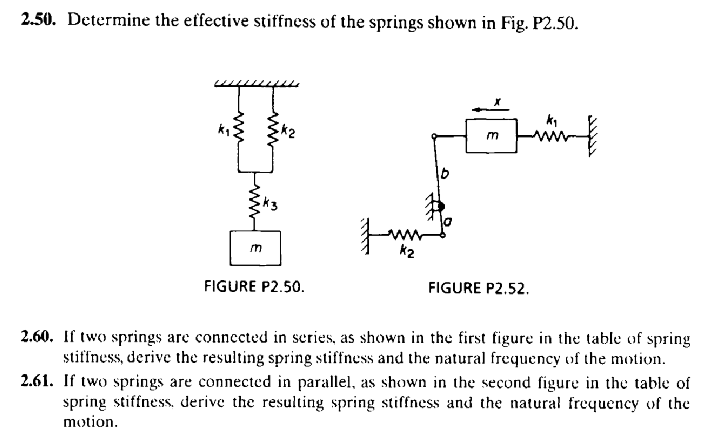 2.50. Determine the effective stiffness of the springs shown in Fig. P2.50.
pa
" te fn
Oo
ks
i
FIGURE P2.50. FIGURE P2.52
2.60. If two springs are connceted in series, as shown in the first figure in the table of spring
stiffness, derive the resulting spring stiffness and the natural frequency of the motion.
2.61. If two springs are connected in parallel, as shown in the second figure in the table of
spring stiffness. derive the resulting spring stiffness and the natural frequency of the
motion.
This is AI generated Response.
Asked by: manish kumar
Created at: 2025-09-11 21:43:16
Asked by: manish kumar
Created at: 2025-09-11 21:43:16
Final Answer:
Rendered
Raw Text
Did you like this answer?
Sure! Let's break down the problem and the concepts involved.
---
# 2.50: Effective Stiffness of Springs in Figure P2.50
## **Given Diagram (Figure P2.50)**
You have **three springs** (with stiffnesses \(k_1\), \(k_2\), and \(k_3\)) and a mass \(m\):
- **k₁ and k₂ are in parallel** (connected side by side at the top).
- Their combination is then in **series with k₃** (the bottom spring).
```
Top -> [k₁ || k₂] -> [k₃] -> m
```
Where `[k₁ || k₂]` means k₁ and k₂ are in parallel.
---
## **Step 1: Find Equivalent Stiffness of k₁ and k₂ (Parallel)**
For **springs in parallel**:
\[
k_{parallel} = k_1 + k_2
\]
---
## **Step 2: Combine with k₃ in Series**
For **springs in series**:
\[
\frac{1}{k_{eq}} = \frac{1}{k_{parallel}} + \frac{1}{k_3}
\]
Substitute \(k_{parallel}\):
\[
\frac{1}{k_{eq}} = \frac{1}{k_1 + k_2} + \frac{1}{k_3}
\]
\[
k_{eq} = \left( \frac{1}{k_1 + k_2} + \frac{1}{k_3} \right)^{-1}
\]
---
## **Step 3: Final Formula**
\[
\boxed{
k_{eq} = \left( \frac{1}{k_1 + k_2} + \frac{1}{k_3} \right)^{-1}
}
\]
Or, if you want to combine into a single fraction:
\[
k_{eq} = \frac{(k_1 + k_2) k_3}{k_1 + k_2 + k_3}
\]
---
## **Summary Table: Series and Parallel**
| Connection | Equivalent Stiffness (\(k_{eq}\)) |
|---------------|-----------------------------------------------|
| Series | \( \frac{1}{k_{eq}} = \frac{1}{k_1} + \frac{1}{k_2} \) |
| Parallel | \( k_{eq} = k_1 + k_2 \) |
---
## **Application to Figure P2.50**
1. **Combine** \(k_1\) and \(k_2\) in parallel: \(k_p = k_1 + k_2\)
2. **Combine** \(k_p\) in series with \(k_3\):
\[
k_{eff} = \frac{(k_1 + k_2) k_3}{k_1 + k_2 + k_3}
\]
---
### Let me know if you'd like to see the natural frequency derivation or help with the other figures (P2.52)!
📢 Instructions:
- Ask anything relatd to above question only.
- For new Question goto :