 VIPSolutions
Act like a helpful tutor and exlain me :140 150 sid @® 5V. 5 E JE 3 10V,
Question:
Act like a helpful tutor and exlain me :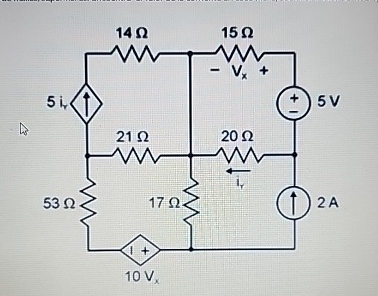 140 150
sid @® 5V.
5
E JE 3
10V,
This is AI generated Response.
Asked by: Alok Kumar
Created at: 2026-01-28 04:55:14
Asked by: Alok Kumar
Created at: 2026-01-28 04:55:14
Final Answer:
Rendered
Raw Text
Did you like this answer?
Absolutely! Let's break down the circuit step by step so you can understand how to approach it.
---
# **Step-by-Step Explanation**
## **1. Identify Key Elements**
- **Resistors:** 14Ω, 15Ω, 21Ω, 20Ω, 53Ω, 17Ω
- **Independent Sources:**
- Voltage source: 5V
- Current source: 2A
- **Dependent Sources:**
- Current source: \( 5i_x \) (left side)
- Voltage source: \( 10V_x \) (bottom left)
- **Variables:**
- \( i_x \): The current through the 20Ω resistor (as indicated by the direction arrow)
- \( V_x \): The voltage across the 15Ω resistor (marked \( -V_x \) and \( +V_x \) at the ends)
---
## **2. Assign Node Voltages**
Let's assign some node voltages for easier analysis using **nodal analysis**.
- **Top Node (A):** Let's call this \( V_A \)
- **Middle Node (B):** Let's call this \( V_B \)
- **Bottom Node (Ground):** Reference node, \( V = \)
- **Right Node (C, after 20Ω):** Let's call this \( V_C \)
---
## **3. Express Controlled Sources**
- The **current source \( 5i_x \)** is controlled by the current \( i_x \) (the current through the 20Ω resistor).
- The **voltage source \( 10V_x \)** is controlled by the voltage across the 15Ω resistor.
---
## **4. Write Equations (KCL)**
### **At Node A:**
Sum the currents leaving node A:
\[
\frac{V_A - }{14} + \frac{V_A - V_B}{21} + \frac{V_A - V_C}{15} =
\]
But, due to controlled sources, you may need to include their effects directly.
### **At Node B:**
\[
\frac{V_B - V_A}{21} + \frac{V_B - }{53} + \frac{V_B - V_C}{17} + \text{(current from dependent source)} =
\]
### **At Node C:**
\[
\frac{V_C - V_A}{15} + \frac{V_C - V_B}{17} + \frac{V_C - }{20} = 2
\]
(The 2A is a current source into node C.)
---
## **5. Relate Controlled Sources**
- **For \( i_x \):**
\( i_x = \frac{V_C - }{20} \) (current through the 20Ω resistor)
- **For \( V_x \):**
\( V_x = V_A - V_C \) (voltage across the 15Ω resistor)
- **For the dependent sources:**
- The **current source \( 5i_x \)** injects current into the node above the 21Ω resistor.
- The **voltage source \( 10V_x \)** is between ground and the bottom left node (below 53Ω resistor).
---
## **6. Solving the Circuit**
- Use **nodal analysis** to write KCL for each node.
- Substitute the expressions for the dependent sources.
- You'll end up with a system of equations in terms of \( V_A, V_B, V_C \), \( i_x \), and \( V_x \).
- Solve the equations simultaneously.
---
## **Summary of Steps**
1. **Label nodes and variables.**
2. **Write KCL for each node.**
3. **Express dependent sources using controlling variables (\( i_x \), \( V_x \)).**
4. **Solve the resulting system of equations.**
---
## **If You Want to Solve for a Specific Value**
Let me know if you want to find a specific value (e.g., \( i_x \), \( V_x \), or voltage at a certain node), and I’ll guide you through the exact steps and equations!
---
**Let me know what part you want to focus on or if you want a worked example for solving the circuit!**
📢 Instructions:
- Ask anything relatd to above question only.
- For new Question goto :