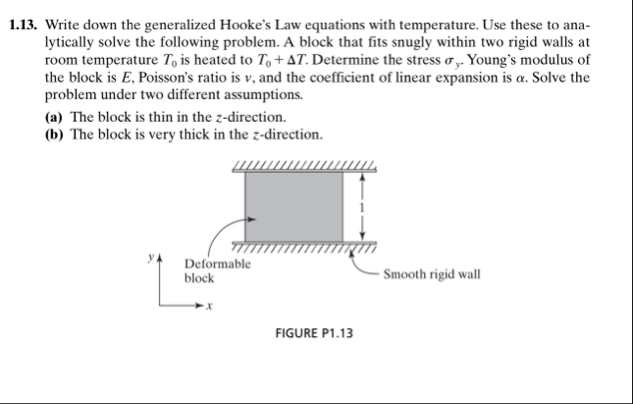
Act like a helpful tutor and exlain me :113. Write down the generalized Hooke's Law cquations with temperature. Use these to ana-
Iytically solve the following problem. A block that fits snugly within two rigid walls at
room temperature 7, s heated to 7, + AT: Determine the stress o,. Young's modulus of
the block is E. Poissons rato is v, and the coefficient of linear expansion is a. Solve the
problem under two different assumptions.
(®) The block is thin in the direction.
(b) The block is very thick in the z-direction.
7 i
B 7
formabl
Dhcigrmatle Smooth rigid wall
x
FIGURE P1.13
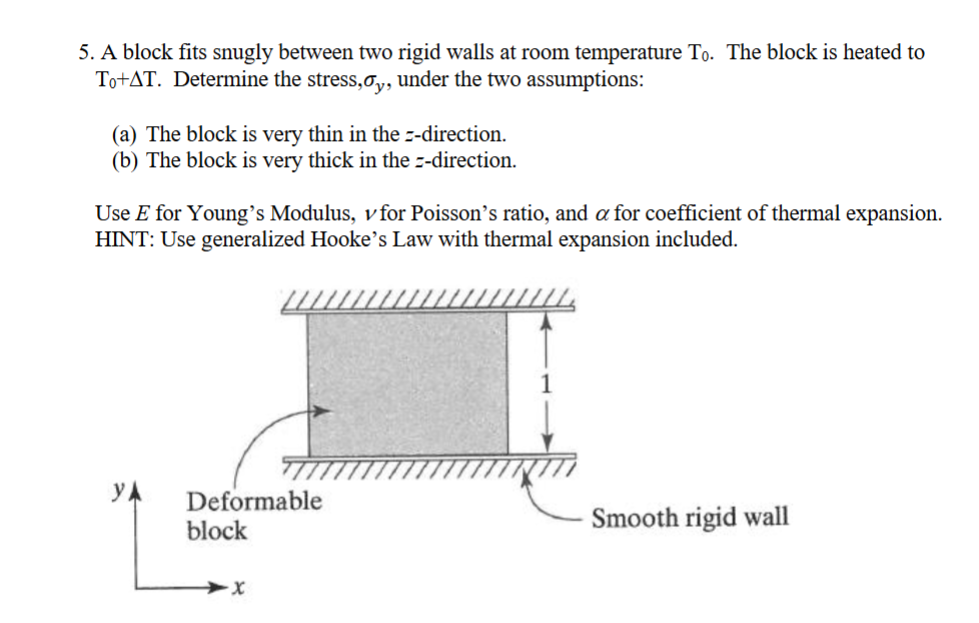
5. A block fits snugly between two rigid walls at room temperature To. The block is heated to
Tot+AT. Determine the stress,y,, under the two assumptions:
(a) The block is very thin in the z-direction.
(b) The block is very thick in the z-direction.
Use E for Young’s Modulus, v for Poisson’s ratio, and « for coefficient of thermal expansion.
HINT: Use generalized Hooke’s Law with thermal expansion included.
1
/
y Deformable way
block Smooth rigid wall
x
Question:
Act like a helpful tutor and exlain me :113. Write down the generalized Hooke's Law cquations with temperature. Use these to ana-
Iytically solve the following problem. A block that fits snugly within two rigid walls at
room temperature 7, s heated to 7, + AT: Determine the stress o,. Young's modulus of
the block is E. Poissons rato is v, and the coefficient of linear expansion is a. Solve the
problem under two different assumptions.
(®) The block is thin in the direction.
(b) The block is very thick in the z-direction.
7 i
B 7
formabl
Dhcigrmatle Smooth rigid wall
x
FIGURE P1.13
5. A block fits snugly between two rigid walls at room temperature To. The block is heated to
Tot+AT. Determine the stress,y,, under the two assumptions:
(a) The block is very thin in the z-direction.
(b) The block is very thick in the z-direction.
Use E for Young’s Modulus, v for Poisson’s ratio, and « for coefficient of thermal expansion.
HINT: Use generalized Hooke’s Law with thermal expansion included.
1
/
y Deformable way
block Smooth rigid wall
x
This is AI generated Response.
Asked by: Alok Kumar
Created at: 2026-01-27 04:07:06
Final Answer:
RenderedRaw Text
Did you like this answer?
Let's break down the problem step by step:
---
# **Generalized Hooke’s Law with Temperature**
For a linear elastic isotropic material, the generalized Hooke’s Law including thermal effects is:
\[
\epsilon_{ij} = \frac{1+\nu}{E}\sigma_{ij} - \frac{\nu}{E}\delta_{ij}\sigma_{kk} + \alpha \Delta T \delta_{ij}
\]
where:
- \(\epsilon_{ij}\): Strain tensor components
- \(\sigma_{ij}\): Stress tensor components
- \(E\): Young's modulus
- \(\nu\): Poisson’s ratio
- \(\alpha\): Coefficient of linear expansion
- \(\Delta T\): Temperature change
- \(\delta_{ij}\): Kronecker delta (1 when \(i=j\), otherwise)
- \(\sigma_{kk}\): Sum of normal stresses (trace of the stress tensor)
---
# **Physical Setup**
- At \(T_\), the block fits exactly between the rigid walls.
- When heated to \(T_ + \Delta T\), the block wants to expand but is prevented by the walls, creating stress.
- We want to find the induced stress \(\sigma_y\) in the block under two cases.
---
## **Case (a): Block is Thin in the \(z\)-Direction**
### **Assumption:** Plane Stress Condition (\(\sigma_z = \))
#### **Step 1: Constraints**
- No expansion in the \(y\)-direction (between walls): \(\epsilon_y = \)
- Free in the \(z\)-direction: \(\sigma_z = \)
#### **Step 2: Write the Strain Equation**
For the \(y\)-direction:
\[
\epsilon_y = \frac{1}{E} (\sigma_y - \nu \sigma_x) + \alpha \Delta T
\]
But since the block is free along \(x\): \(\sigma_x = \).
So,
\[
\epsilon_y = \frac{\sigma_y}{E} + \alpha \Delta T
\]
But the wall doesn't allow expansion:
\[
\epsilon_y =
\]
#### **Step 3: Solve for Stress**
\[
= \frac{\sigma_y}{E} + \alpha \Delta T
\]
\[
\sigma_y = -E \alpha \Delta T
\]
**Interpretation**: The stress is compressive since the block wants to expand but is restrained.
---
## **Case (b): Block is Very Thick in the \(z\)-Direction**
### **Assumption:** Plane Strain Condition (\(\epsilon_z = \))
#### **Step 1: Constraints**
- No expansion in the \(y\)-direction: \(\epsilon_y = \)
- No expansion in the \(z\)-direction: \(\epsilon_z = \)
#### **Step 2: Write Strain Equations**
\[
\epsilon_y = \frac{1}{E}[\sigma_y - \nu (\sigma_x + \sigma_z)] + \alpha \Delta T
\]
\[
\epsilon_z = \frac{1}{E}[\sigma_z - \nu (\sigma_x + \sigma_y)] + \alpha \Delta T
\]
But block is free along \(x\): \(\sigma_x = \).
So:
\[
\epsilon_y = \frac{1}{E}(\sigma_y - \nu \sigma_z) + \alpha \Delta T
\]
\[
\epsilon_z = \frac{1}{E}(\sigma_z - \nu \sigma_y) + \alpha \Delta T
\]
#### **Step 3: Apply Constraints**
\[
\epsilon_y = \implies \frac{\sigma_y - \nu \sigma_z}{E} + \alpha \Delta T =
\]
\[
\epsilon_z = \implies \frac{\sigma_z - \nu \sigma_y}{E} + \alpha \Delta T =
\]
#### **Step 4: Solve Simultaneous Equations**
Write both:
\[
\sigma_y - \nu \sigma_z = -E \alpha \Delta T \quad (1)
\]
\[
\sigma_z - \nu \sigma_y = -E \alpha \Delta T \quad (2)
\]
Multiply (1) by \(\nu\):
\[
\nu \sigma_y - \nu^2 \sigma_z = -\nu E \alpha \Delta T
\]
Add to (2):
\[
(\sigma_z - \nu \sigma_y) + (\nu \sigma_y - \nu^2 \sigma_z) = -E \alpha \Delta T - \nu E \alpha \Delta T
\]
\[
\sigma_z - \nu^2 \sigma_z = -(1+\nu) E \alpha \Delta T
\]
\[
\sigma_z (1 - \nu^2) = -(1+\nu) E \alpha \Delta T
\]
\[
\sigma_z = -\frac{(1+\nu)}{1-\nu^2} E \alpha \Delta T
\]
Now substitute \(\sigma_z\) into (1):
\[
\sigma_y - \nu \left[-\frac{(1+\nu)}{1-\nu^2} E \alpha \Delta T\right] = -E \alpha \Delta T
\]
\[
\sigma_y + \frac{\nu (1+\nu)}{1-\nu^2} E \alpha \Delta T = -E \alpha \Delta T
\]
\[
\sigma_y = -E \alpha \Delta T - \frac{\nu (1+\nu)}{1-\nu^2} E \alpha \Delta T
\]
\[
\sigma_y = -E \alpha \Delta T \left[ 1 + \frac{\nu (1+\nu)}{1-\nu^2} \right]
\]
\[
\sigma_y = -E \alpha \Delta T \left[ \frac{1-\nu^2 + \nu(1+\nu)}{1-\nu^2} \right]
\]
\[
1 - \nu^2 + \nu + \nu^2 = 1 + \nu
\]
\[
\sigma_y = -E \alpha \Delta T \left( \frac{1+\nu}{1-\nu} \right)
\]
---
# **Summary of Results**
| Case | Stress, \(\sigma_y\) |
|------|----------------------|
| (a) Thin in \(z\) | \(-E \alpha \Delta T\) |
| (b) Thick in \(z\) | \(-E \alpha \Delta T \left(\frac{1+\nu}{1-\nu}\right)\) |
---
## **Physical Meaning**
- **Case (a):** Only direct restraint in the \(y\)-direction, so stress is simply the negative of what thermal strain would have been.
- **Case (b):** Block is also restrained in \(z\), so Poisson effect adds to the restraint, increasing the stress.
---
## **If you need the full derivations or have questions about each step, just ask!**
Question:
Final answer pls
This is AI generated Response.
Asked by: Alok Kumar
Created at: 2026-01-27 04:08:46
Final Answer:
RenderedRaw Text
Did you like this answer?
# **Final Answer: Stress Calculations from Thermal Expansion**
The stress \(\sigma_y\) induced in the block due to thermal expansion can be summarized as follows:
## **Results Summary**
| Case | Description | Stress, \(\sigma_y\) |
|------|---------------------------------|---------------------------------------------------------|
| (a) | Thin in \(z\)-direction | \(\sigma_y = -E \alpha \Delta T\) |
| (b) | Very thick in \(z\)-direction | \(\sigma_y = -E \alpha \Delta T \left(\frac{1+\nu}{1-\nu}\right)\) |
### **Key Variables:**
- \(E\): Young's modulus
- \(\nu\): Poisson's ratio
- \(\alpha\): Coefficient of linear expansion
- \(\Delta T\): Change in temperature
---
## **Interpretation of Results**
- **For Case (a)**: The stress is directly related to the thermal expansion in the \(y\)-direction, resulting in simple compression.
- **For Case (b)**: The stress is influenced by both the thermal expansion and the Poisson effect, leading to a more complex relationship due to the constraints in both \(y\) and \(z\) directions.
If you need further clarification on any specific part, feel free to ask!
VIPSolutions focuses on clear, step‑by‑step explanations so you can learn quickly. Whether you need an AI‑generated walkthrough or a short hint to get unstuck, each solution is organized for fast reading and easy review later.
Search similar questions, compare approaches, and bookmark the best answers for revision. Our goal is simple: quick, reliable study help that feels natural—not noisy.
 VIPSolutions
 113. Write down the generalized Hooke's Law cquations with temperature. Use these to ana-
Iytically solve the following problem. A block that fits snugly within two rigid walls at
room temperature 7, s heated to 7, + AT: Determine the stress o,. Young's modulus of
the block is E. Poissons rato is v, and the coefficient of linear expansion is a. Solve the
problem under two different assumptions.
(®) The block is thin in the direction.
(b) The block is very thick in the z-direction.
7 i
B 7
formabl
Dhcigrmatle Smooth rigid wall
x
FIGURE P1.13
5. A block fits snugly between two rigid walls at room temperature To. The block is heated to
Tot+AT. Determine the stress,y,, under the two assumptions:
(a) The block is very thin in the z-direction.
(b) The block is very thick in the z-direction.
Use E for Young’s Modulus, v for Poisson’s ratio, and « for coefficient of thermal expansion.
HINT: Use generalized Hooke’s Law with thermal expansion included.
1
/
y Deformable way
block Smooth rigid wall
x