 VIPSolutions
Act like a helpful tutor and exlain me :1. Why the ideal and the actual transfer functions are not identical for the system shown What should you consider then? F Reyer, Ju Vorage supply R - R2 nr Ul | 2. How many variance can be explained in a thermocouple sensor transfer function with coefficient of determination equal to 66% ? How much the noise here?
Question:
Act like a helpful tutor and exlain me :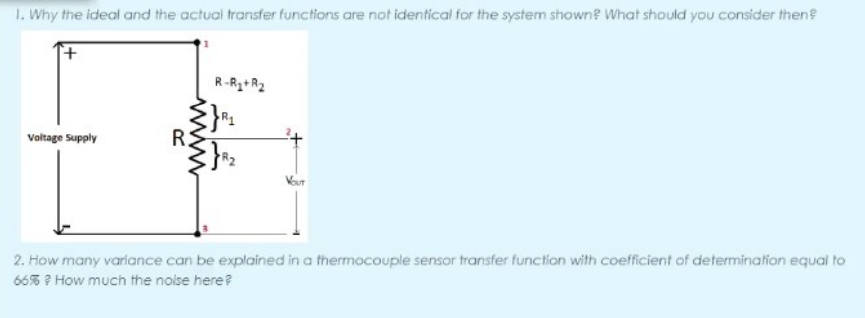 1. Why the ideal and the actual transfer functions are not identical for the system shown What should you consider then?
F
Reyer,
Ju
Vorage supply R -
R2
nr
Ul |
2. How many variance can be explained in a thermocouple sensor transfer function with coefficient of determination equal to
66% ? How much the noise here?
This is AI generated Response.
Asked by: Alok Kumar
Created at: 2026-01-28 16:57:19
Asked by: Alok Kumar
Created at: 2026-01-28 16:57:19
Final Answer:
Rendered
Raw Text
Did you like this answer?
Sure! Let’s break down each question step by step.
---
## 1. **Why are the ideal and actual transfer functions not identical for the system shown? What should you consider then?**
### **Explanation**
The circuit shown is a **voltage divider** using resistors \( R_1 \) and \( R_2 \). The **ideal transfer function** is derived assuming perfect conditions:
\[
V_{out,\, ideal} = V_{supply} \cdot \frac{R_2}{R_1 + R_2}
\]
However, in reality, **actual transfer function** can differ due to several non-ideal factors:
### **Reasons for Difference**
- **Tolerance of resistors:** Real resistors have manufacturing tolerances (e.g., ±1%, ±5%), affecting their actual resistance values.
- **Parasitic elements:** Wires and connections have small resistance, capacitance, and inductance that are not included in the ideal calculation.
- **Loading effect:** If a measuring instrument (like a voltmeter or ADC) is connected across \( R_2 \), it has its own input resistance, which forms a parallel resistance with \( R_2 \), altering the output voltage.
- **Temperature dependence:** The resistance of real resistors can change with temperature.
- **Noise and interference:** Electromagnetic interference or thermal noise can affect the measured output.
### **What to Consider**
- **Component tolerances:** Use precise resistors or account for their tolerance in calculations.
- **Loading effects:** Consider the input impedance of any connected measurement devices.
- **Environmental factors:** Take into account temperature and noise sources.
- **Calibration:** Regularly calibrate sensors and circuits to minimize errors.
---
## 2. **How much variance can be explained in a thermocouple sensor transfer function with a coefficient of determination equal to 66%? How much is noise here?**
### **Explanation**
- The **coefficient of determination** (\( R^2 \)) indicates how much of the variance in the output can be explained by the model.
- An \( R^2 \) value of **66%** means **66% of the output variance** is explained by the transfer function (the model).
- The remainder is **unexplained variance** (i.e., noise, unmodeled effects, or errors).
\[
\text{Explained variance} = R^2 = 66\%
\]
\[
\text{Unexplained variance (noise)} = 100\% - R^2 = 34\%
\]
### **Summary Table**
| Component | Percentage |
|--------------------|------------|
| Explained variance | 66% |
| Noise (unexplained) | 34% |
---
### **Key Points**
- Ideal and actual transfer functions differ due to real-world non-idealities.
- **Always consider** tolerances, loading effects, and environmental factors.
- With \( R^2 = 66\% \), **66%** of variance is explained, **34%** is noise.
Let me know if you need more detail on any part!
📢 Instructions:
- Ask anything relatd to above question only.
- For new Question goto :