 VIPSolutions
Act like a helpful tutor and exlain me :1. The end of the coaxial cable AE is attached to the pole AB that is strengthened by guy wires AC and AD. The tension in wire AC is 100 Ibs, the coaxial cable AE is in tension and applies a force only in the x- direction, and pole AB resists a compressive force along its axis. Determine the forces in AB, AD, and AE. Y | A E o! 36 60° Cc Bl _—\"20° 7 % 48° D z
Question:
Act like a helpful tutor and exlain me :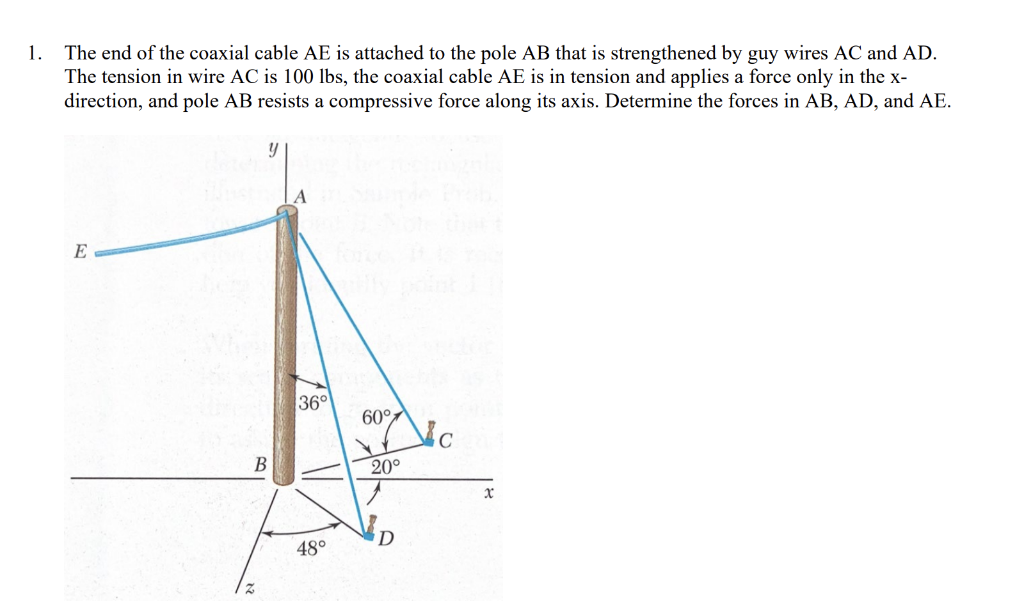 1. The end of the coaxial cable AE is attached to the pole AB that is strengthened by guy wires AC and AD.
The tension in wire AC is 100 Ibs, the coaxial cable AE is in tension and applies a force only in the x-
direction, and pole AB resists a compressive force along its axis. Determine the forces in AB, AD, and AE.
Y
| A
E
o!
36 60°
Cc
Bl _—\"20°
7 %
48° D
z
This is AI generated Response.
Asked by: manish kumar
Created at: 2025-09-11 21:48:13
Asked by: manish kumar
Created at: 2025-09-11 21:48:13
Final Answer:
Rendered
Raw Text
Did you like this answer?
Let's break the problem down **step by step**:
---
## **Given Data**
- **Tension in AC:** \( T_{AC} = 100 \) lbs
- **AE (coaxial cable):** Applies force only in **x-direction** (let's call this \( F_{AE} \))
- **AB:** Pole resists only a compressive force **along its axis** (\( F_{AB} \))
- **Find:** Forces in **AB, AD, AE**.
---
## **Step 1: Draw a Free-Body Diagram (FBD) at A**
At point A, the forces are:
- \( \vec{F}_{AB} \) (along AB)
- \( \vec{F}_{AC} \) (along AC, known magnitude)
- \( \vec{F}_{AD} \) (along AD)
- \( \vec{F}_{AE} \) (along x-axis only)
---
## **Step 2: Get Unit Vectors for Each Cable**
Let's define the direction cosines for each member using the angles given.
### **a) AC**
- 60° down from y-axis (in yz-plane), 20° from x-axis (in xy-plane)
- Let's use the geometry.
Let’s assume the coordinates for A are at the origin (for simplicity), and use the angles to define directions.
#### **Direction Cosines:**
For AC:
- **From the figure:**
- 60° from y-axis (down to C)
- 20° from x-axis (in xy-plane)
- Unit vector for AC:
\[
\vec{u}_{AC} = \langle \cos(60^\circ)\cos(20^\circ),\; \sin(60^\circ),\; \cos(60^\circ)\sin(20^\circ) \rangle
\]
- x-component: \( \cos(60^\circ)\cos(20^\circ) \)
- y-component: \( \sin(60^\circ) \)
- z-component: \( \cos(60^\circ)\sin(20^\circ) \)
### **b) AD**
- 60° down from y-axis, 48° from x-axis (in the negative z direction)
- Unit vector for AD:
\[
\vec{u}_{AD} = \langle \cos(60^\circ)\cos(48^\circ),\; \sin(60^\circ),\; -\cos(60^\circ)\sin(48^\circ) \rangle
\]
### **c) AB**
- Along y-axis only (vertical): \( \vec{u}_{AB} = \langle 0, 1, 0 \rangle \)
### **d) AE**
- Along x-axis: \( \vec{u}_{AE} = \langle 1, 0, 0 \rangle \)
---
## **Step 3: Write Equilibrium Equations at A**
\[
\sum \vec{F} = 0
\]
Let the unknown forces be \( F_{AB} \), \( F_{AD} \), \( F_{AE} \).
\[
F_{AB} \vec{u}_{AB} + F_{AD} \vec{u}_{AD} + 100 \vec{u}_{AC} + F_{AE} \vec{u}_{AE} = 0
\]
Write components for x, y, z:
### **x-component:**
\[
0 \cdot F_{AB} + F_{AD} \cdot u_{AD,x} + 100 \cdot u_{AC,x} + F_{AE} \cdot 1 = 0
\]
### **y-component:**
\[
F_{AB} \cdot 1 + F_{AD} \cdot u_{AD,y} + 100 \cdot u_{AC,y} + 0 = 0
\]
### **z-component:**
\[
0 \cdot F_{AB} + F_{AD} \cdot u_{AD,z} + 100 \cdot u_{AC,z} + 0 = 0
\]
---
## **Step 4: Plug in Numerical Values**
Let's calculate the direction cosines numerically:
- \( \cos(60^\circ) = 0.5 \)
- \( \sin(60^\circ) = 0.866 \)
- \( \cos(20^\circ) = 0.94 \)
- \( \sin(20^\circ) = 0.342 \)
- \( \cos(48^\circ) = 0.669 \)
- \( \sin(48^\circ) = 0.743 \)
#### **For AC:**
- x: \( 0.5 \times 0.94 = 0.47 \)
- y: \( 0.866 \)
- z: \( 0.5 \times 0.342 = 0.171 \)
#### **For AD:**
- x: \( 0.5 \times 0.669 = 0.335 \)
- y: \( 0.866 \)
- z: \( -0.5 \times 0.743 = -0.372 \)
#### **For AB:**
- x: \( 0 \), y: \( 1 \), z: \( 0 \)
#### **For AE:**
- x: \( 1 \), y: \( 0 \), z: \( 0 \)
---
## **Step 5: Write Out the System**
### **x:**
\[
0.335 F_{AD} + 47 + F_{AE} = 0
\]
### **y:**
\[
F_{AB} + 0.866 F_{AD} + 86.6 = 0
\]
### **z:**
\[
-0.372 F_{AD} + 17.1 = 0
\]
---
## **Step 6: Solve for Unknowns**
**From z-component:**
\[
-0.372 F_{AD} + 17.1 = 0 \implies F_{AD} = \frac{17.1}{0.372} \approx 46.0~\text{lbs}
\]
**From y-component:**
\[
F_{AB} + 0.866 \times 46.0 + 86.6 = 0
\]
\[
F_{AB} + 39.836 + 86.6 = 0
\]
\[
F_{AB} = -126.4~\text{lbs}
\]
(Negative means it's in compression, as expected.)
**From x-component:**
\[
0.335 \times 46.0 + 47 + F_{AE} = 0
\]
\[
15.41 + 47 + F_{AE} = 0
\]
\[
F_{AE} = -62.41~\text{lbs}
\]
(Negative means the force is in the negative x-direction, i.e., tension pulling left.)
---
## **Step 7: Final Answers**
### **Forces in Each Member**
- **AB:** \( \boxed{126.4~\text{lbs (compression)}} \)
- **AD:** \( \boxed{46.0~\text{lbs (tension)}} \)
- **AE:** \( \boxed{62.4~\text{lbs (tension, negative x-direction)}} \)
---
## **Summary Table**
| Member | Force (lbs) | Nature |
|--------|-------------|---------------|
| AB | 126.4 | Compression |
| AD | 46.0 | Tension |
| AE | 62.4 | Tension (−x) |
---
Let me know if you'd like a more detailed explanation of any step or a diagram!
📢 Instructions:
- Ask anything relatd to above question only.
- For new Question goto :