 VIPSolutions
Act like a helpful tutor and exlain me :1. Problem 1 Define as follows: 10 2 1 [ssl=1[0 1 2, [a]=|2|. 30 3 3, Evaluate the following: (a) si (b) sijsij (€) sjkskj (d) amam (€) SmnGman
Question:
Act like a helpful tutor and exlain me :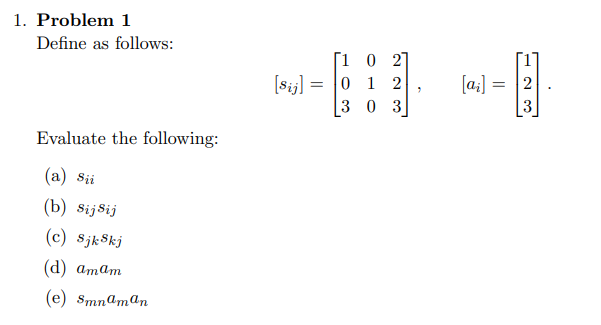 1. Problem 1
Define as follows:
10 2 1
[ssl=1[0 1 2, [a]=|2|.
30 3 3,
Evaluate the following:
(a) si
(b) sijsij
(€) sjkskj
(d) amam
(€) SmnGman
This is AI generated Response.
Asked by: Alok Kumar
Created at: 2026-01-27 03:35:31
Asked by: Alok Kumar
Created at: 2026-01-27 03:35:31
Final Answer:
Rendered
Raw Text
Did you like this answer?
Let's break down each part step by step.
We are given:
\[
[s_{ij}] = \begin{bmatrix}
1 & & 2 \\
& 1 & 2 \\
3 & & 3
\end{bmatrix}, \quad
[a_i] = \begin{bmatrix}
1 \\
2 \\
3
\end{bmatrix}
\]
Let’s evaluate each item:
---
## (a) \( s_{ii} \)
This means the **diagonal elements** of \( s_{ij} \):
- \( s_{11} = 1 \)
- \( s_{22} = 1 \)
- \( s_{33} = 3 \)
### **Answer:**
\( s_{ii} = \{1,\, 1,\, 3\} \)
---
## (b) \( s_{ij} s_{ij} \)
This means **sum over all \(i\) and \(j\)** of the squares of each entry:
\[
s_{ij} s_{ij} = \sum_{i=1}^3 \sum_{j=1}^3 (s_{ij})^2
\]
Calculate each entry squared and sum:
\[
\begin{align*}
\text{Row 1: } & 1^2,\, ^2,\, 2^2 \rightarrow 1 + + 4 = 5 \\
\text{Row 2: } & ^2,\, 1^2,\, 2^2 \rightarrow + 1 + 4 = 5 \\
\text{Row 3: } & 3^2,\, ^2,\, 3^2 \rightarrow 9 + + 9 = 18 \\
\end{align*}
\]
Sum: \( 5 + 5 + 18 = 28 \)
### **Answer:**
\( s_{ij} s_{ij} = 28 \)
---
## (c) \( s_{jk} s_{kj} \)
This is \(\sum_{j=1}^3 \sum_{k=1}^3 s_{jk} s_{kj}\), or the sum of each entry times its transpose entry:
\[
\sum_{j,k} s_{jk} s_{kj}
\]
Let's list all pairs:
- For (1,1): \(s_{11} s_{11}\)
- For (1,2): \(s_{12} s_{21}\)
- For (1,3): \(s_{13} s_{31}\)
- For (2,1): \(s_{21} s_{12}\)
- For (2,2): \(s_{22} s_{22}\)
- For (2,3): \(s_{23} s_{32}\)
- For (3,1): \(s_{31} s_{13}\)
- For (3,2): \(s_{32} s_{23}\)
- For (3,3): \(s_{33} s_{33}\)
Now substitute the values:
\[
\begin{align*}
s_{11}s_{11} &= 1 \times 1 = 1 \\
s_{12}s_{21} &= \times = \\
s_{13}s_{31} &= 2 \times 3 = 6 \\
s_{21}s_{12} &= \times = \\
s_{22}s_{22} &= 1 \times 1 = 1 \\
s_{23}s_{32} &= 2 \times = \\
s_{31}s_{13} &= 3 \times 2 = 6 \\
s_{32}s_{23} &= \times 2 = \\
s_{33}s_{33} &= 3 \times 3 = 9 \\
\end{align*}
\]
Sum: \( 1 + + 6 + + 1 + + 6 + + 9 = 23 \)
### **Answer:**
\( s_{jk} s_{kj} = 23 \)
---
## (d) \( a_m a_m \)
This is the sum of the squares of all elements in \( a_i \):
\[
a_m a_m = \sum_{m=1}^3 (a_m)^2 = 1^2 + 2^2 + 3^2 = 1 + 4 + 9 = 14
\]
### **Answer:**
\( a_m a_m = 14 \)
---
## (e) \( s_{mn} a_m a_n \)
This is a **quadratic form**: \( a^T S a \)
\[
s_{mn} a_m a_n = \sum_{m=1}^3 \sum_{n=1}^3 s_{mn} a_m a_n
\]
Let's compute this step by step:
First, write values:
- \( a = \begin{bmatrix}1\\2\\3\end{bmatrix} \)
- \( S = \begin{bmatrix}1 & & 2 \\ & 1 & 2 \\ 3 & & 3 \end{bmatrix} \)
Compute \( S a \):
\[
S a = \begin{bmatrix}
1 \times 1 + \times 2 + 2 \times 3 \\
\times 1 + 1 \times 2 + 2 \times 3 \\
3 \times 1 + \times 2 + 3 \times 3
\end{bmatrix}
=
\begin{bmatrix}
1 + + 6 \\
+ 2 + 6 \\
3 + + 9
\end{bmatrix}
=
\begin{bmatrix}
7 \\
8 \\
12
\end{bmatrix}
\]
Now, \( a^T (Sa) = 1 \times 7 + 2 \times 8 + 3 \times 12 = 7 + 16 + 36 = 59 \)
### **Answer:**
\( s_{mn} a_m a_n = 59 \)
---
## **Summary Table**
| Part | Expression | Value |
|------|-----------------------|--------|
| (a) | \( s_{ii} \) | \( \{1, 1, 3\} \) |
| (b) | \( s_{ij} s_{ij} \) | \( 28 \) |
| (c) | \( s_{jk} s_{kj} \) | \( 23 \) |
| (d) | \( a_m a_m \) | \( 14 \) |
| (e) | \( s_{mn} a_m a_n \) | \( 59 \) |
If you have questions about any step, let me know!
📢 Instructions:
- Ask anything relatd to above question only.
- For new Question goto :