 VIPSolutions
Act like a helpful tutor and exlain me :1. Joint Distribution (Advanced) Let the joint pdf of random variables X and ¥ be Jey) =k’ +4), 0
Question:
Act like a helpful tutor and exlain me :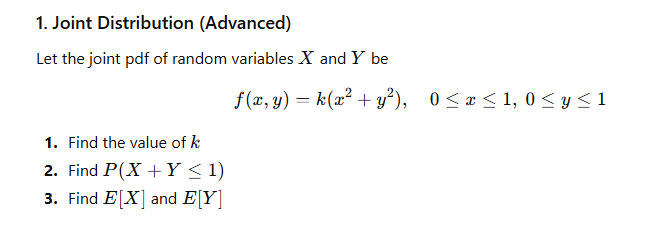 1. Joint Distribution (Advanced)
Let the joint pdf of random variables X and ¥ be
Jey) =k’ +4), 0
This is AI generated Response.
Asked by: Alok Kumar
Created at: 2026-02-02 10:56:17
Asked by: Alok Kumar
Created at: 2026-02-02 10:56:17
Final Answer:
Rendered
Raw Text
Did you like this answer?
Sure! Let's tackle each part step by step.
---
## 1. **Find the value of \( k \)**
The joint pdf must integrate to 1 over the entire support:
\[
\int_^1 \int_^1 k(x^2 + y^2) \, dx \, dy = 1
\]
Let’s compute the integral:
\[
\int_^1 \int_^1 (x^2 + y^2) \, dx \, dy = \int_^1 \left[ \int_^1 x^2 \, dx + \int_^1 y^2 \, dx \right] dy
\]
But \(\int_^1 y^2 \, dx = y^2 \cdot \int_^1 dx = y^2 \cdot (1-) = y^2\).
So:
\[
\int_^1 \int_^1 (x^2 + y^2) dx\,dy = \int_^1 \left( \int_^1 x^2 dx + y^2 \right) dy
\]
Calculate \(\int_^1 x^2 dx = \frac{1}{3}\):
\[
= \int_^1 \left(\frac{1}{3} + y^2\right) dy = \frac{1}{3} \int_^1 dy + \int_^1 y^2 dy = \frac{1}{3}(1) + \left[\frac{y^3}{3}\right]_^1 = \frac{1}{3} + \frac{1}{3} = \frac{2}{3}
\]
So,
\[
k \cdot \frac{2}{3} = 1 \implies k = \frac{3}{2}
\]
---
## 2. **Find \(P(X + Y \leq 1)\)**
We want:
\[
P(X+Y \leq 1) = \int_^1 \int_^{1-y} k(x^2 + y^2) dx\,dy
\]
Plug in \( k = \frac{3}{2} \):
\[
= \frac{3}{2} \int_^1 \int_^{1-y} (x^2 + y^2) dx\,dy
\]
Evaluate the inner integral:
\[
\int_^{1-y} (x^2 + y^2) dx = \int_^{1-y} x^2 dx + \int_^{1-y} y^2 dx
= \left[\frac{x^3}{3}\right]_^{1-y} + y^2[x]_^{1-y}
= \frac{(1-y)^3}{3} + y^2(1-y)
\]
Now, integrate with respect to \( y \):
\[
P = \frac{3}{2} \int_^1 \left[\frac{(1-y)^3}{3} + y^2(1-y)\right] dy
\]
Expand:
\[
= \frac{3}{2} \int_^1 \left( \frac{(1-y)^3}{3} + y^2 - y^3 \right) dy
\]
\[
= \frac{3}{2} \left[ \frac{1}{3}\int_^1 (1-y)^3 dy + \int_^1 y^2 dy - \int_^1 y^3 dy \right]
\]
Compute each term:
- \(\int_^1 (1-y)^3 dy = \left[\frac{(1-y)^4}{-4}\right]_^1 = \left(\frac{}{-4}\right) - \left(\frac{1}{-4}\right) = \frac{1}{4}\)
- \(\int_^1 y^2 dy = \frac{1}{3}\)
- \(\int_^1 y^3 dy = \frac{1}{4}\)
So:
\[
P = \frac{3}{2} \left[ \frac{1}{3} \cdot \frac{1}{4} + \frac{1}{3} - \frac{1}{4} \right] = \frac{3}{2} \left( \frac{1}{12} + \frac{1}{3} - \frac{1}{4} \right)
\]
Get common denominator (12):
\[
\frac{1}{12} + \frac{4}{12} - \frac{3}{12} = \frac{2}{12} = \frac{1}{6}
\]
\[
P = \frac{3}{2} \cdot \frac{1}{6} = \frac{1}{4}
\]
---
## 3. **Find \( E[X] \) and \( E[Y] \)**
By symmetry, both will be the same.
\[
E[X] = \int_^1\int_^1 x f(x,y) dx dy = \int_^1\int_^1 x \cdot k(x^2 + y^2) dx dy
\]
Plug \(k = \frac{3}{2}\):
\[
= \frac{3}{2} \int_^1\int_^1 x(x^2 + y^2) dx dy
= \frac{3}{2} \int_^1\int_^1 (x^3 + x y^2) dx dy
\]
Let’s split and solve:
- \(\int_^1 x^3 dx = \frac{1}{4}\)
- \(\int_^1 x dx = \frac{1}{2}\)
- \(\int_^1 y^2 dy = \frac{1}{3}\)
So,
\[
\int_^1 (x^3 + x y^2) dx = \frac{1}{4} + y^2 \cdot \frac{1}{2}
\]
Now integrate over \(y\):
\[
E[X] = \frac{3}{2} \int_^1 \left( \frac{1}{4} + \frac{y^2}{2} \right) dy = \frac{3}{2} \left[ \frac{1}{4} \cdot 1 + \frac{1}{2} \cdot \frac{1}{3} \right] = \frac{3}{2} \left( \frac{1}{4} + \frac{1}{6} \right)
\]
\[
= \frac{3}{2} \cdot \frac{5}{12} = \frac{15}{24} = \frac{5}{8}
\]
Similarly, \(E[Y] = \frac{5}{8}\) due to symmetry.
---
## **Summary of Answers**
1. **\( k = \frac{3}{2} \)**
2. **\( P(X+Y \leq 1) = \frac{1}{4} \)**
3. **\( E[X] = E[Y] = \frac{5}{8} \)**
If you need any step explained further, let me know!
📢 Instructions:
- Ask anything relatd to above question only.
- For new Question goto :