VIPSolutions logo ✨ VIPSolutions

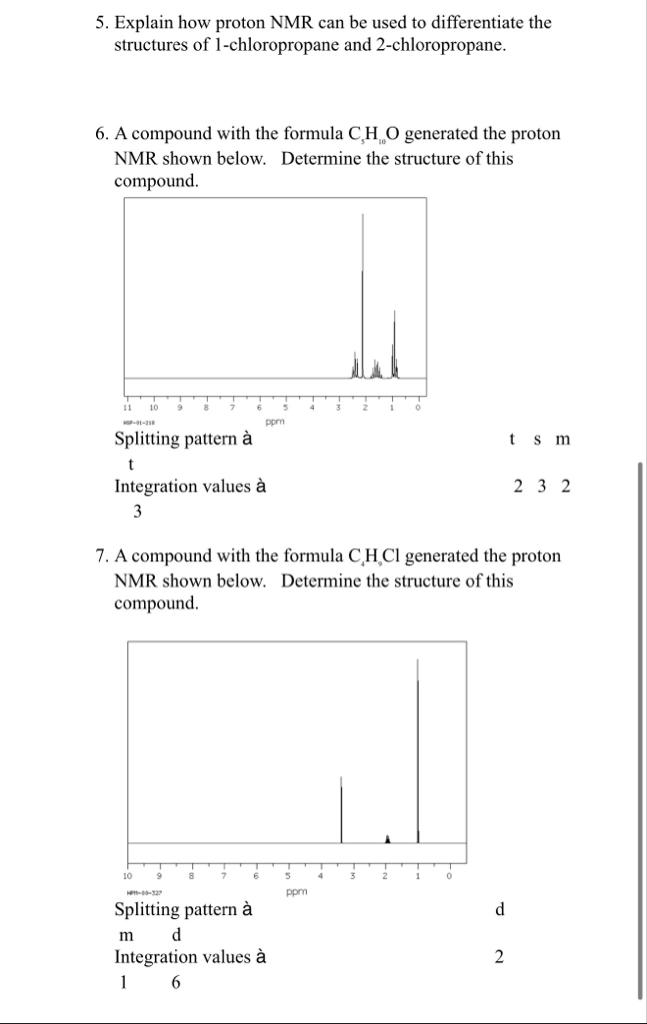
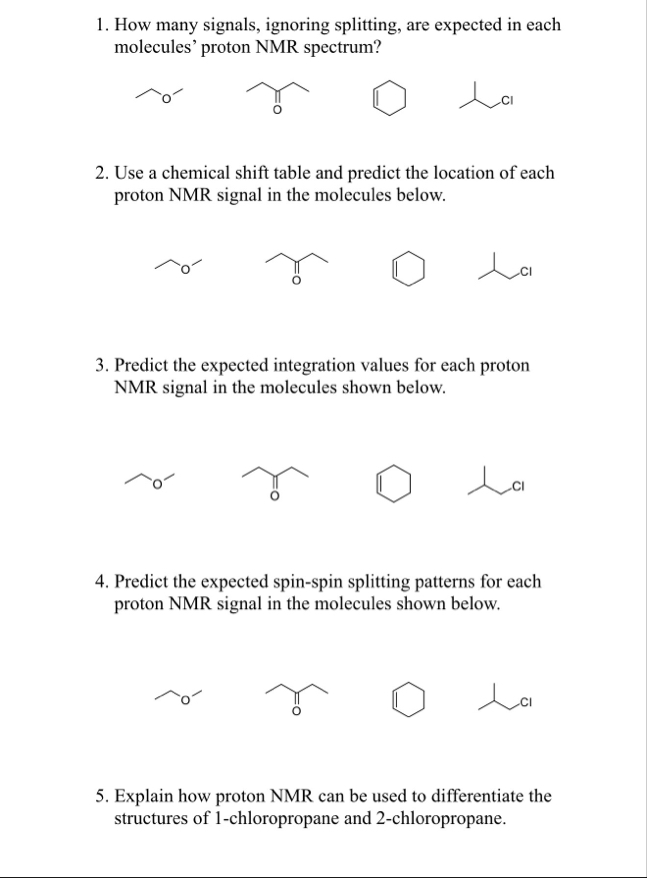
Act like a helpful tutor and exlain me :1. How many signals, ignoring splitting, are expected in cach molecules’ proton NMR spectrum? ~~ Be QO Ka 2. Use a chemical shift table and predict the location of each proton NMR signal in the molecules below. ~~ 0 A 3. Predict the expected integration values for each proton NMR signal in the molecules shown below. “So” 2% 0 Aa 4. Predict the expected spin-spin splitting patterns for each proton NMR signal in the molecules shown below. ~ © rT 0 ke 5. Explain how proton NMR can be used to differentiate the structures of 1-chloropropane and 2-chloropropane. 5. Explain how proton NMR can be used to differentiate the structures of 1-chloropropane and 2-chloropropane. 6. A compound with the formula CH O generated the proton NMR shown below. Determine the structure of this compound. Splitting pattern & i t sm t Integration values & 232 3 7. A compound with the formula C H C1 generated the proton NMR shown below. Determine the structure of this compound. | nN EERE RE REDE REDE BEBE Splitting pattern & d m d Integration values a 2 1 6

Question:

Act like a helpful tutor and exlain me :Uploaded ImageUploaded Image1. How many signals, ignoring splitting, are expected in cach molecules’ proton NMR spectrum? ~~ Be QO Ka 2. Use a chemical shift table and predict the location of each proton NMR signal in the molecules below. ~~ 0 A 3. Predict the expected integration values for each proton NMR signal in the molecules shown below. “So” 2% 0 Aa 4. Predict the expected spin-spin splitting patterns for each proton NMR signal in the molecules shown below. ~ © rT 0 ke 5. Explain how proton NMR can be used to differentiate the structures of 1-chloropropane and 2-chloropropane. 5. Explain how proton NMR can be used to differentiate the structures of 1-chloropropane and 2-chloropropane. 6. A compound with the formula CH O generated the proton NMR shown below. Determine the structure of this compound. Splitting pattern & i t sm t Integration values & 232 3 7. A compound with the formula C H C1 generated the proton NMR shown below. Determine the structure of this compound. | nN EERE RE REDE REDE BEBE Splitting pattern & d m d Integration values a 2 1 6
This is AI generated Response.
Asked by: Alok Kumar
Created at: 2026-01-29 07:34:25

Final Answer:

Rendered Raw Text
Did you like this answer?
Absolutely! Let’s break down each question step by step. I’ll use clear explanations and organize answers for each part. --- # 1. **How many signals, ignoring splitting, are expected in each molecule’s proton NMR spectrum?** **a. Ethyl methyl ether (CH₃CH₂OCH₃):** - **Signals:** 3 - CH₃ (methyl, attached to O) - CH₂ (attached to O) - CH₃ (methyl, attached to CH₂) **b. 2-Butanone (CH₃COCH₂CH₃):** - **Signals:** 3 - CH₃ (adjacent to CO) - CH₂ (between CO and CH₃) - CH₃ (terminal) **c. Cyclohexane (C₆H₁₂):** - **Signals:** 1 (all hydrogens are equivalent due to rapid ring flipping) **d. Isopropyl chloride (CH₃)₂CHCl:** - **Signals:** 2 - CH₃ (two equivalent methyls) - CH (attached to Cl) --- # 2. **Predict the location of each proton NMR signal using a chemical shift table.** - **Ethyl methyl ether:** - OCH₃: ~3.3–3.5 ppm - OCH₂: ~3.3–4. ppm - CH₃ (ethyl): ~1.–1.2 ppm - **2-Butanone:** - CH₃ (COCH₃): ~2.1–2.5 ppm - CH₂ (COCH₂): ~2.3–2.7 ppm - CH₃ (terminal): ~.9–1. ppm - **Cyclohexane:** - All H: ~1.4–1.6 ppm - **Isopropyl chloride:** - CH (Cl): ~4.–4.5 ppm - CH₃: ~1.–1.2 ppm --- # 3. **Predict the expected integration values for each proton NMR signal.** - **Ethyl methyl ether:** - OCH₃: 3H - OCH₂: 2H - CH₃ (ethyl): 3H - **2-Butanone:** - CH₃ (COCH₃): 3H - CH₂: 2H - CH₃ (terminal): 3H - **Cyclohexane:** - All H: 12H - **Isopropyl chloride:** - CH (Cl): 1H - CH₃: 6H --- # 4. **Predicted spin-spin splitting patterns:** - **Ethyl methyl ether:** - OCH₃: singlet - OCH₂: quartet (from CH₃) - CH₃ (ethyl): triplet (from CH₂) - **2-Butanone:** - CH₃ (COCH₃): singlet - CH₂: quartet - CH₃ (terminal): triplet - **Cyclohexane:** - All H: singlet (in practice, sometimes broad) - **Isopropyl chloride:** - CH (Cl): septet (from 6H, two equivalent methyls) - CH₃: doublet (from CH) --- # 5. **How can proton NMR differentiate 1-chloropropane vs. 2-chloropropane?** - **1-Chloropropane:** - Three sets of protons, three signals - Splitting: triplet, sextet, doublet (due to CH₂, CH₂Cl, CH₃) - **2-Chloropropane:** - Two sets of protons, two signals - Splitting: septet (CH), doublet (CH₃, 6H) ### **Conclusion:** 1-chloropropane shows three signals; 2-chloropropane shows two. The splitting patterns are distinct due to the arrangement of protons. --- # 6. **Interpret the NMR for C₅H₁₀O:** - **Integration (2:3:2):** Suggests 7 protons, but formula is C₅H₁₀O, so one signal is overlapping. - **Splitting:** t (triplet), s (singlet), m (multiplet) - **Likely structure:** **2-pentanone** - CH₃-CH₂-CO-CH₂-CH₃ - NMR: Triplet (CH₃), singlet (COCH₂), multiplet (CH₂) --- # 7. **Interpret the NMR for C₂H₅Cl:** - **Integration (6:1:2):** Actually, the NMR shows a doublet (d), a multiplet (m), and another doublet (d) with integration 6 and 2. - **This matches:** **1,1-dichloroethane** or **ethyl chloride** - But with C₂H₅Cl: - CH₃-CH₂Cl - CH₃ (triplet), CH₂ (quartet) - So the NMR is for **ethyl chloride (chloroethane)** - CH₃ (triplet, 3H), CH₂ (quartet, 2H) --- ## **Summary Table** | Molecule | # Signals | Example Shifts (ppm) | Integration | Splitting | |----------------------|-----------|----------------------|-------------|-------------------| | Ethyl methyl ether | 3 | 3.3, 3.5, 1.2 | 3, 2, 3 | s, q, t | | 2-Butanone | 3 | 2.1, 2.3, 1. | 3, 2, 3 | s, q, t | | Cyclohexane | 1 | 1.5 | 12 | s | | Isopropyl chloride | 2 | 4.2, 1.1 | 1, 6 | septet, doublet | If you need more details or have a specific part you'd like to review, let me know!

📢 Instructions:

  • Ask anything relatd to above question only.
  • For new Question goto :

Study Help, Fast Answers

VIPSolutions focuses on clear, step‑by‑step explanations so you can learn quickly. Whether you need an AI‑generated walkthrough or a short hint to get unstuck, each solution is organized for fast reading and easy review later.

Search similar questions, compare approaches, and bookmark the best answers for revision. Our goal is simple: quick, reliable study help that feels natural—not noisy.