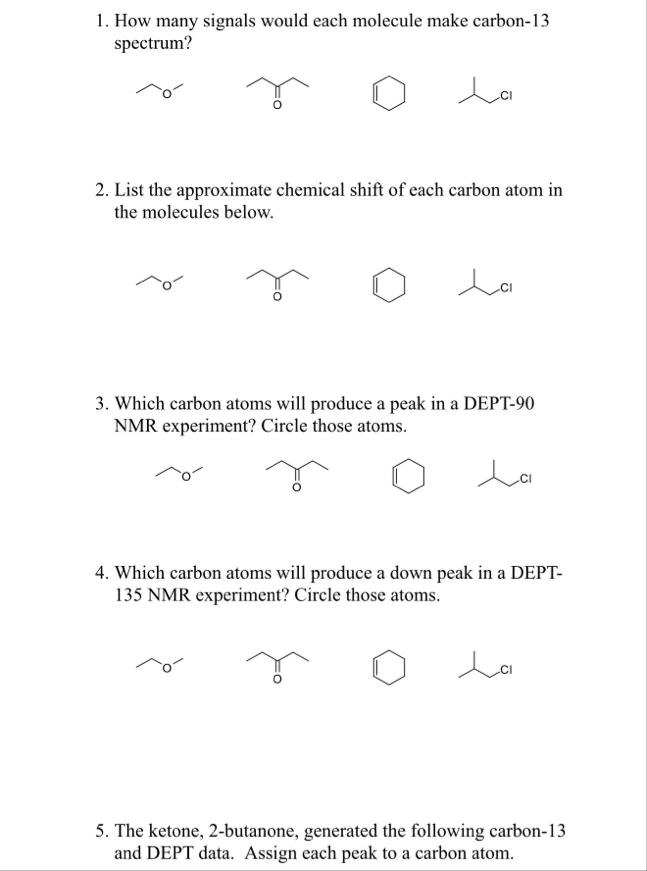
Act like a helpful tutor and exlain me :1. How many signals would each molecule make carbon-13
spectrum?
~ TO Ae
2. List the approximate chemical shift of each carbon atom in
the molecules below.
~ rT 0 Ae
3. Which carbon atoms will produce a peak in a DEPT-90
NMR experiment? Circle those atoms.
~~
cr 0
4. Which carbon atoms will produce a down peak in a DEPT-
135 NMR experiment? Circle those atoms.
~ TO Ae
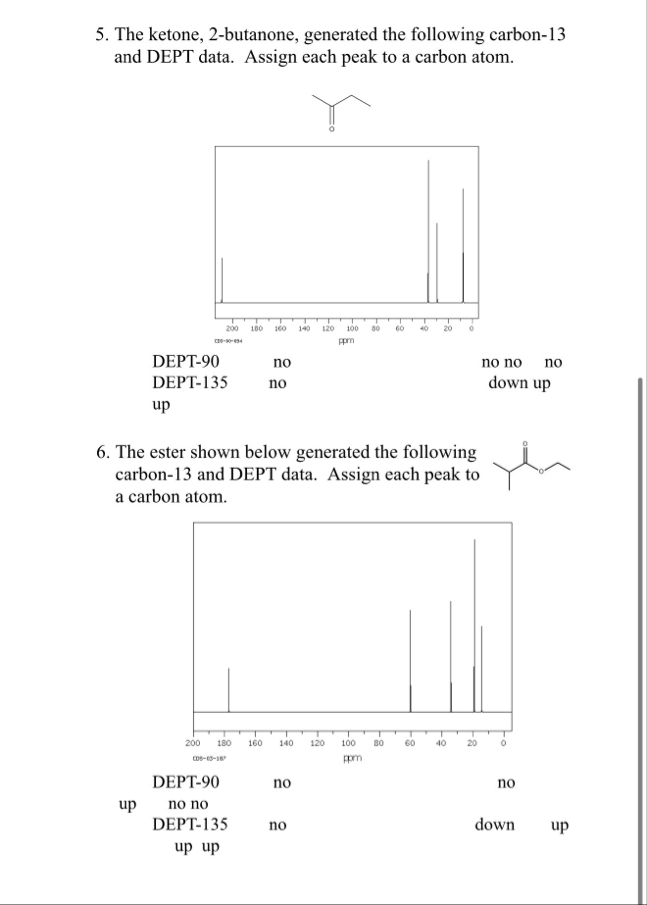
5. The ketone, 2-butanone, generated the following carbon-13
and DEPT data. Assign each peak to a carbon atom.
5. The ketone, 2-butanone, generated the following carbon-13
and DEPT data. Assign each peak to a carbon atom.
DEPT-90 no nono no
DEPT-135 no down up
up
6. The ester shown below generated the following i
carbon-13 and DEPT data. Assign each peak to oe
a carbon atom.
——— om
DEPT-90 no no
up nono
DEPT-135 no down up
up up
Question:
Act like a helpful tutor and exlain me :1. How many signals would each molecule make carbon-13
spectrum?
~ TO Ae
2. List the approximate chemical shift of each carbon atom in
the molecules below.
~ rT 0 Ae
3. Which carbon atoms will produce a peak in a DEPT-90
NMR experiment? Circle those atoms.
~~
cr 0
4. Which carbon atoms will produce a down peak in a DEPT-
135 NMR experiment? Circle those atoms.
~ TO Ae
5. The ketone, 2-butanone, generated the following carbon-13
and DEPT data. Assign each peak to a carbon atom.
5. The ketone, 2-butanone, generated the following carbon-13
and DEPT data. Assign each peak to a carbon atom.
DEPT-90 no nono no
DEPT-135 no down up
up
6. The ester shown below generated the following i
carbon-13 and DEPT data. Assign each peak to oe
a carbon atom.
——— om
DEPT-90 no no
up nono
DEPT-135 no down up
up up
This is AI generated Response.
Asked by: Alok Kumar
Created at: 2026-01-29 06:18:55
Final Answer:
RenderedRaw Text
Did you like this answer?
Let's break down each question step by step so you understand **carbon-13 NMR** and **DEPT** experiments!
---
# 1. **How many signals would each molecule make in a carbon-13 spectrum?**
- **Each unique carbon environment = 1 signal.** Look for symmetry!
### a. Ethyl methyl ether (CH₃CH₂OCH₃)
- CH₃–CH₂–O–CH₃
- CH₃ (methyl group by O): 1 type
- CH₂ (next to O): 1 type
- CH₃ (ethyl group): 1 type
**Total: 3 signals**
### b. 2-Butanone (CH₃COCH₂CH₃)
- CH₃–CO–CH₂–CH₃
- CH₃ (by C=O): 1 type
- CO (carbonyl): 1 type
- CH₂: 1 type
- CH₃ (at end): 1 type
**Total: 4 signals**
### c. Benzene (C₆H₆)
- All carbons are equivalent by symmetry.
**Total: 1 signal**
### d. Cyclohexane (C₆H₁₂)
- All carbons are equivalent by symmetry.
**Total: 1 signal**
### e. Isopropyl chloride (CH₃)₂CHCl
- (CH₃)₂CH–Cl
- Two equivalent CH₃ groups: 1 type
- Central carbon (attached to Cl): 1 type
**Total: 2 signals**
---
# 2. **Approximate chemical shift of each carbon atom**
General ranges:
- Methyl (CH₃): 10–20 ppm
- Methylenes (CH₂): 20–40 ppm
- Carbonyl (C=O): 180–220 ppm (ketones), 160–180 ppm (esters)
- Aromatic: 120–140 ppm
- Ether (C–O): 50–80 ppm
- Alkyl-Cl: 30–50 ppm
### a. Ethyl methyl ether
- CH₃ (by O): ~55 ppm
- CH₂ (by O): ~65 ppm
- CH₃ (ethyl): ~15 ppm
### b. 2-Butanone
- CH₃ (by C=O): ~30 ppm
- CO: ~205 ppm
- CH₂: ~40 ppm
- CH₃ (alkyl): ~15 ppm
### c. Benzene
- Aromatic C: ~128 ppm
### d. Cyclohexane
- All: ~26 ppm
### e. Isopropyl chloride
- CH₃: ~23 ppm
- CH (by Cl): ~48 ppm
---
# 3. **Which carbon atoms will produce a peak in a DEPT-90 NMR experiment?**
- **DEPT-90:** Only CH (methine) carbons show up.
### a. Ethyl methyl ether
- None (no CH)
### b. 2-Butanone
- CH₂, CH₃, and C=O (no CH)
### c. Benzene
- Each C–H is a CH!
- All 6 carbons show up.
### d. Cyclohexane
- All are CH₂, so **none** show up.
### e. Isopropyl chloride
- Central CH (attached to Cl): **shows up**
---
# 4. **Which carbon atoms will produce a down peak in a DEPT-135 NMR experiment?**
- **DEPT-135:** CH₃ and CH = positive (up), CH₂ = negative (down), quaternary and C=O = no peak.
### a. Ethyl methyl ether
- CH₂ next to O: **down**
### b. 2-Butanone
- CH₂: **down**
### c. Benzene
- All CH (up)
### d. Cyclohexane
- All CH₂: **down**
### e. Isopropyl chloride
- No CH₂, so **none**
---
# 5. **Assign each peak to a carbon atom in 2-butanone (from DEPT and C-13 spectrum)**
- **Peaks at:** ~205, ~50, ~30, ~20 ppm
- **DEPT-90:** Only one peak is "up" (so one CH)
- **DEPT-135:** One "down" (CH₂), one "up" (CH₃), two "no" (quaternary or C=O)
Assignment:
- ~205 ppm: C=O (no DEPT)
- ~50 ppm: CH₂ (down in DEPT-135)
- ~30 ppm: CH₃ (up in DEPT-135)
- ~20 ppm: CH₃ (up in DEPT-135)
But 2-butanone only has one CH₂ and two CH₃ groups, but those two CH₃ are not equivalent.
So, roughly:
- 205: C=O
- 50: CH₂ (next to C=O)
- 30: CH₃ (next to C=O)
- 20: CH₃ (end of chain)
---
# 6. **Assign each peak in the ester (ethyl acetate) to a carbon atom**
- **Peaks at:** ~170, 60, 20, 14 ppm
- **DEPT-90:** Only one up (CH)
- **DEPT-135:** One down (CH₂), two up (CH₃), one no (quaternary/C=O)
Assignment:
- 170: C=O (no DEPT)
- 60: CH₂ (down in DEPT-135)
- 20: CH₃ (up in DEPT-135, likely CH₃–CO)
- 14: CH₃ (up in DEPT-135, likely CH₃–CH₂–O)
---
## **Summary Table**
| Carbon Type | C-13 | DEPT-90 | DEPT-135 |
|-------------|------|---------|----------|
| CH₃ | Yes | No | Up |
| CH₂ | Yes | No | Down |
| CH | Yes | Up | Up |
| C (quaternary/C=O) | Yes | No | No |
---
If you need clarification on a specific molecule, let me know!
VIPSolutions focuses on clear, step‑by‑step explanations so you can learn quickly. Whether you need an AI‑generated walkthrough or a short hint to get unstuck, each solution is organized for fast reading and easy review later.
Search similar questions, compare approaches, and bookmark the best answers for revision. Our goal is simple: quick, reliable study help that feels natural—not noisy.
 VIPSolutions
 1. How many signals would each molecule make carbon-13
spectrum?
~ TO Ae
2. List the approximate chemical shift of each carbon atom in
the molecules below.
~ rT 0 Ae
3. Which carbon atoms will produce a peak in a DEPT-90
NMR experiment? Circle those atoms.
~~
cr 0
4. Which carbon atoms will produce a down peak in a DEPT-
135 NMR experiment? Circle those atoms.
~ TO Ae
5. The ketone, 2-butanone, generated the following carbon-13
and DEPT data. Assign each peak to a carbon atom.
5. The ketone, 2-butanone, generated the following carbon-13
and DEPT data. Assign each peak to a carbon atom.
DEPT-90 no nono no
DEPT-135 no down up
up
6. The ester shown below generated the following i
carbon-13 and DEPT data. Assign each peak to oe
a carbon atom.
——— om
DEPT-90 no no
up nono
DEPT-135 no down up
up up