 VIPSolutions
Act like a helpful tutor and exlain me :1. For the continuous time signal x(t) shown below, sketch and label carefully each of the following signals: a) x(t) b) x21) ©) x(2t+1) 4) x(1-7) )
Question:
Act like a helpful tutor and exlain me :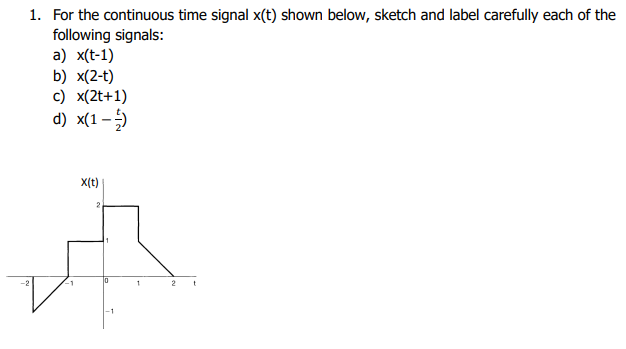 1. For the continuous time signal x(t) shown below, sketch and label carefully each of the
following signals:
a) x(t)
b) x21)
©) x(2t+1)
4) x(1-7)
)
This is AI generated Response.
Asked by: Alok Kumar
Created at: 2026-02-01 04:27:07
Asked by: Alok Kumar
Created at: 2026-02-01 04:27:07
Final Answer:
Rendered
Raw Text
Did you like this answer?
Absolutely! Let's break down each transformation step by step, including what each one **means** and **how to sketch it** based on the original signal \( x(t) \).
---
## **Original Signal \( x(t) \)**
- The plot shows a piecewise function:
- For \( -2 \leq t < -1 \), it goes from (−2, ) to (−1, −1)
- For \( -1 \leq t < \), it goes from (−1, −1) to (, 1)
- For \( \leq t < 1 \), it goes from (, 1) to (1, 2)
- For \( 1 \leq t \leq 2 \), it goes from (1, 2) to (2, )
---
## **a) \( x(t-1) \) — **Delay by 1 unit**
### **Explanation**
- \( x(t-1) \) **shifts the signal to the right** by 1 unit.
- Every feature at time \( t_ \) in \( x(t) \) moves to \( t_ + 1 \).
### **How to Sketch**
- The segment from (−2, ) to (−1, −1) now goes from (−1, ) to (, −1).
- The segment from (−1, −1) to (, 1) now goes from (, −1) to (1, 1).
- The segment from (, 1) to (1, 2) now goes from (1, 1) to (2, 2).
- The segment from (1, 2) to (2, ) now goes from (2, 2) to (3, ).
---
## **b) \( x(2-t) \) — **Time Reversal and Compression**
### **Explanation**
- \( x(2-t) \) applies **time reversal** (flip over the y-axis), then shifts **right by 2 units** (since the minus sign is inside).
- Alternatively: Flip x(t) about \( t=1 \).
### **How to Sketch**
- Replace \( t \) with \( 2-t \): To find the new value at \( t=a \), look at the value \( x(2-a) \).
- E.g., for \( t= \), plot \( x(2-) = x(2) \).
- The shape is flipped (mirrored) and shifted.
---
## **c) \( x(2t+1) \) — **Time Scaling and Shift**
### **Explanation**
- \( x(2t+1) \) is compressed by a factor of 2 (since 2 is multiplied inside), **and shifted left by .5** (since \( 2t+1= \) at \( t=-.5 \)).
### **How to Sketch**
- To get the point at \( t = a \), calculate \( x(2a+1) \).
- The signal is compressed horizontally by 2 and shifted left by .5 units.
---
## **d) \( x\left(1-\frac{t}{2}\right) \) — **Time Reversal, Scaling, and Shift**
### **Explanation**
- \( x\left(1-\frac{t}{2}\right) \) reverses time (because of the minus), shifts right by 1 (since \( t=2 \) at \( x() \)), and stretches by a factor of 2.
### **How to Sketch**
- Set \( s = 1-\frac{t}{2} \), solve for \( t \): \( t = 2(1-s) \).
- So, the signal is **flipped**, **stretched**, and **shifted**.
---
## **Summary Table**
| Transformation | Operation(s) | Effect |
|----------------------|---------------------------------------------------------|--------------------------------------------|
| \( x(t-1) \) | Shift right by 1 | All features move right by 1 |
| \( x(2-t) \) | Time reversal & shift right by 2 | Flip over y-axis, shift right by 2 |
| \( x(2t+1) \) | Compress by 2, shift left by .5 | Features halve in width, move left by .5 |
| \( x(1-\frac{t}{2}) \) | Time reversal, stretch by 2, shift right by 1 | Flip, double width, shift right by 1 |
---
## **Sketching Tips**
- **Shifts**: Move all points left/right by the shift amount.
- **Scaling**: Divide all \( t \)-values by the scaling factor.
- **Reversal**: Replace \( t \) with \( -t \), flipping over the y-axis.
---
Would you like **step-by-step sketches** for each, or a specific transformation explained in more detail?
📢 Instructions:
- Ask anything relatd to above question only.
- For new Question goto :