VIPSolutions logo ✨ VIPSolutions

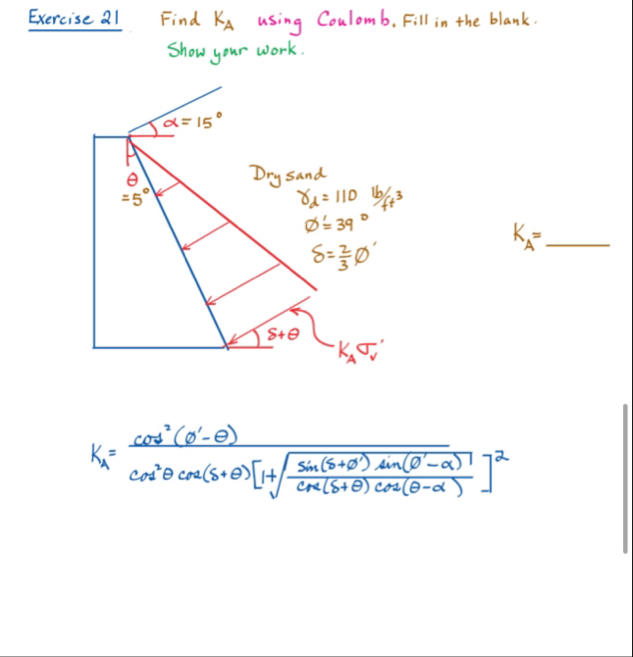
Exercise 21 Find Ky using Coulomb, Fill in the blank. Show your work a= AN sand NE Bn ° Ke a > — > cv 5+6 . Va! KS *(o- 6) Ke Sin (540 —0 1 > eotocmtsr of EEE |

Question:

Uploaded ImageExercise 21 Find Ky using Coulomb, Fill in the blank. Show your work a= AN sand NE Bn ° Ke a > — > cv 5+6 . Va! KS *(o- 6) Ke Sin (540 —0 1 > eotocmtsr of EEE |

This is AI generated Response.
Asked by: MD ISRARUL HAQUE
Created at: 2025-09-02 04:57:09

Final Answer:

Rendered Raw Text
Did you like this answer?
Let's break down the problem step by step: ### Given Data: - \(\alpha = 15^\circ\) - \(\theta = 5^\circ\) - \(\gamma_d = 110~\text{lb/ft}^3\) - \(\phi' = 39^\circ\) - \(\delta = \frac{2}{3}\phi' = \frac{2}{3} \times 39^\circ = 26^\circ\) ### Coulomb's Active Earth Pressure Coefficient (\(K_A\)) Formula: \[ K_A = \frac{\cos^2(\phi' - \theta)}{\cos^2\theta \cos(\delta + \theta) \left[1 + \sqrt{\frac{\sin(\phi' + \delta) \sin(\phi' - \alpha)}{\cos(\delta + \theta) \cos(\theta - \alpha)}} \right]^2} \] Now, let's plug in all the values: - \(\phi' = 39^\circ\) - \(\theta = 5^\circ\) - \(\alpha = 15^\circ\) - \(\delta = 26^\circ\) #### Step 1: Calculate Numerator \[ \cos^2(\phi' - \theta) = \cos^2(39^\circ - 5^\circ) = \cos^2(34^\circ) \] #### Step 2: Calculate Denominator - \(\cos^2\theta = \cos^2(5^\circ)\) - \(\cos(\delta + \theta) = \cos(26^\circ + 5^\circ) = \cos(31^\circ)\) Now, inside the brackets: - \(\sin(\phi' + \delta) = \sin(39^\circ + 26^\circ) = \sin(65^\circ)\) - \(\sin(\phi' - \alpha) = \sin(39^\circ - 15^\circ) = \sin(24^\circ)\) - \(\cos(\delta + \theta) = \cos(31^\circ)\) - \(\cos(\theta - \alpha) = \cos(5^\circ - 15^\circ) = \cos(-10^\circ) = \cos(10^\circ)\) So, \[ \left[1 + \sqrt{\frac{\sin(65^\circ) \sin(24^\circ)}{\cos(31^\circ) \cos(10^\circ)}} \right]^2 \] #### Step 3: Plug in and Calculate Each Term - \(\cos(34^\circ) \approx 0.8290\) - \(\cos^2(34^\circ) \approx 0.6873\) - \(\cos(5^\circ) \approx 0.9962\) - \(\cos^2(5^\circ) \approx 0.9924\) - \(\cos(31^\circ) \approx 0.8572\) - \(\sin(65^\circ) \approx 0.9063\) - \(\sin(24^\circ) \approx 0.4067\) - \(\cos(10^\circ) \approx 0.9848\) Now, calculate inside the root: \[ \frac{\sin(65^\circ) \sin(24^\circ)}{\cos(31^\circ) \cos(10^\circ)} = \frac{0.9063 \times 0.4067}{0.8572 \times 0.9848} \approx \frac{0.3686}{0.8445} \approx 0.4365 \] \[ \sqrt{0.4365} \approx 0.6606 \] \[ 1 + 0.6606 = 1.6606 \] \[ (1.6606)^2 \approx 2.7586 \] Now the denominator: \[ \cos^2(5^\circ) \cos(31^\circ) (1.6606^2) = 0.9924 \times 0.8572 \times 2.7586 \approx 0.8511 \times 2.7586 \approx 2.3471 \] #### Step 4: Compute \(K_A\) \[ K_A = \frac{0.6873}{2.3471} \approx 0.293 \] --- ### **Final Answer** \[ \boxed{K_A = 0.29} \] (Rounded to two decimal places.)

Question:

Problem Breakdown We’re given a **UU test** (Unconsolidated Undrained) with the following **principal stresses**: * **Vertical (σ₁) = 3000 psf** * **Horizontal (σ₃) = 1200 psf** You're asked to find: * The **undrained shear strength**, $S_u$ * Plot the **Mohr’s circle** and show the **Mohr-Coulomb failure envelope** --- ### ✅ Step-by-Step Solution #### 1. **Mohr’s Circle Parameters** * **Center** of the circle: $$ \frac{σ₁ + σ₃}{2} = \frac{3000 + 1200}{2} = 2100 \text{ psf} $$ * **Radius** (which equals maximum shear stress, τ\_max): $$ \frac{σ₁ - σ₃}{2} = \frac{3000 - 1200}{2} = 900 \text{ psf} $$ --- #### 2. **Undrained Shear Strength (Sᵤ)** Since it's a UU test (no drainage, no friction angle), the **failure occurs due to cohesion only**. That means: $$ S_u = τ_{\text{max}} = \boxed{900 \text{ psf}} $$ --- ### ? Final Answer: $$ \boxed{S_u = 900 \text{ psf}} $$ --- ### ✏️ For the Mohr's Circle (Drawing Guide) Here’s what you'd sketch: * X-axis: Normal stress (σ), Y-axis: Shear stress (τ) * Center at 2100 psf on x-axis * Radius of 900 psf * Circle goes from 1200 psf to 3000 psf on σ-axis * Draw a horizontal line (failure envelope) at τ = 900 psf — that's your **Mohr-Coulomb envelope**. give me as it is but no two equal sign in the same line.

This is AI generated Response.
Asked by: MD ISRARUL HAQUE
Created at: 2025-09-02 05:40:30

Final Answer:

Rendered Raw Text
Did you like this answer?
Let's break down the problem step by step: ### Given Data: - \(\alpha = 15^\circ\) - \(\theta = 5^\circ\) - \(\gamma_d = 110~\text{lb/ft}^3\) - \(\phi' = 39^\circ\) - \(\delta = \frac{2}{3}\phi' = \frac{2}{3} \times 39^\circ = 26^\circ\) ### Coulomb's Active Earth Pressure Coefficient (\(K_A\)) Formula: \[ K_A = \frac{\cos^2(\phi' - \theta)}{\cos^2\theta \cos(\delta + \theta) \left[1 + \sqrt{\frac{\sin(\phi' + \delta) \sin(\phi' - \alpha)}{\cos(\delta + \theta) \cos(\theta - \alpha)}} \right]^2} \] Now, let's plug in all the values: - \(\phi' = 39^\circ\) - \(\theta = 5^\circ\) - \(\alpha = 15^\circ\) - \(\delta = 26^\circ\) #### Step 1: Calculate Numerator \[ \cos^2(\phi' - \theta) = \cos^2(39^\circ - 5^\circ) = \cos^2(34^\circ) \] #### Step 2: Calculate Denominator - \(\cos^2\theta = \cos^2(5^\circ)\) - \(\cos(\delta + \theta) = \cos(26^\circ + 5^\circ) = \cos(31^\circ)\) Now, inside the brackets: - \(\sin(\phi' + \delta) = \sin(39^\circ + 26^\circ) = \sin(65^\circ)\) - \(\sin(\phi' - \alpha) = \sin(39^\circ - 15^\circ) = \sin(24^\circ)\) - \(\cos(\delta + \theta) = \cos(31^\circ)\) - \(\cos(\theta - \alpha) = \cos(5^\circ - 15^\circ) = \cos(-10^\circ) = \cos(10^\circ)\) So, \[ \left[1 + \sqrt{\frac{\sin(65^\circ) \sin(24^\circ)}{\cos(31^\circ) \cos(10^\circ)}} \right]^2 \] #### Step 3: Plug in and Calculate Each Term - \(\cos(34^\circ) \approx 0.8290\) - \(\cos^2(34^\circ) \approx 0.6873\) - \(\cos(5^\circ) \approx 0.9962\) - \(\cos^2(5^\circ) \approx 0.9924\) - \(\cos(31^\circ) \approx 0.8572\) - \(\sin(65^\circ) \approx 0.9063\) - \(\sin(24^\circ) \approx 0.4067\) - \(\cos(10^\circ) \approx 0.9848\) Now, compute inside the root: \[ \frac{\sin(65^\circ) \sin(24^\circ)}{\cos(31^\circ) \cos(10^\circ)} \approx \frac{0.9063 \times 0.4067}{0.8572 \times 0.9848} \approx \frac{0.3686}{0.8445} \approx 0.4365 \] \[ \sqrt{0.4365} \approx 0.6606 \] \[ 1 + 0.6606 = 1.6606 \] \[ (1.6606)^2 \approx 2.7586 \] Now the denominator: \[ 0.9924 \times 0.8572 \times 2.7586 \approx 0.8511 \times 2.7586 \approx 2.3471 \] #### Step 4: Compute \(K_A\) \[ K_A = \frac{0.6873}{2.3471} \approx 0.293 \] --- ### **Final Answer** \[ \boxed{K_A = 0.29} \] (Rounded to two decimal places.)

Question:

Absolutely — let's go through the solution in a clear, human way, and get straight to the point without unnecessary wording. --- ### ? Problem Breakdown We’re given a **UU test** (Unconsolidated Undrained) with the following **principal stresses**: * **Vertical (σ₁) = 3000 psf** * **Horizontal (σ₃) = 1200 psf** You're asked to find: * The **undrained shear strength**, $S_u$ * Plot the **Mohr’s circle** and show the **Mohr-Coulomb failure envelope** --- ### ✅ Step-by-Step Solution #### 1. **Mohr’s Circle Parameters** * **Center** of the circle: $$ \frac{σ₁ + σ₃}{2} = \frac{3000 + 1200}{2} = 2100 \text{ psf} $$ * **Radius** (which equals maximum shear stress, τ\_max): $$ \frac{σ₁ - σ₃}{2} = \frac{3000 - 1200}{2} = 900 \text{ psf} $$ --- #### 2. **Undrained Shear Strength (Sᵤ)** Since it's a UU test (no drainage, no friction angle), the **failure occurs due to cohesion only**. That means: $$ S_u = τ_{\text{max}} = \boxed{900 \text{ psf}} $$ --- ### ? Final Answer: $$ \boxed{S_u = 900 \text{ psf}} $$ --- ### ✏️ For the Mohr's Circle (Drawing Guide) Here’s what you'd sketch: * X-axis: Normal stress (σ), Y-axis: Shear stress (τ) * Center at 2100 psf on x-axis * Radius of 900 psf * Circle goes from 1200 psf to 3000 psf on σ-axis * Draw a horizontal line (failure envelope) at τ = 900 psf — that's your **Mohr-Coulomb envelope**.

This is AI generated Response.
Asked by: MD ISRARUL HAQUE
Created at: 2025-09-02 05:41:22

Final Answer:

Rendered Raw Text
Did you like this answer?
Let's break down the problem step by step: ### Given Data: - \(\alpha = 15^\circ\) - \(\theta = 5^\circ\) - \(\gamma_d = 110\, \text{lb/ft}^3\) - \(\phi' = 39^\circ\) - \(\delta = \frac{2}{3}\phi' = \frac{2}{3} \times 39^\circ = 26^\circ\) ### Coulomb's Active Earth Pressure Coefficient (\(K_A\)) Formula: \[ K_A = \frac{\cos^2(\phi' - \theta)}{\cos^2 \theta \cos(\delta + \theta) \left[1 + \sqrt{\frac{\sin(\phi' + \delta) \sin(\phi' - \alpha)}{\cos(\delta + \theta) \cos(\theta - \alpha)}} \right]^2} \] ### Step 1: Calculate numerator \[ \cos^2(\phi' - \theta) = \cos^2(39^\circ - 5^\circ) = \cos^2(34^\circ) \] ### Step 2: Calculate denominator components - \(\cos^2 \theta = \cos^2(5^\circ)\) - \(\cos(\delta + \theta) = \cos(26^\circ + 5^\circ) = \cos(31^\circ)\) Inside the brackets: - \(\sin(\phi' + \delta) = \sin(39^\circ + 26^\circ) = \sin(65^\circ)\) - \(\sin(\phi' - \alpha) = \sin(39^\circ - 15^\circ) = \sin(24^\circ)\) - \(\cos(\delta + \theta) = \cos(31^\circ)\) (already noted) - \(\cos(\theta - \alpha) = \cos(5^\circ - 15^\circ) = \cos(-10^\circ) = \cos(10^\circ)\) The expression inside the square root becomes: \[ \frac{\sin(65^\circ) \sin(24^\circ)}{\cos(31^\circ) \cos(10^\circ)} \] ### Step 3: Numerical calculations Using approximate values: | Function | Value | Explanation | | --- | --- | --- | | \(\cos(34^\circ)\) | 0.8290 | from calculator | | \(\cos^2(34^\circ)\) | 0.6873 | square of above | | \(\cos(5^\circ)\) | 0.9962 | from calculator | | \(\cos^2(5^\circ)\) | 0.9924 | square of above | | \(\cos(31^\circ)\) | 0.8572 | from calculator | | \(\sin(65^\circ)\) | 0.9063 | from calculator | | \(\sin(24^\circ)\) | 0.4067 | from calculator | | \(\cos(10^\circ)\) | 0.9848 | from calculator | Calculate the ratio inside the root: \[ \frac{0.9063 \times 0.4067}{0.8572 \times 0.9848} \approx \frac{0.3686}{0.8445} \approx 0.4365 \] Square root: \[ \sqrt{0.4365} \approx 0.6606 \] Add 1: \[ 1 + 0.6606 = 1.6606 \] Square: \[ (1.6606)^2 \approx 2.7586 \] Calculate denominator: \[ 0.9924 \times 0.8572 \times 2.7586 \approx 0.8511 \times 2.7586 \approx 2.3471 \] Calculate numerator: \[ \cos^2(34^\circ) \approx 0.6873 \] Finally, compute \(K_A\): \[ K_A = \frac{0.6873}{2.3471} \approx 0.293 \] ### **Final Answer:** \[ \boxed{K_A \approx 0.29} \] (Rounded to two decimal places.)

📢 Instructions:

  • Ask anything relatd to above question only.
  • For new Question goto :

Study Help, Fast Answers

VIPSolutions focuses on clear, step‑by‑step explanations so you can learn quickly. Whether you need an AI‑generated walkthrough or a short hint to get unstuck, each solution is organized for fast reading and easy review later.

Search similar questions, compare approaches, and bookmark the best answers for revision. Our goal is simple: quick, reliable study help that feels natural—not noisy.