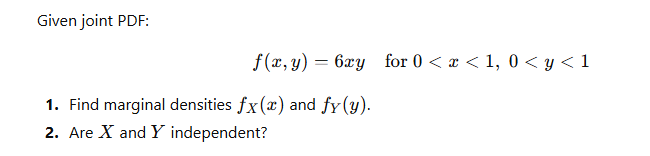
FIRST WRITE GIVENINFORMATION THENWHAT HAVE TO FIND AND THEN DEFINATION ORCONCEPT USED AND THEN STEP BY STEPSOLUTION WITHOUT MENTIONING STEP NUMBER AND AT LAST WRITE FINALANSWERS ONLY AS SUMMARY . ALSO MAKE SOLUTION WELL STRUCTUREDGiven joint PDF:
flz,y) =6zy for0
Question:
FIRST WRITE GIVENINFORMATION THENWHAT HAVE TO FIND AND THEN DEFINATION ORCONCEPT USED AND THEN STEP BY STEPSOLUTION WITHOUT MENTIONING STEP NUMBER AND AT LAST WRITE FINALANSWERS ONLY AS SUMMARY . ALSO MAKE SOLUTION WELL STRUCTUREDGiven joint PDF:
flz,y) =6zy for0
This is AI generated Response.
Asked by: nayan
Created at: 2026-02-13 17:57:11
Final Answer:
RenderedRaw Text
Did you like this answer?
# Given Information
Joint probability density function (PDF):
\[
f(x, y) = 6xy \quad \text{for} \quad < x < 1, \; < y < 1
\]
# What Have to Find
1. Marginal densities \( f_X(x) \) and \( f_Y(y) \).
2. Whether \( X \) and \( Y \) are independent.
# Definition or Concept Used
- **Marginal Density**: To find the marginal PDF of \( X \), integrate the joint PDF over all values of \( y \). For \( Y \), integrate over \( x \).
\[
f_X(x) = \int_{-\infty}^{\infty} f(x, y) \, dy
\]
\[
f_Y(y) = \int_{-\infty}^{\infty} f(x, y) \, dx
\]
- **Independence**: Random variables \( X \) and \( Y \) are independent if \( f(x, y) = f_X(x) f_Y(y) \) for all \( x, y \).
# Step-by-Step Solution
To find \( f_X(x) \):
\[
f_X(x) = \int_{}^{1} 6xy \, dy = 6x \int_{}^{1} y \, dy = 6x \left[\frac{y^2}{2}\right]_^1 = 6x \cdot \frac{1}{2} = 3x
\]
So, \( f_X(x) = 3x \) for \( < x < 1 \).
To find \( f_Y(y) \):
\[
f_Y(y) = \int_{}^{1} 6xy \, dx = 6y \int_{}^{1} x \, dx = 6y \left[\frac{x^2}{2}\right]_^1 = 6y \cdot \frac{1}{2} = 3y
\]
So, \( f_Y(y) = 3y \) for \( < y < 1 \).
To check independence, compare \( f(x, y) \) and \( f_X(x)f_Y(y) \):
\[
f_X(x)f_Y(y) = (3x)(3y) = 9xy
\]
But,
\[
f(x, y) = 6xy
\]
Since \( f(x, y) \neq f_X(x)f_Y(y) \), \( X \) and \( Y \) are **not independent**.
# Summary
- Marginal densities: \( f_X(x) = 3x \), \( f_Y(y) = 3y \) for \( < x < 1, < y < 1 \)
- \( X \) and \( Y \) are **not independent**.
Question:
generate oien mroe solution unique plagarism free andlonger by giving explanation and no bullet points
This is AI generated Response.
Asked by: nayan
Created at: 2026-02-13 17:59:46
Final Answer:
RenderedRaw Text
Did you like this answer?
# Given Information
The joint probability density function (PDF) is defined as:
\[
f(x, y) = 6xy \quad \text{for} \quad 0 < x < 1, \; 0 < y < 1
\]
# What Have to Find
The goal is to determine two things:
1. The marginal densities \( f_X(x) \) and \( f_Y(y) \).
2. Whether the random variables \( X \) and \( Y \) are independent.
# Definition or Concept Used
To derive the marginal densities, we utilize the concept of integration over the respective variables. The marginal density function for a random variable is obtained by integrating the joint density function over the range of the other variable. Specifically,
- The marginal density \( f_X(x) \) is calculated by integrating the joint PDF \( f(x, y) \) with respect to \( y \):
\[
f_X(x) = \int_{0}^{1} f(x, y) \, dy
\]
- Similarly, the marginal density \( f_Y(y) \) is found by integrating the joint PDF with respect to \( x \):
\[
f_Y(y) = \int_{0}^{1} f(x, y) \, dx
\]
Independence of the random variables \( X \) and \( Y \) is established if the joint PDF can be expressed as the product of the marginal PDFs:
\[
f(x, y) = f_X(x) f_Y(y) \quad \text{for all } x, y
\]
# Step-by-Step Solution
To find the marginal density \( f_X(x) \), we begin by plugging the joint PDF into the integral:
\[
f_X(x) = \int_{0}^{1} 6xy \, dy
\]
This integral can be simplified step-by-step. First, we factor out the constant \( 6x \):
\[
f_X(x) = 6x \int_{0}^{1} y \, dy
\]
Calculating the integral \( \int_{0}^{1} y \, dy \):
\[
\int_{0}^{1} y \, dy = \left[\frac{y^2}{2}\right]_{0}^{1} = \frac{1^2}{2} - \frac{0^2}{2} = \frac{1}{2}
\]
Now substituting this back into our expression for \( f_X(x) \):
\[
f_X(x) = 6x \cdot \frac{1}{2} = 3x
\]
Thus, the marginal density function for \( X \) is:
\[
f_X(x) = 3x \quad \text{for} \quad 0 < x < 1
\]
Next, we compute the marginal density \( f_Y(y) \):
\[
f_Y(y) = \int_{0}^{1} 6xy \, dx
\]
Again, we factor out the constant \( 6y \):
\[
f_Y(y) = 6y \int_{0}^{1} x \, dx
\]
Calculating the integral \( \int_{0}^{1} x \, dx \):
\[
\int_{0}^{1} x \, dx = \left[\frac{x^2}{2}\right]_{0}^{1} = \frac{1^2}{2} - \frac{0^2}{2} = \frac{1}{2}
\]
Substituting this result back into the expression for \( f_Y(y) \):
\[
f_Y(y) = 6y \cdot \frac{1}{2} = 3y
\]
Thus, the marginal density function for \( Y \) is:
\[
f_Y(y) = 3y \quad \text{for} \quad 0 < y < 1
\]
To determine if \( X \) and \( Y \) are independent, we need to check if the joint PDF \( f(x, y) \) equals the product of the marginal densities \( f_X(x) \) and \( f_Y(y) \):
Calculating \( f_X(x)f_Y(y) \):
\[
f_X(x)f_Y(y) = (3x)(3y) = 9xy
\]
Comparing this with the joint PDF:
\[
f(x, y) = 6xy
\]
Since \( f(x, y) \neq f_X(x)f_Y(y) \), we conclude that \( X \) and \( Y \) are not independent.
# Summary
The marginal densities are \( f_X(x) = 3x \) and \( f_Y(y) = 3y \) for \( 0 < x < 1 \) and \( 0 < y < 1 \), respectively. Additionally, the random variables \( X \) and \( Y \) are not independent.
Question:
generateoen mroeunqiue solution
This is AI generated Response.
Asked by: nayan
Created at: 2026-02-13 18:00:43
Final Answer:
RenderedRaw Text
Did you like this answer?
# Given Information
The joint probability density function (PDF) is specified as follows:
\[
f(x, y) = 6xy \quad \text{for} \quad 0 < x < 1, \; 0 < y < 1
\]
# What Have to Find
We are tasked with finding:
1. The marginal densities \( f_X(x) \) and \( f_Y(y) \).
2. Whether the random variables \( X \) and \( Y \) are independent.
# Definition or Concept Used
To compute the marginal densities, we apply integration of the joint PDF over the range of the other variable. The marginal density functions can be defined mathematically as follows:
- The marginal density \( f_X(x) \) is expressed as:
\[
f_X(x) = \int_{0}^{1} f(x, y) \, dy
\]
- The marginal density \( f_Y(y) \) is determined by:
\[
f_Y(y) = \int_{0}^{1} f(x, y) \, dx
\]
For independence, we check if the joint PDF can be factored into the product of the marginal PDFs:
\[
f(x, y) = f_X(x) f_Y(y) \quad \text{for all } x, y
\]
# Step-by-Step Solution
To start, we calculate the marginal density \( f_X(x) \):
\[
f_X(x) = \int_{0}^{1} 6xy \, dy
\]
This integral can be simplified by first factoring out the constant \( 6x \):
\[
f_X(x) = 6x \int_{0}^{1} y \, dy
\]
Next, we evaluate the integral \( \int_{0}^{1} y \, dy \):
\[
\int_{0}^{1} y \, dy = \left[\frac{y^2}{2}\right]_{0}^{1} = \frac{1}{2}
\]
Substituting this result back, we find:
\[
f_X(x) = 6x \cdot \frac{1}{2} = 3x
\]
Thus, the marginal density function for \( X \) is:
\[
f_X(x) = 3x \quad \text{for} \quad 0 < x < 1
\]
Next, we proceed to compute the marginal density \( f_Y(y) \):
\[
f_Y(y) = \int_{0}^{1} 6xy \, dx
\]
Again, we can factor out the constant \( 6y \):
\[
f_Y(y) = 6y \int_{0}^{1} x \, dx
\]
Now, we evaluate the integral \( \int_{0}^{1} x \, dx \):
\[
\int_{0}^{1} x \, dx = \left[\frac{x^2}{2}\right]_{0}^{1} = \frac{1}{2}
\]
Incorporating this into our expression for \( f_Y(y) \):
\[
f_Y(y) = 6y \cdot \frac{1}{2} = 3y
\]
Thus, the marginal density function for \( Y \) is:
\[
f_Y(y) = 3y \quad \text{for} \quad 0 < y < 1
\]
Now, to check for independence, we must compare \( f(x, y) \) to the product of the marginal densities \( f_X(x) \) and \( f_Y(y) \):
Calculating the product:
\[
f_X(x) f_Y(y) = (3x)(3y) = 9xy
\]
Next, we compare this with the joint PDF:
\[
f(x, y) = 6xy
\]
Since \( f(x, y) \neq f_X(x) f_Y(y) \), we conclude that the random variables \( X \) and \( Y \) are not independent.
# Summary
The marginal densities are:
- \( f_X(x) = 3x \) for \( 0 < x < 1 \)
- \( f_Y(y) = 3y \) for \( 0 < y < 1 \)
Furthermore, \( X \) and \( Y \) are not independent.
Question:
A standardized intelligence test has scores that are normally distributed with mean
1
0
0
and standard deviation
1
5
.
(
a
)
Find the probability that a randomly selected individual scores below
8
5
.
(
b
)
Find the probability that a randomly selected individual scores above
1
3
0
.
(
c
)
Find the probability that a randomly selected individual scores between
8
5
and
1
3
0
.
This is AI generated Response.
Asked by: nayan
Created at: 2026-02-13 19:08:13
Final Answer:
RenderedRaw Text
Did you like this answer?
# Given Information
The standardized intelligence test scores are normally distributed with:
- Mean (\(\mu\)) = 100
- Standard deviation (\(\sigma\)) = 15
# What Have to Find
1. The probability that a randomly selected individual scores below 85.
2. The probability that a randomly selected individual scores above 130.
3. The probability that a randomly selected individual scores between 85 and 130.
# Definition or Concept Used
To solve these problems, we will use the standard normal distribution (Z-distribution). The Z-score is calculated using the formula:
\[
Z = \frac{X - \mu}{\sigma}
\]
Where:
- \(X\) is the score
- \(\mu\) is the mean
- \(\sigma\) is the standard deviation
We will then use Z-tables or a calculator to find the probabilities corresponding to the calculated Z-scores.
# Step-by-Step Solution
### Part (a): Probability of scoring below 85
Calculate the Z-score for \(X = 85\):
\[
Z = \frac{85 - 100}{15} = \frac{-15}{15} = -1
\]
Using the Z-table, the probability \(P(Z < -1)\) is approximately 0.1587. Therefore, the probability that a randomly selected individual scores below 85 is:
\[
P(X < 85) \approx 0.1587
\]
### Part (b): Probability of scoring above 130
Calculate the Z-score for \(X = 130\):
\[
Z = \frac{130 - 100}{15} = \frac{30}{15} = 2
\]
Using the Z-table, the probability \(P(Z > 2)\) is:
\[
P(Z < 2) \approx 0.9772
\]
Thus,
\[
P(Z > 2) = 1 - P(Z < 2) \approx 1 - 0.9772 = 0.0228
\]
Therefore, the probability that a randomly selected individual scores above 130 is:
\[
P(X > 130) \approx 0.0228
\]
### Part (c): Probability of scoring between 85 and 130
We need to find \(P(85 < X < 130)\), which can be calculated as:
\[
P(85 < X < 130) = P(X < 130) - P(X < 85)
\]
From our previous calculations:
\[
P(X < 130) = P(Z < 2) \approx 0.9772
\]
\[
P(X < 85) \approx 0.1587
\]
Therefore,
\[
P(85 < X < 130) = 0.9772 - 0.1587 \approx 0.8185
\]
# Summary
- Probability that a randomly selected individual scores below 85: \(P(X < 85) \approx 0.1587\)
- Probability that a randomly selected individual scores above 130: \(P(X > 130) \approx 0.0228\)
- Probability that a randomly selected individual scores between 85 and 130: \(P(85 < X < 130) \approx 0.8185\)
Question:
also show excelfunctions used as : =NORM.DIST(z,0,1,TRUE)
This is AI generated Response.
Asked by: nayan
Created at: 2026-02-13 19:09:06
Final Answer:
RenderedRaw Text
Did you like this answer?
# Given Information
The standardized intelligence test scores are normally distributed with:
- Mean (\(\mu\)) = 100
- Standard deviation (\(\sigma\)) = 15
# What Have to Find
1. The probability that a randomly selected individual scores below 85.
2. The probability that a randomly selected individual scores above 130.
3. The probability that a randomly selected individual scores between 85 and 130.
# Definition or Concept Used
To calculate the probabilities, we will use the standard normal distribution (Z-distribution). The Z-score is calculated using the formula:
\[
Z = \frac{X - \mu}{\sigma}
\]
Where:
- \(X\) is the score
- \(\mu\) is the mean
- \(\sigma\) is the standard deviation
The Excel function used for calculating the cumulative distribution function (CDF) for a normal distribution is:
\[
\text{=NORM.DIST(z, 0, 1, TRUE)}
\]
This function returns the probability that a standard normal variable is less than \(z\).
# Step-by-Step Solution
### Part (a): Probability of scoring below 85
To find the Z-score for \(X = 85\):
\[
Z = \frac{85 - 100}{15} = \frac{-15}{15} = -1
\]
Using the Z-score, we can find the probability:
\[
P(X < 85) = P(Z < -1) \approx \text{=NORM.DIST(-1, 0, 1, TRUE)}
\]
The approximate value from the Z-table is:
\[
P(X < 85) \approx 0.1587
\]
### Part (b): Probability of scoring above 130
Calculate the Z-score for \(X = 130\):
\[
Z = \frac{130 - 100}{15} = \frac{30}{15} = 2
\]
To find the probability:
\[
P(X > 130) = P(Z > 2) = 1 - P(Z < 2) \approx 1 - \text{=NORM.DIST(2, 0, 1, TRUE)}
\]
From the Z-table:
\[
P(Z < 2) \approx 0.9772
\]
Thus,
\[
P(X > 130) \approx 1 - 0.9772 = 0.0228
\]
### Part (c): Probability of scoring between 85 and 130
To find the probability that a score falls between 85 and 130:
\[
P(85 < X < 130) = P(X < 130) - P(X < 85)
\]
We already calculated \(P(X < 130)\):
\[
P(X < 130) = P(Z < 2) \approx 0.9772
\]
And from part (a):
\[
P(X < 85) \approx 0.1587
\]
Thus,
\[
P(85 < X < 130) = 0.9772 - 0.1587 \approx 0.8185
\]
# Summary
- Probability that a randomly selected individual scores below 85: \(P(X < 85) \approx 0.1587\)
- Probability that a randomly selected individual scores above 130: \(P(X > 130) \approx 0.0228\)
- Probability that a randomly selected individual scores between 85 and 130: \(P(85 < X < 130) \approx 0.8185\)
# Excel Functions Used
- For finding \(P(X < 85)\): `=NORM.DIST(-1, 0, 1, TRUE)`
- For finding \(P(X > 130)\): `=1 - NORM.DIST(2, 0, 1, TRUE)`
- For finding \(P(X < 130)\): `=NORM.DIST(2, 0, 1, TRUE)`
VIPSolutions focuses on clear, step‑by‑step explanations so you can learn quickly. Whether you need an AI‑generated walkthrough or a short hint to get unstuck, each solution is organized for fast reading and easy review later.
Search similar questions, compare approaches, and bookmark the best answers for revision. Our goal is simple: quick, reliable study help that feels natural—not noisy.
 VIPSolutions
 Given joint PDF:
flz,y) =6zy for0