VIPSolutions logo ✨ VIPSolutions

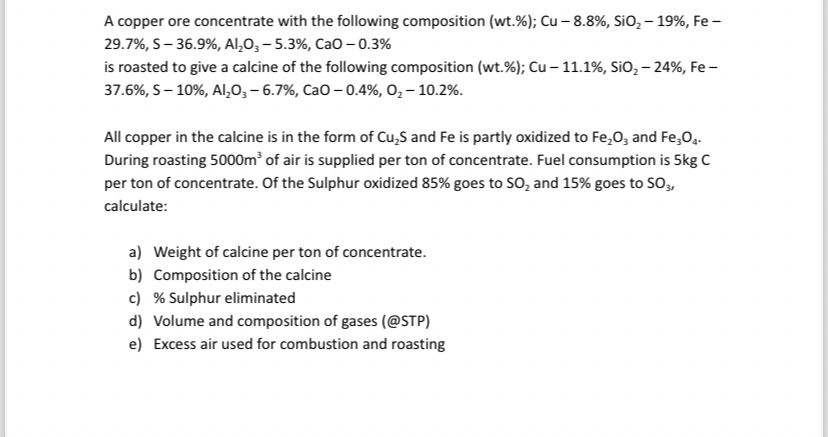
A copper ore concentrate with the following composition (wt.%); Cu-8.8%, SiO₂-19%, Fe-29.7%, S-36.9%, Al2O3-5.3%, CaO -0.3% is roasted to give a calcine of the following composition (wt.%); Cu-11.1%, SiO₂ - 24%, Fe-37.6%, S-10%, Al₂O₃-6.7%, CaO -0.4%, 02-10.2%. All copper in the calcine is in the form of Cu₂S and Fe is partly oxidized to Fe₂O₃ and Fe3O4. During roasting 5000m³ of air is supplied per ton of concentrate. Fuel consumption is 5kg C per ton of concentrate. Of the Sulphur oxidized 85% goes to SO₂ and 15% goes to SO3, calculate: a) Weight of calcine per ton of concentrate. b) Composition of the calcine c) % Sulphur eliminated d) Volume and composition of gases (@STP) e) Excess air used for combustion and roastingA copper ore concentrate with the following composition (t.%); Cu — 8.8%, Si0; — 19%, Fe — 29.7%, 36.9%, ALLO, — 5.3%, Ca0 — 0.3% is roasted to give a calcine of the following composition (wt.%); Cu — 11.1%, SiO, — 24%, Fe — 37.6%, S— 10%, ALO; ~ 6.7%, CaO — 0.4%, 0, ~ 10.2%. All copper in the calcine is in the form of Cu, and Fe is partly oxidized to Fe,0; and Fe,0,. During roasting 5000m’ of air is supplied per ton of concentrate. Fuel consumption is Skg C per ton of concentrate. Of the Sulphur oxidized 85% goes to SO; and 15% goes to SO, calculate: a) Weight of calcine per ton of concentrate. b) Composition of the calcine ©) % Sulphur eliminated d) Volume and composition of gases (@STP) e) Excess air used for combustion and roasting
Question:

A copper ore concentrate with the following composition (wt.%); Cu-8.8%, SiO₂-19%, Fe-29.7%, S-36.9%, Al2O3-5.3%, CaO -0.3% is roasted to give a calcine of the following composition (wt.%); Cu-11.1%, SiO₂ - 24%, Fe-37.6%, S-10%, Al₂O₃-6.7%, CaO -0.4%, 02-10.2%. All copper in the calcine is in the form of Cu₂S and Fe is partly oxidized to Fe₂O₃ and Fe3O4. During roasting 5000m³ of air is supplied per ton of concentrate. Fuel consumption is 5kg C per ton of concentrate. Of the Sulphur oxidized 85% goes to SO₂ and 15% goes to SO3, calculate: a) Weight of calcine per ton of concentrate. b) Composition of the calcine c) % Sulphur eliminated d) Volume and composition of gases (@STP) e) Excess air used for combustion and roastingUploaded ImageA copper ore concentrate with the following composition (t.%); Cu — 8.8%, Si0; — 19%, Fe — 29.7%, 36.9%, ALLO, — 5.3%, Ca0 — 0.3% is roasted to give a calcine of the following composition (wt.%); Cu — 11.1%, SiO, — 24%, Fe — 37.6%, S— 10%, ALO; ~ 6.7%, CaO — 0.4%, 0, ~ 10.2%. All copper in the calcine is in the form of Cu, and Fe is partly oxidized to Fe,0; and Fe,0,. During roasting 5000m’ of air is supplied per ton of concentrate. Fuel consumption is Skg C per ton of concentrate. Of the Sulphur oxidized 85% goes to SO; and 15% goes to SO, calculate: a) Weight of calcine per ton of concentrate. b) Composition of the calcine ©) % Sulphur eliminated d) Volume and composition of gases (@STP) e) Excess air used for combustion and roasting

This is AI generated Response.
Asked by: Francis
Created at: 2025-10-15 18:31:40

Final Answer:

Rendered Raw Text
Did you like this answer?
Let's work through the problem step by step, using **1 ton (100 kg) of copper concentrate** as the basis. --- # **a) Weight of Calcine per Ton of Concentrate** Let: - \( W_{conc} = 100 \) kg (basis) - \( W_{calcine} \) = unknown (to be found) **Elemental Balance Method:** Let's use a non-volatile element (e.g., **Fe**) for the calculation, since its total amount (except for oxidation state) doesn't change during roasting. #### **Fe in Concentrate:** \[ \text{Fe in concentrate} = 29.7\% \times 100 \text{ kg} = 297 \text{ kg} \] #### **Fe in Calcine:** \[ \text{Fe in calcine} = 37.6\% \times W_{calcine} \] Set equal: \[ 297 = .376 \times W_{calcine} \implies W_{calcine} = \frac{297}{.376} = 790.4 \text{ kg} \] --- # **b) Composition of the Calcine** Given in the problem (by wt.%): | Component | Wt.% | |-----------|------| | Cu | 11.1 | | SiO₂ | 24. | | Fe | 37.6 | | S | 10. | | Al₂O₃ | 6.7 | | CaO | .4 | | O₂ | 10.2 | --- # **c) % Sulphur Eliminated** #### **Sulphur in Concentrate:** \[ \text{S in concentrate} = 36.9\% \times 100 = 369 \text{ kg} \] #### **Sulphur in Calcine:** \[ \text{S in calcine} = 10.\% \times 790.4 = 79.04 \text{ kg} \] #### **Sulphur Eliminated:** \[ \text{S eliminated} = 369 - 79.04 = 289.96 \text{ kg} \] #### **% Sulphur Eliminated:** \[ \% \text{ eliminated} = \frac{289.96}{369} \times 100 = 78.6\% \] --- # **d) Volume and Composition of Gases (@STP)** ### **Mass of Sulphur Oxidized:** \[ \text{S oxidized} = 289.96 \text{ kg} \] #### **To SO₂:** (85%) \[ \text{To SO}_2 = .85 \times 289.96 = 246.47 \text{ kg} \] #### **To SO₃:** (15%) \[ \text{To SO}_3 = .15 \times 289.96 = 43.49 \text{ kg} \] --- ### **Moles of Gaseous Products** #### **SO₂:** \[ n_{SO_2} = \frac{246470}{64.07} = 3847.9 \text{ mol} \] #### **SO₃:** \[ n_{SO_3} = \frac{43490}{80.07} = 543.3 \text{ mol} \] --- ### **CO₂ from Fuel:** \[ \text{C burned} = 5 \text{ kg} = 500 \text{ g} \] \[ n_C = \frac{500}{12} = 416.7 \text{ mol} \] \[ \text{CO}_2 \text{ formed} = 416.7 \text{ mol} \] --- ### **N₂ from Air:** \[ \text{Air supplied} = 500 \text{ m}^3 \] At STP, 1 mol gas = 22.4 L = .0224 m³ \[ \text{Moles of air} = \frac{500}{.0224} = 223,214 \text{ mol} \] Air is 21% O₂, 79% N₂ by volume. #### **N₂:** \[ n_{N_2} = .79 \times 223,214 = 176,339 \text{ mol} \] --- ### **O₂ Consumed:** #### **From SO₂ production:** \[ \text{S} + \text{O}_2 \rightarrow \text{SO}_2 \] 246.47 kg S = 246,470 g / 32.07 = 7686.8 mol S\ O₂ used = 7686.8 mol #### **From SO₃ production:** \[ 2\text{S} + 3\text{O}_2 \rightarrow 2\text{SO}_3 \Rightarrow 1\text{S}:1.5\text{O}_2 \] 43.49 kg S = 43,490 g / 32.07 = 1356.1 mol S\ O₂ used = 1.5 × 1356.1 = 2034.15 mol #### **From Carbon oxidation (CO₂):** \[ \text{C} + \text{O}_2 \rightarrow \text{CO}_2 \] O₂ used = 416.7 mol #### **Total O₂ consumed:** \[ \text{O}_2 \text{ used: } = 7686.8 + 2034.15 + 416.7 = 10,137.65 \text{ mol} \] #### **O₂ supplied:** \[ \text{O}_2 \text{ supplied: } .21 \times 223,214 = 46,875 \text{ mol} \] #### **O₂ remaining (in gases):** \[ \text{O}_2 \text{ remaining: } 46,875 - 10,137.65 = 36,737.35 \text{ mol} \] --- ### **Summary Table** | Gas | Moles | |-------|---------| | SO₂ | 3847.9 | | SO₃ | 543.3 | | CO₂ | 416.7 | | N₂ | 176,339 | | O₂ | 36,737 | #### **Total moles:** \[ \text{Total moles} = 3847.9 + 543.3 + 416.7 + 176,339 + 36,737 = 217,884.9 \text{ mol} \] #### **Volume at STP:** \[ \text{Total volume} = 217,884.9 \times .0224 = 4,877 \text{ m}^3 \] --- # **e) Excess Air Used** #### **O₂ Required:** - S oxidized: \( 10,137.65 \) mol O₂ - C oxidized: \( 416.7 \) mol O₂ \[ \text{Total O}_2 \text{ required} = 10,137.65 \text{ mol} \] \[ \text{O}_2 \text{ supplied} = 46,875 \text{ mol} \] #### **Excess O₂:** \[ \text{Excess O}_2 = 46,875 - 10,137.65 = 36,737.35 \text{ mol} \] #### **% Excess Air:** \[ \% \text{ excess air} = \frac{\text{O}_2 \text{ supplied} - \text{O}_2 \text{ required}}{\text{O}_2 \text{ required}} \times 100 = \frac{46,875 - 10,137.65}{10,137.65} \times 100 = 362\% \] --- # **Summary Table** | Part | Result | |------|--------| | (a) | Weight of calcine: **790.4 kg per 100 kg concentrate** | | (b) | Given in problem (see table above) | | (c) | % Sulphur eliminated: **78.6%** | | (d) | Volume and composition of gases: **4877 m³ at STP**<br>SO₂: 3848 mol, SO₃: 543 mol, CO₂: 417 mol, N₂: 176,339 mol, O₂: 36,737 mol | | (e) | **362% excess air** used | --- **If you need further breakdowns (e.g., per component calculation), let me know!**

📢 Instructions:

  • Ask anything relatd to above question only.
  • For new Question goto :

Study Help, Fast Answers

VIPSolutions focuses on clear, step‑by‑step explanations so you can learn quickly. Whether you need an AI‑generated walkthrough or a short hint to get unstuck, each solution is organized for fast reading and easy review later.

Search similar questions, compare approaches, and bookmark the best answers for revision. Our goal is simple: quick, reliable study help that feels natural—not noisy.