Question:
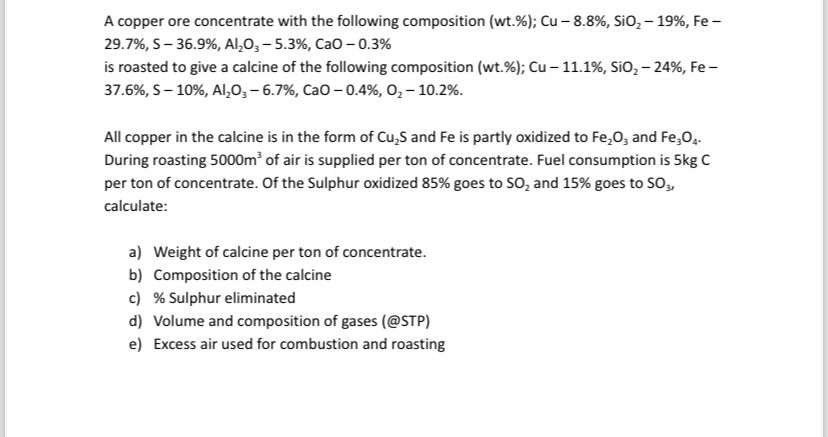
A copper ore concentrate with the following composition (wt.%); Cu-8.8%, SiO₂-19%, Fe-29.7%, S-36.9%, Al2O3-5.3%, CaO -0.3%
is roasted to give a calcine of the following composition (wt.%); Cu-11.1%, SiO₂ - 24%, Fe-37.6%, S-10%, Al₂O₃-6.7%, CaO -0.4%, 02-10.2%.
All copper in the calcine is in the form of Cu₂S and Fe is partly oxidized to Fe₂O₃ and Fe3O4. During roasting 5000m³ of air is supplied per ton of concentrate. Fuel consumption is 5kg C per ton of concentrate. Of the Sulphur oxidized 85% goes to SO₂ and 15% goes to SO3,
calculate:
a) Weight of calcine per ton of concentrate.
b) Composition of the calcine
c) % Sulphur eliminated
d) Volume and composition of gases (@STP)
e) Excess air used for combustion and roasting
Did you like this answer?
👍 0
👎 0
Let's break down the **copper ore roasting problem** step-by-step. For clarity, **all calculations are based on 1 ton (100 kg) of concentrate**.
---
## 1. **Given Data**
### **Concentrate (per ton, 100 kg)**
| Component | wt.% | Mass (kg) |
|-----------|------|-----------|
| Cu | 8.8 | 88 |
| SiO₂ | 19 | 190 |
| Fe | 29.7 | 297 |
| S | 36.9 | 369 |
| Al₂O₃ | 5.3 | 53 |
| CaO | .3 | 3 |
| **Total** | 100 | 100 |
### **Calcine (Unknown mass, let it be x kg)**
| Component | wt.% |
|-----------|------|
| Cu | 11.1 |
| SiO₂ | 24 |
| Fe | 37.6 |
| S | 10 |
| Al₂O₃ | 6.7 |
| CaO | .4 |
| O₂ | 10.2 |
| **Total** | 100 |
---
## (a) **Weight of Calcine per Ton of Concentrate**
Let the mass of calcine = \( x \) kg
**Mass balance for a non-volatile element (Al₂O₃ or SiO₂):**
Let's use **Al₂O₃** (assuming no loss):
\[
\text{Al}_2\text{O}_3 \text{ in concentrate} = \text{Al}_2\text{O}_3 \text{ in calcine}
\]
\[
53 \text{ kg} = x \times \frac{6.7}{100}
\]
\[
x = \frac{53 \times 100}{6.7} = \underline{791} \text{ kg (rounded)}
\]
---
## (b) **Composition of the Calcine**
Already given as wt.% in the question. For mass (kg) in calcine, multiply wt.% by 791 kg:
| Component | wt.% | Mass (kg) |
|-----------|------|-----------|
| Cu | 11.1 | 87.8 |
| SiO₂ | 24 | 190 |
| Fe | 37.6 | 297.4 |
| S | 10 | 79.1 |
| Al₂O₃ | 6.7 | 53 |
| CaO | .4 | 3.2 |
| O₂ | 10.2 | 80.6 |
---
## (c) **% Sulphur Eliminated**
\[
\text{S in concentrate} = 369 \text{ kg}
\]
\[
\text{S in calcine} = 79.1 \text{ kg}
\]
\[
\text{S eliminated} = 369 - 79.1 = 289.9 \text{ kg}
\]
\[
\%\text{S eliminated} = \frac{289.9}{369} \times 100 = \underline{78.6\%}
\]
---
## (d) **Volume and Composition of Gases (@STP)**
### **Sulphur to SO₂ and SO₃**
- S eliminated: 289.9 kg = 9,048.8 mol
- 1 mol S → 1 mol SO₂ or 1 mol SO₃
- **85% to SO₂**: \( .85 \times 9048.8 = 7691.5 \) mol
- **15% to SO₃**: \( .15 \times 9048.8 = 1357.3 \) mol
#### **SO₂:**
\[
7691.5 \text{ mol} \times 64.07\text{ g/mol} = 492,746 \text{ g} = 492.7 \text{ kg}
\]
#### **SO₃:**
\[
1357.3 \text{ mol} \times 80.07\text{ g/mol} = 108,682 \text{ g} = 108.7 \text{ kg}
\]
---
### **Combustion of Carbon (Fuel)**
\[
5 \text{ kg C} \rightarrow \text{CO}_2
\]
\[
\text{Moles C} = \frac{500}{12} = 416.7\text{ mol}
\]
\[
416.7\text{ mol} \times 44.01 = 18,334\text{ g} = 18.3\text{ kg CO}_2
\]
---
### **O₂ Consumed**
#### **For S:**
\[
\text{For SO}_2: S + O_2 \rightarrow SO_2 \implies 7691.5 \text{ mol S} \rightarrow 7691.5 \text{ mol O}_2
\]
\[
\text{For SO}_3: S + 1.5 O_2 \rightarrow SO_3 \implies 1357.3 \text{ mol S} \rightarrow 2035.95 \text{ mol O}_2
\]
\[
\text{Total O}_2 \text{ for S} = 7691.5 + 2035.95 = 9727.45 \text{ mol}
\]
#### **For C:**
\[
\text{C + O}_2 \rightarrow \text{CO}_2 \implies 416.7 \text{ mol O}_2
\]
---
### **Total O₂ Consumed:**
\[
9727.45 + 416.7 = 10,144.2 \text{ mol} = 324.6 \text{ kg}
\]
---
### **Air Supplied**
\[
500 \text{ m}^3 \text{ air per ton}
\]
\[
\text{1 mol gas at STP} = 22.4 \text{ L} = .0224 \text{ m}^3
\]
\[
500 \div .0224 = 223,214 \text{ mol air}
\]
- Air: 21% O₂, 79% N₂ (by mol)
\[
\text{O}_2 \text{ supplied} = 223,214 \times .21 = 46,875 \text{ mol}
\]
\[
\text{N}_2 \text{ supplied} = 223,214 \times .79 = 176,339 \text{ mol}
\]
---
### **O₂ Remaining**
O₂ in calcine: 80.6 kg = 2,518.75 mol
O₂ in gas (unused):
\[
\text{O}_2 \text{ supplied} - \text{O}_2 \text{ consumed} - \text{O}_2 \text{ in calcine}
\]
\[
= 46,875 - 10,144.2 - 2,518.75 = 34,212 \text{ mol}
\]
---
### **Total Gas Volumes (at STP):**
- SO₂: 7,691.5 mol
- SO₃: 1,357.3 mol
- CO₂: 416.7 mol
- O₂ (unused): 34,212 mol
- N₂: 176,339 mol
**Total moles of gas:**
\[
7,691.5 + 1,357.3 + 416.7 + 34,212 + 176,339 = 220,016.5 \text{ mol}
\]
**Total volume at STP:**
\[
220,016.5 \times .0224 = \underline{4,928 \, \text{m}^3}
\]
---
**Composition by mole %:**
| Component | Moles | Mole % |
|-----------|-------|--------|
| SO₂ | 7,691.5 | 3.5% |
| SO₃ | 1,357.3 | .6% |
| CO₂ | 416.7 | .2% |
| O₂ | 34,212 | 15.6% |
| N₂ | 176,339 | 80.1% |
---
## (e) **Excess Air Used**
\[
\text{Theoretical O}_2 \text{ needed} = \text{O}_2 \text{ consumed by S and C} = 10,144.2 \text{ mol}
\]
\[
\text{Air needed theoretically} = \frac{10,144.2}{.21} = 48,306 \text{ mol}
\]
\[
\text{Air supplied} = 223,214 \text{ mol}
\]
\[
\text{Excess air} = \frac{223,214 - 48,306}{48,306} \times 100 = \underline{362\%}
\]
---
## **Summary Table**
| Item | Value |
|----------------|------------------------------|
| (a) Calcine | 791 kg per ton concentrate |
| (b) Composition| Given in calcine table above |
| (c) S removed | 78.6% |
| (d) Gas volume | 4,928 m³ @ STP, see above |
| (e) Excess air | 362% |
---
### **Let me know if you need any step in more detail or want to see a specific calculation expanded.**
 VIPSolutions
 A copper ore concentrate with the following composition (t.%); Cu — 8.8%, Si0; — 19%, Fe —
29.7%, 36.9%, ALLO, — 5.3%, Ca0 — 0.3%
is roasted to give a calcine of the following composition (wt.%); Cu — 11.1%, SiO, — 24%, Fe —
37.6%, S— 10%, ALO; ~ 6.7%, CaO — 0.4%, 0, ~ 10.2%.
All copper in the calcine is in the form of Cu, and Fe is partly oxidized to Fe,0; and Fe,0,.
During roasting 5000m’ of air is supplied per ton of concentrate. Fuel consumption is Skg C
per ton of concentrate. Of the Sulphur oxidized 85% goes to SO; and 15% goes to SO,
calculate:
a) Weight of calcine per ton of concentrate.
b) Composition of the calcine
©) % Sulphur eliminated
d) Volume and composition of gases (@STP)
e) Excess air used for combustion and roasting