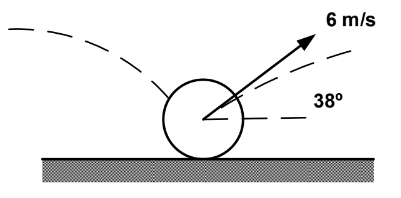
A ball is bouncing on the floor at a speed of
6
m
/
s
,
forming an angle of
3
8
°
with respect to the horizontal, as shown in the image.
Determine:
a
)
The maximum height it reaches after the bounce.
b
)
The magnitudes of the normal and tangential components of the ball's acceleration,
0
.
2
seconds after the bounce.
c
)
The distance at which the next bounce will occur.
Notes:
-
Create free
-
body diagrams
(
FBDs
)
that correctly reflect the acting forces and the initial displacement angle, facilitating vector analysis.
-
Correctly use expressions derived from Newton's second law to determine the components of acceleration and associated kinematic parameters
(
maximum height, time, range
)
.
-
Present calculations in an orderly manner, showing each step with mathematical precision and logical clarity.— 6m/s
BREN
~N —
“2
38°
Question:
A ball is bouncing on the floor at a speed of
6
m
/
s
,
forming an angle of
3
8
°
with respect to the horizontal, as shown in the image.
Determine:
a
)
The maximum height it reaches after the bounce.
b
)
The magnitudes of the normal and tangential components of the ball's acceleration,
0
.
2
seconds after the bounce.
c
)
The distance at which the next bounce will occur.
Notes:
-
Create free
-
body diagrams
(
FBDs
)
that correctly reflect the acting forces and the initial displacement angle, facilitating vector analysis.
-
Correctly use expressions derived from Newton's second law to determine the components of acceleration and associated kinematic parameters
(
maximum height, time, range
)
.
-
Present calculations in an orderly manner, showing each step with mathematical precision and logical clarity.— 6m/s
BREN
~N —
“2
38°
This is AI generated Response.
Asked by: Sahab Sharan
Created at: 2025-10-18 20:13:01
Final Answer:
RenderedRaw Text
Did you like this answer?
Let's systematically analyze the problem step by step, including free-body diagrams, component calculations, and kinematic analysis.
---
# Given Data
- Initial speed after bounce: \( v_ = 6\, \text{m/s} \)
- Launch angle: \( \theta = 38^\circ \)
- Time after bounce: \( t = .2\, \text{s} \)
- Gravitational acceleration: \( g = 9.81\, \text{m/s}^2 \)
---
# Step 1: Free-Body Diagram (FBD)
### Initial velocity components:
- Horizontal: \( v_{x} = v_ \cos \theta \)
- Vertical: \( v_{y} = v_ \sin \theta \)
### Forces acting:
- Gravity: \( \vec{F}_g = m \vec{g} \), acting downward
- No other horizontal forces (assuming air resistance negligible)
---
# Step 2: Components of Initial Velocity
\[
v_{x} = 6 \times \cos 38^\circ \approx 6 \times .788 = 4.73\, \text{m/s}
\]
\[
v_{y} = 6 \times \sin 38^\circ \approx 6 \times .6157 = 3.69\, \text{m/s}
\]
---
# Part (a): Maximum Height After Bounce
### Vertical velocity at start:
\[
v_{y} = 3.69\, \text{m/s}
\]
### Maximum height:
\[
h_{max} = \frac{v_{y}^2}{2g}
\]
\[
h_{max} = \frac{(3.69)^2}{2 \times 9.81} \approx \frac{13.61}{19.62} \approx .694\, \text{m}
\]
**Answer:**
\[
\boxed{
h_{max} \approx .694\, \text{m}
}
\]
---
# Part (b): Acceleration Components .2 s After Bounce
### Acceleration components:
- Horizontal: \( a_x = \) (assuming negligible air resistance)
- Vertical: \( a_y = -g = -9.81\, \text{m/s}^2 \)
### Magnitudes:
\[
|a_x| =
\]
\[
|a_y| = 9.81\, \text{m/s}^2
\]
### Components at \( t = .2\, \text{s} \):
- Horizontal acceleration: \( \)
- Vertical acceleration: \( -9.81\, \text{m/s}^2 \)
### Magnitude of total acceleration:
\[
a_{total} = \sqrt{a_x^2 + a_y^2} = 9.81\, \text{m/s}^2
\]
### Components in normal and tangential directions:
- **Tangential component:** along the velocity vector
- **Normal component:** perpendicular to the velocity vector
Since only gravity acts, the accelerations in the tangential and normal directions depend on the current velocity vector, but the *magnitude* of acceleration remains \( g \).
---
# Part (c): Distance to Next Bounce
### Step 1: Time to reach maximum height:
\[
t_{up} = \frac{v_{y}}{g} = \frac{3.69}{9.81} \approx .376\, \text{s}
\]
### Step 2: Total time of flight (up and down):
\[
T_{flight} = 2 t_{up} \approx .752\, \text{s}
\]
### Step 3: Horizontal range during this time:
\[
x_{range} = v_x \times T_{flight} = 4.73 \times .752 \approx 3.56\, \text{m}
\]
**Answer:**
\[
\boxed{
\text{Next bounce occurs approximately } 3.56\, \text{m} \ \text{away}
}
\]
---
# Summary:
| Part | Result |
|---------|------------------------------|
| (a) | Max height \( \approx .694\, \text{m} \) |
| (b) | Acceleration magnitude \( 9.81\, \text{m/s}^2 \); components: \( \) horizontally, \( -9.81\, \text{m/s}^2 \) vertically |
| (c) | Next bounce at \( \approx 3.56\, \text{m} \) from current position |
---
Let me know if you'd like further clarifications or detailed derivations!
VIPSolutions focuses on clear, step‑by‑step explanations so you can learn quickly. Whether you need an AI‑generated walkthrough or a short hint to get unstuck, each solution is organized for fast reading and easy review later.
Search similar questions, compare approaches, and bookmark the best answers for revision. Our goal is simple: quick, reliable study help that feels natural—not noisy.
 VIPSolutions
 — 6m/s
BREN
~N —
“2
38°