 VIPSolutions
give answer in 2 step with all parts explanation at the end of each step and final answer at the end:Sketch the function and the describe the intervals where the slope is increasing and the intervals where it is decreasing. a f= —— b. gx) = = +4 c h(x)=1 -=
Question:
give answer in 2 step with all parts explanation at the end of each step and final answer at the end: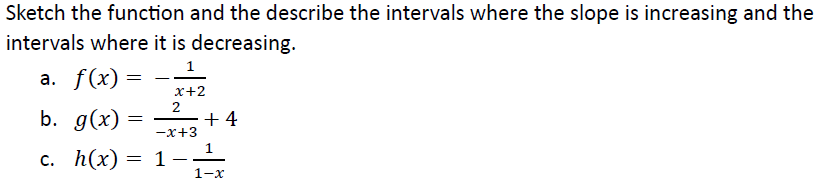 Sketch the function and the describe the intervals where the slope is increasing and the
intervals where it is decreasing.
a f= ——
b. gx) = = +4
c h(x)=1 -=
This is AI generated Response.
Asked by: Rahul
Created at: 2025-11-27 06:17:59
Asked by: Rahul
Created at: 2025-11-27 06:17:59
Final Answer:
Rendered
Raw Text
Did you like this answer?
Let's solve each part in ** steps** as requested:
---
## a. \( f(x) = -\frac{1}{x+2} \)
### **Step 1: Analyze the Function and Its Derivative**
- The function is a **rational function**, undefined at \( x = -2 \).
- Derivative:
\[
f'(x) = -\frac{d}{dx}\left(\frac{1}{x+2}\right) = -\left(-\frac{1}{(x+2)^2}\right) = \frac{1}{(x+2)^2}
\]
- \( f'(x) > \) for all \( x \neq -2 \).
#### **Explanation:**
The derivative is always **positive** except where undefined, so the function is **increasing** everywhere it is defined.
---
### **Step 2: Intervals of Increase/Decrease**
- **Increasing:** \( (-\infty, -2) \cup (-2, \infty) \)
- **Decreasing:** Nowhere
#### **Explanation:**
There are **no intervals where the function is decreasing** since the derivative is always positive.
---
**Final Answer for (a):**
- **Increasing:** \( (-\infty, -2) \cup (-2, \infty) \)
- **Decreasing:** None
---
## b. \( g(x) = \frac{2}{-x+3} + 4 \)
### **Step 1: Analyze the Function and Its Derivative**
- The function is undefined at \( x = 3 \).
- Derivative:
\[
g'(x) = \frac{d}{dx}\left(\frac{2}{-x+3}\right) = 2 \cdot \frac{d}{dx}(-x+3)^{-1} = 2(-1)(-x+3)^{-2} = \frac{2}{(-x+3)^2}
\]
#### **Explanation:**
The derivative is always **positive** except at \( x = 3 \) (undefined).
---
### **Step 2: Intervals of Increase/Decrease**
- **Increasing:** \( (-\infty, 3) \cup (3, \infty) \)
- **Decreasing:** None
#### **Explanation:**
There are **no intervals where \( g(x) \) is decreasing** because the derivative is always positive.
---
**Final Answer for (b):**
- **Increasing:** \( (-\infty, 3) \cup (3, \infty) \)
- **Decreasing:** None
---
## c. \( h(x) = 1 - \frac{1}{1-x} \)
### **Step 1: Analyze the Function and Its Derivative**
- The function is undefined at \( x = 1 \).
- Derivative:
\[
h'(x) = -\frac{d}{dx}\left(\frac{1}{1-x}\right) = -(-1)(1-x)^{-2} = \frac{1}{(1-x)^2}
\]
#### **Explanation:**
The derivative is **always positive** except at \( x = 1 \) (undefined).
---
### **Step 2: Intervals of Increase/Decrease**
- **Increasing:** \( (-\infty, 1) \cup (1, \infty) \)
- **Decreasing:** None
#### **Explanation:**
There are **no intervals where \( h(x) \) is decreasing** because the derivative is always positive.
---
**Final Answer for (c):**
- **Increasing:** \( (-\infty, 1) \cup (1, \infty) \)
- **Decreasing:** None
---
## **Summary Table**
| Function | Increasing Intervals | Decreasing Intervals |
|--------------------|----------------------------------------|---------------------|
| \( f(x) \) | \( (-\infty, -2) \cup (-2, \infty) \) | None |
| \( g(x) \) | \( (-\infty, 3) \cup (3, \infty) \) | None |
| \( h(x) \) | \( (-\infty, 1) \cup (1, \infty) \) | None |
Question:
A,b,c, parts solved correct
This is AI generated Response.
Asked by: Rahul
Created at: 2025-11-27 06:18:50
Asked by: Rahul
Created at: 2025-11-27 06:18:50
Final Answer:
Rendered
Raw Text
Did you like this answer?
# Function Analysis and Slope Behavior
This document provides a structured analysis of three functions, detailing their increasing and decreasing intervals based on their derivatives.
## a. \( f(x) = -\frac{1}{x+2} \)
### **Step 1: Analyze the Function and Its Derivative**
- The function \( f(x) \) is a rational function and is undefined at \( x = -2 \).
- Derivative:
\[
f'(x) = -\frac{d}{dx}\left(\frac{1}{x+2}\right) = -\left(-\frac{1}{(x+2)^2}\right) = \frac{1}{(x+2)^2}
\]
- Since \( f'(x) > 0 \) for all \( x \neq -2 \), the function is always increasing where defined.
#### **Explanation:**
The positive derivative indicates that the function increases in the intervals where it is defined.
---
### **Step 2: Intervals of Increase/Decrease**
- **Increasing:** \( (-\infty, -2) \cup (-2, \infty) \)
- **Decreasing:** None
#### **Explanation:**
There are no intervals of decrease since the derivative is always positive.
---
**Final Answer for (a):**
- **Increasing:** \( (-\infty, -2) \cup (-2, \infty) \)
- **Decreasing:** None
---
## b. \( g(x) = \frac{2}{-x+3} + 4 \)
### **Step 1: Analyze the Function and Its Derivative**
- The function \( g(x) \) is undefined at \( x = 3 \).
- Derivative:
\[
g'(x) = \frac{d}{dx}\left(\frac{2}{-x+3}\right) = 2 \cdot \frac{d}{dx}(-x+3)^{-1} = 2(-1)(-x+3)^{-2} = \frac{2}{(-x+3)^2}
\]
- The derivative is positive for all \( x \neq 3 \).
#### **Explanation:**
The positive derivative indicates that the function is increasing where defined.
---
### **Step 2: Intervals of Increase/Decrease**
- **Increasing:** \( (-\infty, 3) \cup (3, \infty) \)
- **Decreasing:** None
#### **Explanation:**
The function does not decrease as the derivative remains positive.
---
**Final Answer for (b):**
- **Increasing:** \( (-\infty, 3) \cup (3, \infty) \)
- **Decreasing:** None
---
## c. \( h(x) = 1 - \frac{1}{1-x} \)
### **Step 1: Analyze the Function and Its Derivative**
- The function \( h(x) \) is undefined at \( x = 1 \).
- Derivative:
\[
h'(x) = -\frac{d}{dx}\left(\frac{1}{1-x}\right) = -(-1)(1-x)^{-2} = \frac{1}{(1-x)^2}
\]
- The derivative is positive for all \( x \neq 1 \).
#### **Explanation:**
The positive derivative indicates the function is increasing where it is defined.
---
### **Step 2: Intervals of Increase/Decrease**
- **Increasing:** \( (-\infty, 1) \cup (1, \infty) \)
- **Decreasing:** None
#### **Explanation:**
The function does not decrease, as the derivative remains positive.
---
**Final Answer for (c):**
- **Increasing:** \( (-\infty, 1) \cup (1, \infty) \)
- **Decreasing:** None
---
## **Summary Table**
| Function | Increasing Intervals | Decreasing Intervals |
|--------------------|----------------------------------------|---------------------|
| \( f(x) \) | \( (-\infty, -2) \cup (-2, \infty) \) | None |
| \( g(x) \) | \( (-\infty, 3) \cup (3, \infty) \) | None |
| \( h(x) \) | \( (-\infty, 1) \cup (1, \infty) \) | None |
📢 Instructions:
- Ask anything relatd to above question only.
- For new Question goto :