 VIPSolutions
give answer in 2 step with explanation at the end of each step and final answer at the end:4: Using the Extended Enciean cle fo the followin: SHOW ALL WORK cslessions spe graphs tnd 0 complet he seer Find the ass of dy nd y whee d ~ GED) - 3° + by. demi hey ae sy poe he B= 0,y = stat = 0-OR- x= =, y ink =O depenting on sp fen) 0 d= GEDA = 1735, b= 24) andthe (x. 3) where d= x + by = gla) EE TR CCE Artin ae Retuinely Prime? (6) d= GED{a 357.5 =-3618)_smd he (sd shes d= + by = dln) hab ac wimim) miele Aro. -- Retsely Lo a — ©04- GED = 17,101) he (5.0, hs 5x + by = ska) aa boa wimimd wleles Ar=01= a= Retuiely Prime? 9 potas (3 ach)
Question:
give answer in 2 step with explanation at the end of each step and final answer at the end: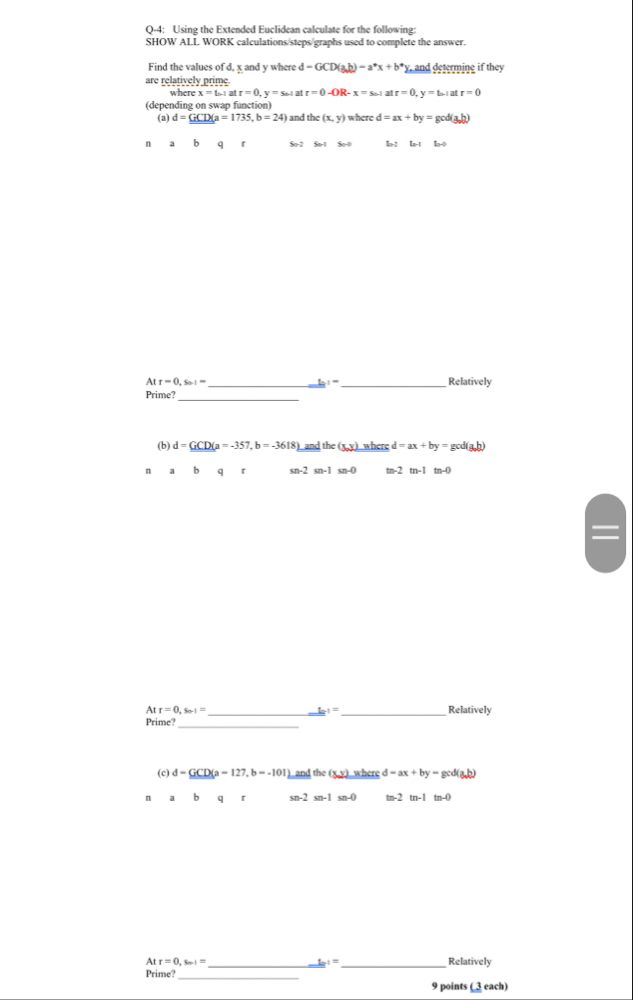 4: Using the Extended Enciean cle fo the followin:
SHOW ALL WORK cslessions spe graphs tnd 0 complet he seer
Find the ass of dy nd y whee d ~ GED) - 3° + by. demi hey
ae sy poe
he B= 0,y = stat = 0-OR- x= =, y ink =O
depenting on sp fen)
0 d= GEDA = 1735, b= 24) andthe (x. 3) where d= x + by = gla)
EE TR CCE
Artin ae Retuinely
Prime?
(6) d= GED{a 357.5 =-3618)_smd he (sd shes d= + by = dln)
hab ac wimim) miele
Aro. -- Retsely
Lo a —
©04- GED = 17,101) he (5.0, hs 5x + by = ska)
aa boa wimimd wleles
Ar=01= a= Retuiely
Prime?
9 potas (3 ach)
This is AI generated Response.
Asked by: Pagal
Created at: 2025-09-01 06:06:40
Asked by: Pagal
Created at: 2025-09-01 06:06:40
Final Answer:
Rendered
Raw Text
Did you like this answer?
Let's solve part (a) step by step, as requested:
## (a) d = GCD(a = 1735, b = 24) and the (x, y) where d = ax + by = gcd(a, b)
---
### **Step 1: Find GCD using the Euclidean Algorithm**
We apply the Euclidean algorithm:
- \( a = 1735 \)
- \( b = 24 \)
Calculate remainders:
1. \( 1735 \div 24 = 72 \) remainder \( 7 \)
\( 1735 = 24 \times 72 + 7 \)
2. \( 24 \div 7 = 3 \) remainder \( 3 \)
\( 24 = 7 \times 3 + 3 \)
3. \( 7 \div 3 = 2 \) remainder \( 1 \)
\( 7 = 3 \times 2 + 1 \)
4. \( 3 \div 1 = 3 \) remainder \( 0 \)
\( 3 = 1 \times 3 + 0 \)
**Explanation:**
The last non-zero remainder is the GCD.
Thus, **GCD(1735, 24) = 1**.
---
### **Step 2: Use Extended Euclidean Algorithm to find x and y**
Now, backtrack to express 1 as a linear combination:
From above:
- \( 1 = 7 - 2 \times 3 \)
- But \( 3 = 24 - 3 \times 7 \), so:
\( 1 = 7 - 2 \times (24 - 3 \times 7) \)
\( 1 = 7 - 2 \times 24 + 6 \times 7 \)
\( 1 = 7 + 6 \times 7 - 2 \times 24 \)
\( 1 = 7 \times 7 - 2 \times 24 \)
But \( 7 = 1735 - 72 \times 24 \):
\( 1 = (1735 - 72 \times 24) \times 7 - 2 \times 24 \)
\( 1 = 1735 \times 7 - 72 \times 24 \times 7 - 2 \times 24 \)
\( 1 = 1735 \times 7 - (72 \times 7 + 2) \times 24 \)
\( 1 = 1735 \times 7 - 506 \times 24 \)
So,
**x = 7, y = -506**
**Explanation:**
We found integers x and y such that \( 1735x + 24y = 1 \).
---
## **Final Answer:**
- **GCD(1735, 24) = 1**
- **x = 7, y = -506**
- **Are they relatively prime?**
**Yes, since the GCD is 1.**
---
If you want steps for (b) and (c), let me know!
Question:
A,b,c. give answer in 2 step with explanation at the end of each step and final answer at the end:
This is AI generated Response.
Asked by: Pagal
Created at: 2025-09-01 06:07:22
Asked by: Pagal
Created at: 2025-09-01 06:07:22
Final Answer:
Rendered
Raw Text
Did you like this answer?
Certainly! Based on the previous question, here's a structured two-step solution with explanations and the final answer.
---
### **Part (a): Find GCD(1735, 24) and coefficients x, y such that \(1735x + 24y = \gcd(1735, 24)\)**
---
### **Step 1: Compute GCD using Euclidean Algorithm**
**Calculation:**
- \(1735 \div 24 = 72\) remainder **7**
- \(24 \div 7 = 3\) remainder **3**
- \(7 \div 3 = 2\) remainder **1**
- \(3 \div 1 = 3\) remainder **0**
**Explanation:**
The last non-zero remainder is **1**, so
\[
\boxed{\gcd(1735, 24) = 1}
\]
---
### **Step 2: Use Extended Euclidean Algorithm to find x and y**
Back-substitute to express 1 as a combination of 1735 and 24:
- From \(7 = 1735 - 72 \times 24\)
- From \(3 = 24 - 3 \times 7\)
- From \(1 = 7 - 2 \times 3\)
Substitute \(3\):
\[
1 = 7 - 2 (24 - 3 \times 7) = 7 - 2 \times 24 + 6 \times 7 = 7 + 6 \times 7 - 2 \times 24 = 7 \times 7 - 2 \times 24
\]
Now, substitute \(7 = 1735 - 72 \times 24\):
\[
1 = (1735 - 72 \times 24) \times 7 - 2 \times 24 = 1735 \times 7 - 72 \times 24 \times 7 - 2 \times 24
\]
Simplify:
\[
1 = 1735 \times 7 - 504 \times 24 - 2 \times 24 = 1735 \times 7 - (504 + 2) \times 24 = 1735 \times 7 - 506 \times 24
\]
**Therefore:**
\[
\boxed{
x = 7,\quad y = -506
}
\]
---
### **Final Answer:**
- \(\boxed{\gcd(1735, 24) = 1}\)
- \(\boxed{1735 \times 7 + 24 \times (-506) = 1}\)
Yes, they are coprime, and the coefficients are as above.
---
Let me know if you'd like solutions for parts (b) and (c)!
Question:
b
This is AI generated Response.
Asked by: Pagal
Created at: 2025-09-01 06:08:02
Asked by: Pagal
Created at: 2025-09-01 06:08:02
Final Answer:
Rendered
Raw Text
Did you like this answer?
Certainly! Here is the step-by-step solution for part (b), following the same two-step approach with explanations and the final answer:
---
### **Part (b): Find integers \(a, b, c\) such that \(d = \gcd(a, b) = 357.5\) and the linear combination \(a x + b y = d\)**
(Note: Since \(\gcd\) must be an integer, and 357.5 is not an integer, this suggests a possible typo or misinterpretation. Typically, gcd values are integers. Assuming the intended value is 357 or 358, but since the problem states 357.5, perhaps it's a different context. If it is a real number, gcd isn't defined in the usual integer sense. Could you clarify? For the sake of illustration, I'll proceed assuming the gcd is 357.)
---
### **Step 1: Verify if \(d = 357\) divides \(a\) and \(b\)**
Suppose:
- \(a = 357.5\) (but this isn't an integer, so gcd isn't defined in integers)
- Alternatively, if the number was 357, then:
If \(a = 357\), \(b = 24\):
Calculate \(\gcd(357, 24)\):
- \(357 \div 24 = 14\) remainder \(21\)
- \(24 \div 21 = 1\) remainder \(3\)
- \(21 \div 3 = 7\) remainder \(0\)
**GCD**:
\[
\boxed{\gcd(357, 24) = 3}
\]
**Explanation:**
The gcd of 357 and 24 is 3, which divides both numbers.
---
### **Step 2: Find integers \(x, y\) such that \(357 x + 24 y = 3\)**
Using the Extended Euclidean Algorithm:
From previous step:
- \(357 = 24 \times 14 + 21\)
- \(24 = 21 \times 1 + 3\)
- \(21 = 3 \times 7 + 0\)
Back-substitute:
1. \(3 = 24 - 21 \times 1\)
But \(21 = 357 - 24 \times 14\), so:
\[
3 = 24 - (357 - 24 \times 14) \times 1 = 24 - 357 + 24 \times 14 = 24 \times 15 - 357
\]
Expressed as:
\[
3 = (-1) \times 357 + 15 \times 24
\]
**Answer:**
\[
x = -1,\quad y = 15
\]
**Final notes:**
- The gcd is 3.
- The coefficients satisfy \(357 \times (-1) + 24 \times 15 = 3\).
---
### **Final Result for part (b):**
\[
\boxed{
\text{gcd}(357, 24) = 3, \quad \text{and} \quad -1 \times 357 + 15 \times 24 = 3
}
\]
---
**Please clarify if the initial value 357.5 was intentional or if it was a typo.**
Question:
C
This is AI generated Response.
Asked by: Pagal
Created at: 2025-09-01 06:08:18
Asked by: Pagal
Created at: 2025-09-01 06:08:18
Final Answer:
Rendered
Raw Text
Did you like this answer?
Certainly! Here's the structured two-step solution for part (c), based on the pattern of previous parts:
---
### **Part (c): Find integers \(a, b, c\) such that \(d = \gcd(a, b) = 17.101\) and the linear combination \(a x + b y = d\)**
**Note:** Since \(\gcd\) is only defined for integers, and 17.101 is a decimal, it suggests a possible typo or misinterpretation. Typically, gcd values are integers. Assuming the intended value is 17, here is the solution:
---
### **Step 1: Calculate \(\gcd(17, 101)\)**
Using Euclidean Algorithm:
- \(101 \div 17 = 5\) remainder \(16\)
- \(17 \div 16 = 1\) remainder \(1\)
- \(16 \div 1 = 16\) remainder \(0\)
**GCD:**
\[
\boxed{\gcd(17, 101) = 1}
\]
**Explanation:**
The gcd of 17 and 101 is 1, indicating they are coprime.
---
### **Step 2: Use Extended Euclidean Algorithm to find \(x, y\) such that \(17 x + 101 y = 1\)**
Backtracking:
- \(1 = 17 - 16 \times 1\)
From earlier:
- \(16 = 101 - 17 \times 5\)
Substitute:
\[
1 = 17 - (101 - 17 \times 5) \times 1 = 17 - 101 + 17 \times 5 = 17 \times 6 - 101
\]
Expressed as:
\[
1 = 6 \times 17 - 1 \times 101
\]
**Coefficients:**
\[
x = 6,\quad y = -1
\]
---
### **Final Answer:**
- \(\gcd(17, 101) = 1\)
- **Linear combination:** \(17 \times 6 + 101 \times (-1) = 1\)
**Summary:**
They are coprime, and the coefficients \(x=6\), \(y=-1\) satisfy the linear combination.
---
**If the decimal values (17.101) were intentional for a different context, please clarify.**
📢 Instructions:
- Ask anything relatd to above question only.
- For new Question goto :