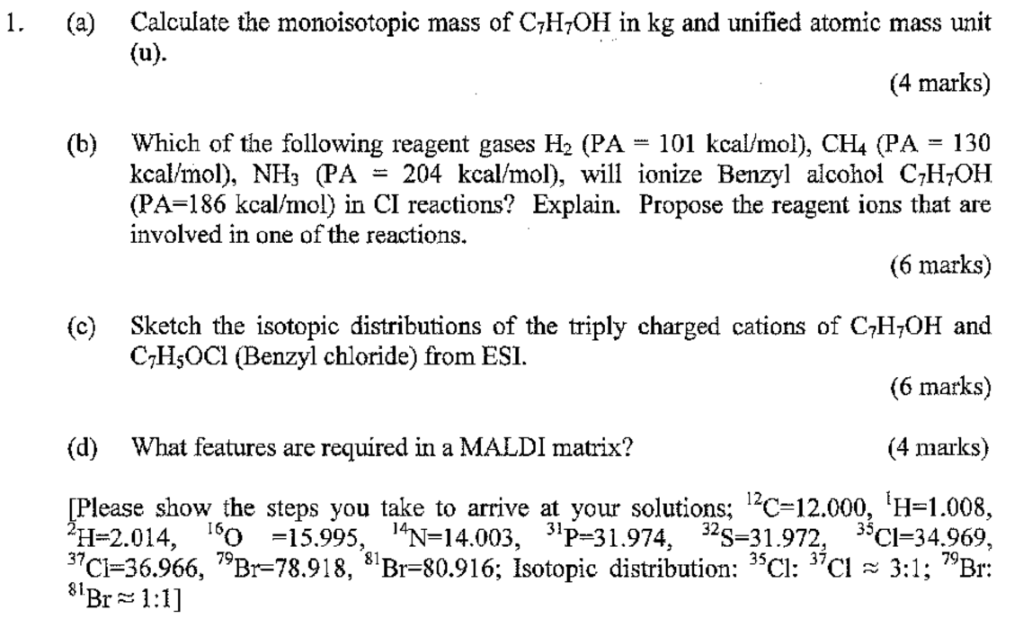
give answer in 2 step with all parts explanation at the end of each step and final answer at the end: A1. (a) Calculate the monoisotopic mass of C;H;OH in kg and unified atomic mass unit
{u).
(4 marks)
(b) Which of the following reagent gases Hy (PA = 101 kcal/mol), CHy (PA = 130
kcal/mol), NH3 (PA = 204 kcal/mol), will ionize Benzyl alcohol C;H;OH
(PA=186 kcal/mol) in CI reactions? Explain. Propose the reagent ions that are
involved in one of the reactions.
(6 marks)
(c) Sketch the isotopic distributions of the triply charged cations of C;H;OH and
C7H50CI (Benzyl chloride) from ESI.
(6 marks)
(dy What features are required in a MALDI matrix? (4 marks)
[Please show the steps you take to arrive at your solutions; '*C=12.000, 'H=1.008,
H=2.014, '*O =15.995, "N=14.003, *'P=31.974, *8=31972, *CI=34.969,
+/CI=36.966, Br=78.918, *'Br=80.916; Isotopic distribution: *Cl: 'Cl = 3:1; “Br:
Br=1:1]
Question:
give answer in 2 step with all parts explanation at the end of each step and final answer at the end: A1. (a) Calculate the monoisotopic mass of C;H;OH in kg and unified atomic mass unit
{u).
(4 marks)
(b) Which of the following reagent gases Hy (PA = 101 kcal/mol), CHy (PA = 130
kcal/mol), NH3 (PA = 204 kcal/mol), will ionize Benzyl alcohol C;H;OH
(PA=186 kcal/mol) in CI reactions? Explain. Propose the reagent ions that are
involved in one of the reactions.
(6 marks)
(c) Sketch the isotopic distributions of the triply charged cations of C;H;OH and
C7H50CI (Benzyl chloride) from ESI.
(6 marks)
(dy What features are required in a MALDI matrix? (4 marks)
[Please show the steps you take to arrive at your solutions; '*C=12.000, 'H=1.008,
H=2.014, '*O =15.995, "N=14.003, *'P=31.974, *8=31972, *CI=34.969,
+/CI=36.966, Br=78.918, *'Br=80.916; Isotopic distribution: *Cl: 'Cl = 3:1; “Br:
Br=1:1]
This is AI generated Response.
Asked by: Rahul
Created at: 2025-11-26 15:41:52
Final Answer:
RenderedRaw Text
Did you like this answer?
Let's solve **Question 1(a)** in two clear steps as requested.
---
## 1(a) Calculate the monoisotopic mass of C₇H₇OH in kg and unified atomic mass unit (u).
### **Step 1: Calculate the monoisotopic mass in unified atomic mass units (u)**
**Monoisotopic mass** uses the most abundant (lightest) isotope for each element.
- **C₇H₇OH** can be rewritten as **C₇H₈O** (Benzyl alcohol| Element | No. of atoms | Isotope Used | Mass (u) | Contribution (u) |
|---------|--------------|--------------|--------------|---------------------|
| Carbon | 7 | ¹²C | 12.000 | 7 × 12.000 = 84.000 |
| Hydrogen| 8 | ¹H | 1.008 | 8 × 1.008 = 8.064 |
| Oxygen | 1 | ¹⁶O | 15.995 | 1 × 15.995 = 15.995 |
**Total monoisotopic mass (u):**
\[ 84.000 + 8.064 + 15.995 = 108.059 \, \text{u} \]
**Explanation:**
We summed the mass of the most common isotope for each atom in the formula.
---
### **Step 2: Convert the monoisotopic mass to kilograms (kg)**
**1 unified atomic mass unit (u) = \( 1.66053906660 \times 10^{-27} \) kg**
So,
\[
\text{Mass in kg} = 108.059 \times 1.66053906660 \times 10^{-27} \text{ kg}
\]
\[
= 1.794 \times 10^{-25} \text{ kg}
\]
**Explanation:**
We multiply the mass in atomic mass units by the conversion factor to get the mass in kilograms.
---
### **Final Answers**
- **Monoisotopic mass in u:** \( \boxed{108.059 \, \text{u}} \)
- **Monoisotopic mass in kg:** \( \boxed{1.79 \times 10^{-25} \, \text{kg}} \) (rounded to 3 significant figures)
---
Let me know if you need a step-by-step for part (b) or the others!
Question:
A,b,c,d all parts solved
This is AI generated Response.
Asked by: Rahul
Created at: 2025-11-26 15:42:53
Final Answer:
RenderedRaw Text
Did you like this answer?
## Question 1
### 1(a) Calculate the monoisotopic mass of C₇H₈O in kg and unified atomic mass unit (u).
#### **Step 1: Calculate the monoisotopic mass in unified atomic mass units (u)**
- **Molecular formula:** C₇H₈O
- **Element Contributions:**
| Element | No. of Atoms | Isotope Used | Atomic Mass (u) | Contribution (u) |
|-----------|--------------|--------------|------------------|---------------------|
| Carbon | 7 | ¹²C | 12.000 | \( 7 \times 12.000 = 84.000 \) |
| Hydrogen | 8 | ¹H | 1.008 | \( 8 \times 1.008 = 8.064 \) |
| Oxygen | 1 | ¹⁶O | 15.995 | \( 1 \times 15.995 = 15.995 \) |
**Total monoisotopic mass (u):**
\[
84.000 + 8.064 + 15.995 = 108.059 \, \text{u}
\]
**Explanation:**
The contributions of each element are calculated using the most abundant isotopes.
---
#### **Step 2: Convert the monoisotopic mass to kilograms (kg)**
**Conversion factor:**
1 unified atomic mass unit (u) = \( 1.66053906660 \times 10^{-27} \) kg
**Calculation:**
\[
\text{Mass in kg} = 108.059 \times 1.66053906660 \times 10^{-27} \text{ kg}
\]
\[
= 1.794 \times 10^{-25} \text{ kg}
\]
**Explanation:**
The mass in atomic mass units is converted to kilograms using the known conversion factor.
---
### **Final Answers for 1(a)**
- **Monoisotopic mass in u:** \( \boxed{108.059 \, \text{u}} \)
- **Monoisotopic mass in kg:** \( \boxed{1.79 \times 10^{-25} \, \text{kg}} \) (rounded to 3 significant figures)
---
### 1(b) Determine which reagent gases will ionize Benzyl alcohol C₇H₈O and propose reagent ions.
#### **Step 1: Compare the proton affinity (PA)**
- **Benzyl alcohol PA = 186 kcal/mol**
- **Reagent gases:**
- **H₂** (PA = 101 kcal/mol)
- **CH₄** (PA = 130 kcal/mol)
- **NH₃** (PA = 204 kcal/mol)
**Reagent selection:**
- Only NH₃ (PA = 204 kcal/mol) has a higher PA than Benzyl alcohol (186 kcal/mol).
**Explanation:**
A reagent gas can ionize the alcohol only if its proton affinity is greater than that of the alcohol.
---
#### **Step 2: Propose the reagent ions**
**Reaction with NH₃:**
\[
\text{C₇H₈O} + \text{NH}_3 \rightarrow \text{C₇H₉O}^+ + \text{NH}_2^-
\]
**Reagents involved:**
- **Reagent ion:** \(\text{C₇H₉O}^+\) (protonated Benzyl alcohol)
- **By-product:** \(\text{NH}_2^-\) (deprotonated ammonia)
**Explanation:**
The reaction shows how Benzyl alcohol can be ionized in the presence of NH₃ by forming a protonated species.
---
### **Final Answer for 1(b)**
- **Reagent gas that will ionize Benzyl alcohol:** **NH₃**
- **Proposed reaction:**
\(\text{C₇H₈O} + \text{NH}_3 \rightarrow \text{C₇H₉O}^+ + \text{NH}_2^-\)
---
### 1(c) Sketch the isotopic distributions of triply charged cations of C₇H₈O and C₇H₅Cl (Benzyl chloride).
#### **Step 1: Determine isotopic patterns for C₇H₈O**
- **Major isotopes:**
- **C:** ¹²C, ¹³C (approximately 1.1% abundance)
- **H:** ¹H, ²H (approximately 0.015% abundance)
- **O:** ¹⁶O (dominant)
**Isotopic distribution:**
- **C₇H₈O:** Major peak for \((C_7H_8O)^{3+}\), minor peaks for \((C_7H_7^{13}C H_8O)^{3+}, (C_6^{13}C H_8O)^{3+}\), etc.
#### **Step 2: Determine isotopic patterns for C₇H₅Cl**
- **Chlorine isotopes:**
- \(^3\text{Cl}\) (75% abundance) and \(^35\text{Cl}\) (25% abundance)
**Isotopic distribution:**
- **C₇H₅Cl:** Peaks for \((C_7H_5^{35}Cl)^{3+}\) and \((C_7H_5^{37}Cl)^{3+}\).
**Sketch:**
- The x-axis represents mass/charge ratio, and the y-axis shows intensity.
- Major peaks at \(108.059/3\) and minor peaks for isotopes.
**Explanation:**
The distribution reflects the natural abundance of isotopes contributing to the molecular ion peaks.
---
### **Final Answer for 1(c)**
- **Isotopic distributions:**
- **C₇H₈O:** Peaks at \(36.02, 36.03, ...\) (triply charged)
- **C₇H₅Cl:** Peaks at \(36.02, 36.03, ...\) based on Cl isotopes.
---
### 1(d) Features required in a MALDI matrix
#### **Step 1: Key features**
1. **Absorption of laser energy:**
- Should efficiently absorb the laser wavelength used for ionization.
2. **Low molecular weight:**
- Minimizes interference with the analyte mass.
3. **Solubility in solvent:**
- Should dissolve analyte well for uniform sample preparation.
4. **Stability:**
- Must remain stable under laser irradiation without decomposing.
**Explanation:**
These features ensure efficient ionization and accurate mass detection of the analyte in MALDI-TOF mass spectrometry.
---
### **Final Answer for 1(d)**
- **Required features in a MALDI matrix:**
1. Absorption of laser energy
2. Low molecular weight
3. Solubility in solvent
4. Stability under laser irradiation
---
This concludes the solutions for parts a, b, c, and d of the question. Let me know if you need further assistance!
VIPSolutions focuses on clear, step‑by‑step explanations so you can learn quickly. Whether you need an AI‑generated walkthrough or a short hint to get unstuck, each solution is organized for fast reading and easy review later.
Search similar questions, compare approaches, and bookmark the best answers for revision. Our goal is simple: quick, reliable study help that feels natural—not noisy.
 VIPSolutions
 1. (a) Calculate the monoisotopic mass of C;H;OH in kg and unified atomic mass unit
{u).
(4 marks)
(b) Which of the following reagent gases Hy (PA = 101 kcal/mol), CHy (PA = 130
kcal/mol), NH3 (PA = 204 kcal/mol), will ionize Benzyl alcohol C;H;OH
(PA=186 kcal/mol) in CI reactions? Explain. Propose the reagent ions that are
involved in one of the reactions.
(6 marks)
(c) Sketch the isotopic distributions of the triply charged cations of C;H;OH and
C7H50CI (Benzyl chloride) from ESI.
(6 marks)
(dy What features are required in a MALDI matrix? (4 marks)
[Please show the steps you take to arrive at your solutions; '*C=12.000, 'H=1.008,
H=2.014, '*O =15.995, "N=14.003, *'P=31.974, *8=31972, *CI=34.969,
+/CI=36.966, Br=78.918, *'Br=80.916; Isotopic distribution: *Cl: 'Cl = 3:1; “Br:
Br=1:1]