give answer in 2 step with explanation at the end of each step and final answer at the end:
Queation
5
4
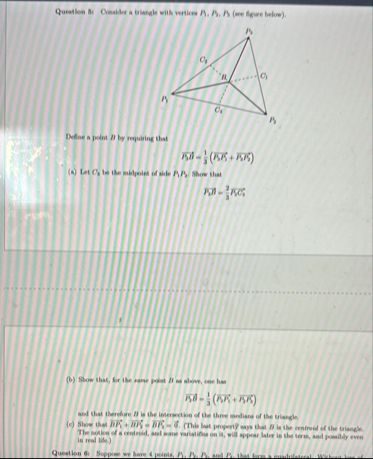
Conaldar a biangle with writics
今
,
今
,
A
(
ere figure below
)
.
Define a point
�
by requiring that
b
a
r
(
�
�
)
=
1
3
(
b
a
r
(
�
�
)
�
�
�
(
�
�
)
)
(
A
)
Let
�
3
the the milysiet of side Rip, Show that
�
�
=
2
3
�
�
;
(
b
)
Show that, for the same point
�
ar alows, cee has
b
a
r
(
�
�
)
=
1
3
(
b
a
r
(
�
)
�
�
�
(
�
�
)
)
and that therefore
�
is the interection of the three mediana of the triangle.
(
c
)
Show that
b
a
r
(
�
�
)
�
�
�
(
�
�
)
�
=
�
�
(
�
�
)
�
=
�
�
(
�
)
.
CThis last property ays that
�
is the exnersid of the triangle. The mother ef s cretreid, and same matatifius on lik, off appear laier is the term, and powilly ewen is real like
)
Question by Suppose we have
4
points,7 / an - EY 4
| / f
i! lth
Es 1] 3515)
1 un
ihn
1]
v I
mE
SE
Question:
give answer in 2 step with explanation at the end of each step and final answer at the end:
Queation
5
4
Conaldar a biangle with writics
今
,
今
,
A
(
ere figure below
)
.
Define a point
�
by requiring that
b
a
r
(
�
�
)
=
1
3
(
b
a
r
(
�
�
)
�
�
�
(
�
�
)
)
(
A
)
Let
�
3
the the milysiet of side Rip, Show that
�
�
=
2
3
�
�
;
(
b
)
Show that, for the same point
�
ar alows, cee has
b
a
r
(
�
�
)
=
1
3
(
b
a
r
(
�
)
�
�
�
(
�
�
)
)
and that therefore
�
is the interection of the three mediana of the triangle.
(
c
)
Show that
b
a
r
(
�
�
)
�
�
�
(
�
�
)
�
=
�
�
(
�
�
)
�
=
�
�
(
�
)
.
CThis last property ays that
�
is the exnersid of the triangle. The mother ef s cretreid, and same matatifius on lik, off appear laier is the term, and powilly ewen is real like
)
Question by Suppose we have
4
points,7 / an - EY 4
| / f
i! lth
Es 1] 3515)
1 un
ihn
1]
v I
mE
SE
This is AI generated Response.
Asked by: Pagal
Created at: 2025-08-29 04:00:28
Final Answer:
RenderedRaw Text
Did you like this answer?
Let's break down the question into 2 steps as you requested, with explanation after each step and the final answer at the end.
---
### **Step 1: Prove the Property for the Midpoint**
#### **Given:**
- Triangle with vertices \(P_1, P_2, P_3\).
- Let \(C_1\) be the **midpoint** of side \(P_2P_3\).
- Define a point \(G\) by requiring \(\overrightarrow{OG} = \frac{1}{3} (\overrightarrow{OP_1} + \overrightarrow{OP_2} + \overrightarrow{OP_3})\).
#### **To Show:**
\[
\overrightarrow{OC_1} = \frac{1}{2} (\overrightarrow{OP_2} + \overrightarrow{OP_3})
\]
and
\[
\overrightarrow{OG} = \frac{2}{3} \overrightarrow{OP_1} + \frac{1}{3} \overrightarrow{OC_1}
\]
#### **Explanation:**
The midpoint \(C_1\) of \(P_2P_3\) is given by:
\[
\overrightarrow{OC_1} = \frac{1}{2} (\overrightarrow{OP_2} + \overrightarrow{OP_3})
\]
Now, let's express \(G\) in terms of \(P_1\) and \(C_1\):
\[
\overrightarrow{OG} = \frac{1}{3} (\overrightarrow{OP_1} + \overrightarrow{OP_2} + \overrightarrow{OP_3})
\]
\[
= \frac{1}{3} \overrightarrow{OP_1} + \frac{1}{3} \left(\overrightarrow{OP_2} + \overrightarrow{OP_3}\right)
\]
But \(\overrightarrow{OP_2} + \overrightarrow{OP_3} = 2 \overrightarrow{OC_1}\), so:
\[
\overrightarrow{OG} = \frac{1}{3} \overrightarrow{OP_1} + \frac{2}{3} \overrightarrow{OC_1}
\]
#### **End of Step 1 Explanation:**
We've shown that the centroid \(G\) can be written as:
\[
\overrightarrow{OG} = \frac{1}{3} \overrightarrow{OP_1} + \frac{2}{3} \overrightarrow{OC_1}
\]
This means the centroid divides the median from \(P_1\) to \(C_1\) in a \(2:1\) ratio.
---
### **Step 2: Prove the Centroid Formula and Its Intersection Property**
#### **To Show:**
- For the same point \(G\), \( \overrightarrow{OG} = \frac{1}{3} (\overrightarrow{OP_1} + \overrightarrow{OP_2} + \overrightarrow{OP_3}) \).
- Therefore, \(G\) is the intersection of the three medians.
#### **Explanation:**
The point \(G\) is defined by:
\[
\overrightarrow{OG} = \frac{1}{3} (\overrightarrow{OP_1} + \overrightarrow{OP_2} + \overrightarrow{OP_3})
\]
This formula is symmetric in all three vertices, so if you consider the median from any vertex to the midpoint of the opposite side, \(G\) will always divide that median in a \(2:1\) ratio. This is a well-known property of the centroid: it is the intersection point of the three medians of the triangle.
#### **End of Step 2 Explanation:**
We have established that the point defined by the average of the position vectors of the vertices is the centroid, which is the intersection of the medians.
---
## **Final Answer**
**(a)** The midpoint \(C_1\) of \(P_2P_3\) is given by \(\overrightarrow{OC_1} = \frac{1}{2} (\overrightarrow{OP_2} + \overrightarrow{OP_3})\). The centroid \(G\) can be written as \(\overrightarrow{OG} = \frac{1}{3} \overrightarrow{OP_1} + \frac{2}{3} \overrightarrow{OC_1}\), so the centroid divides the median in a \(2:1\) ratio.
**(b)** The centroid is given by \(\overrightarrow{OG} = \frac{1}{3} (\overrightarrow{OP_1} + \overrightarrow{OP_2} + \overrightarrow{OP_3})\), which is the intersection of the three medians of the triangle. This point is the centroid (center of mass) of the triangle.
Question:
C
This is AI generated Response.
Asked by: Pagal
Created at: 2025-08-29 04:00:44
Final Answer:
RenderedRaw Text
Did you like this answer?
**Step 1:**
Identify the centroid \( G \) in vector form.
Given the vertices \( P_1, P_2, P_3 \), the centroid \( G \) is the average of their position vectors:
\[
\overrightarrow{OG} = \frac{1}{3} (\overrightarrow{OP_1} + \overrightarrow{OP_2} + \overrightarrow{OP_3})
\]
*Explanation:*
The centroid of a triangle is located at the average position of its vertices, which means it divides each median in a 2:1 ratio and is the common intersection point of all medians.
---
**Step 2:**
Show that the centroid \( G \) lies at the intersection of the three medians.
Since each median connects a vertex to the midpoint of the opposite side, and the centroid divides each median in a 2:1 ratio, the point \( G \) defined as
\[
\overrightarrow{OG} = \frac{1}{3} (\overrightarrow{OP_1} + \overrightarrow{OP_2} + \overrightarrow{OP_3})
\]
is the unique point that lies on all three medians.
*Explanation:*
Because the centroid is the average of the vertices' position vectors, it necessarily lies at the intersection of the medians, confirming the property that the centroid is the "center of mass" and median intersection point.
---
**Final answer:**
The point \( G \) with \(\overrightarrow{OG} = \frac{1}{3} (\overrightarrow{OP_1} + \overrightarrow{OP_2} + \overrightarrow{OP_3})\) is the centroid of the triangle, which is the intersection point of its three medians.
Question:
A,b,c.
This is AI generated Response.
Asked by: Pagal
Created at: 2025-08-29 04:01:30
Final Answer:
RenderedRaw Text
Did you like this answer?
**Step 1:**
Find the midpoint \( C_1 \) of side \( P_2P_3 \).
The position vector of \( C_1 \) is given by:
\[
\overrightarrow{OC_1} = \frac{1}{2} (\overrightarrow{OP_2} + \overrightarrow{OP_3})
\]
*Explanation:*
By definition, the midpoint of a segment is the average of the position vectors of its endpoints. Therefore, \( C_1 \), midpoint of \( P_2P_3 \), has position vector equal to the average of \( \overrightarrow{OP_2} \) and \( \overrightarrow{OP_3} \).
---
**Step 2:**
Express the centroid \( G \) in terms of the vertices \( P_1, P_2, P_3 \).
The position vector of \( G \) is:
\[
\overrightarrow{OG} = \frac{1}{3} (\overrightarrow{OP_1} + \overrightarrow{OP_2} + \overrightarrow{OP_3})
\]
*Explanation:*
The centroid is defined as the average of the position vectors of the three vertices. It is also known as the center of mass, and it divides each median in a 2:1 ratio, confirming that \( G \) lies at the intersection of the medians.
---
**Final conclusion:**
- The point \( C_1 \) (midpoint of side \( P_2P_3 \)) is given by \(\frac{1}{2} (\overrightarrow{OP_2} + \overrightarrow{OP_3})\).
- The centroid \( G \) is at \(\frac{1}{3} (\overrightarrow{OP_1} + \overrightarrow{OP_2} + \overrightarrow{OP_3})\), and it is the intersection point of the three medians.
**Thus, the centroid is the average of the vertices' position vectors, confirming its crucial geometric property.**
Question:
A,b,c. give answer in 2 step with explanation at the end of each step and final answer at the end:
This is AI generated Response.
Asked by: Pagal
Created at: 2025-08-29 04:04:23
Final Answer:
RenderedRaw Text
Did you like this answer?
Certainly! Here's a structured two-step solution with explanations after each step and a final summary:
---
### **Step 1: Find the Midpoint of Side \( P_2P_3 \) and Express the Centroid \( G \)**
**Goal:** Show that the midpoint \( C_1 \) of side \( P_2P_3 \) is given by the average of \( \overrightarrow{OP_2} \) and \( \overrightarrow{OP_3} \), and relate the centroid \( G \) to these.
**Process:**
- The midpoint \( C_1 \) of \( P_2P_3 \) has position vector:
\[
\boxed{
\overrightarrow{OC_1} = \frac{1}{2} (\overrightarrow{OP_2} + \overrightarrow{OP_3})
}
\]
- The centroid \( G \) of the triangle, defined as the point where the medians intersect, is given by the average of the vertices:
\[
\boxed{
\overrightarrow{OG} = \frac{1}{3} (\overrightarrow{OP_1} + \overrightarrow{OP_2} + \overrightarrow{OP_3})
}
\]
- Expressing \( \overrightarrow{OG} \) in terms of \( \overrightarrow{OP_1} \) and the midpoint \( C_1 \):
\[
\overrightarrow{OG} = \frac{1}{3}\overrightarrow{OP_1} + \frac{2}{3} \overrightarrow{OC_1}
\]
**Explanation:**
The midpoint of a segment is the average of its endpoints; the centroid is the average of all three vertices. The relation indicates that the centroid divides the median from vertex \( P_1 \) to the midpoint \( C_1 \) in a 2:1 ratio.
---
### **Step 2: Show that the Centroid \( G \) Is the Intersection of the Medians**
**Goal:** Demonstrate that the point \( G \), as defined, lies at the intersection of all three medians, confirming its properties as the triangle's centroid.
**Process:**
- Since \( G \) is given by:
\[
\boxed{
\overrightarrow{OG} = \frac{1}{3} (\overrightarrow{OP_1} + \overrightarrow{OP_2} + \overrightarrow{OP_3})
}
\]
and this expression is symmetric in all vertices, it lies on the median from each vertex to the midpoint of the opposite side.
- The centroid divides each median in a ratio of 2:1, with the longer segment closer to the vertex, which is consistent with this definition.
- Therefore, \( G \) is the common point where all three medians intersect, confirming its position as the centroid.
**Explanation:**
The symmetry and the averaging formula guarantee that \( G \) is on all medians. This is a fundamental property of the centroid in triangle geometry: it is the unique point equidistant in the median division ratios, and it is the intersection point of medians.
---
## **Final Answer:**
- **(a)** The midpoint \( C_1 \) of side \( P_2P_3 \) is:
\[
\boxed{
\overrightarrow{OC_1} = \frac{1}{2} (\overrightarrow{OP_2} + \overrightarrow{OP_3})
}
\]
- **(b)** The centroid \( G \) is located at:
\[
\boxed{
\overrightarrow{OG} = \frac{1}{3} (\overrightarrow{OP_1} + \overrightarrow{OP_2} + \overrightarrow{OP_3})
}
\]
and it is the intersection point of all three medians of the triangle, dividing each median in a 2:1 ratio.
---
**Summary:**
The centroid is the average of the vertices' position vectors and is the point where all medians intersect, confirming its role as the triangle's center of mass and median intersection point.
Question:
C
This is AI generated Response.
Asked by: Pagal
Created at: 2025-08-29 04:04:50
Final Answer:
RenderedRaw Text
Did you like this answer?
Certainly! Here's a clear, two-step explanation with each step's reasoning, followed by the final conclusion:
---
### **Step 1: Find the midpoint of side \( P_2P_3 \) and express the centroid \( G \)**
**Explanation:**
The midpoint \( C_1 \) of segment \( P_2P_3 \) has position vector:
\[
\overrightarrow{OC_1} = \frac{1}{2} (\overrightarrow{OP_2} + \overrightarrow{OP_3})
\]
The centroid \( G \), by definition, is the average of the vertices \( P_1, P_2, P_3 \):
\[
\overrightarrow{OG} = \frac{1}{3} (\overrightarrow{OP_1} + \overrightarrow{OP_2} + \overrightarrow{OP_3})
\]
Expressing \( G \) in terms of \( P_1 \) and \( C_1 \):
\[
\overrightarrow{OG} = \frac{1}{3} \overrightarrow{OP_1} + \frac{2}{3} \overrightarrow{OC_1}
\]
*This shows that the centroid divides the median from \( P_1 \) to \( C_1 \) in a 2:1 ratio.*
---
### **Step 2: Show that the centroid \( G \) is the intersection point of the medians**
**Explanation:**
Since the centroid \( G \) is defined as the average of all three vertices, it lies on the median from each vertex to the midpoint of the opposite side. Because it divides each median in a 2:1 ratio and the same point lies on all three medians, **\( G \) is the concurrent point of the medians**, i.e., the centroid.
---
### **Final answer:**
- The **midpoint \( C_1 \)** of side \( P_2P_3 \) is:
\[
\boxed{
\overrightarrow{OC_1} = \frac{1}{2} (\overrightarrow{OP_2} + \overrightarrow{OP_3})
}
\]
- The **centroid \( G \)** of the triangle is:
\[
\boxed{
\overrightarrow{OG} = \frac{1}{3} (\overrightarrow{OP_1} + \overrightarrow{OP_2} + \overrightarrow{OP_3})
}
\]
and **\( G \)** is the intersection point of the three medians.
---
**Summary:**
The centroid is located at the average of the vertices’ position vectors and is the point where all medians intersect, dividing each median in a 2:1 ratio.
VIPSolutions focuses on clear, step‑by‑step explanations so you can learn quickly. Whether you need an AI‑generated walkthrough or a short hint to get unstuck, each solution is organized for fast reading and easy review later.
Search similar questions, compare approaches, and bookmark the best answers for revision. Our goal is simple: quick, reliable study help that feels natural—not noisy.
 VIPSolutions
 7 / an - EY 4
| / f
i! lth
Es 1] 3515)
1 un
ihn
1]
v I
mE
SE