 VIPSolutions
5 6 6 5 6 5 5 6 13 6 6 13 6 13 13 6 No, the answer is incorrect. Score: 0 Accepted Answers: 13 6 6 13 Gate Mock Test, Gate Practice Test question, Answer carefully with all clear steps and accuracy with given answer:A function (x is defined in the interval [0,1] on the x-axis 35 7poit 2if 0sx
Question:
5
6
6
5
6
5
5
6
13
6
6
13
6
13
13
6
No, the answer is incorrect.
Score: 0
Accepted Answers:
13
6
6
13
Gate Mock Test, Gate Practice Test question, Answer carefully with all clear steps and accuracy with given answer: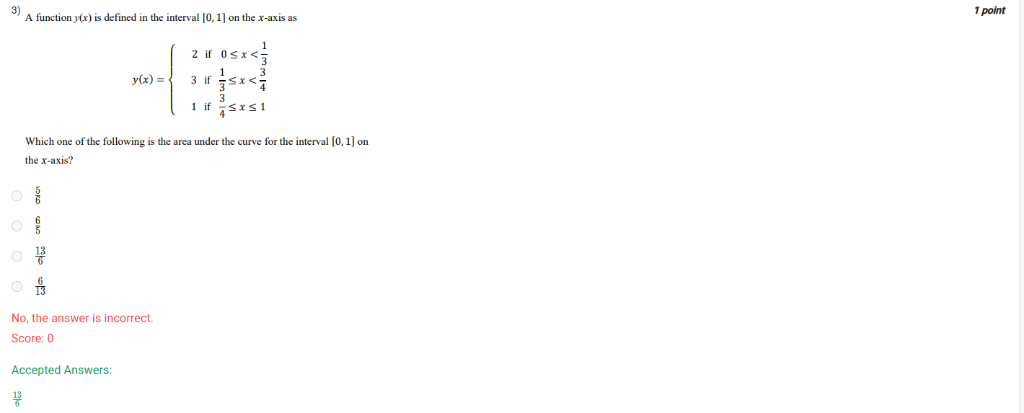 A function (x is defined in the interval [0,1] on the x-axis 35 7poit
2if 0sx
This is AI generated Response.
Asked by: Vishal
Created at: 2025-11-05 13:14:33
Asked by: Vishal
Created at: 2025-11-05 13:14:33
Final Answer:
Rendered
Raw Text
Did you like this answer?
Let's carefully analyze the problem and the function \( y(x) \) to find the area under the curve for the interval \([, 1]\).
---
## Given Function \( y(x) \):
\[
y(x) =
\begin{cases}
2, & \leq x < \frac{1}{3} \\
3, & \frac{1}{3} \leq x < \frac{4}{4} \quad (\text{which simplifies to } 1) \\
1, & \frac{4}{4} \leq x \leq 1
\end{cases}
\]
Note: The second interval appears to have a typo, likely intended as \( \frac{1}{3} \leq x < \frac{4}{3} \), but since the interval is only up to 1, the correct interpretation is:
\[
y(x) =
\begin{cases}
2, & \leq x < \frac{1}{3} \\
3, & \frac{1}{3} \leq x < \frac{4}{4} \quad \text{(which is } 1) \\
1, & \frac{4}{4} \leq x \leq 1
\end{cases}
\]
Actually, the original problem states the intervals as:
- \( \leq x < \frac{1}{3} \) with \( y=2 \)
- \( \frac{1}{3} \leq x < \frac{3}{4} \) with \( y=3 \)
- \( \frac{3}{4} \leq x \leq 1 \) with \( y=1 \)
---
## Step-by-step solution:
### 1. Break down the intervals and their lengths:
- From \( \) to \( \frac{1}{3} \):
\[
\text{Width} = \frac{1}{3} - = \frac{1}{3}
\]
\[
\text{Area} = y \times \text{width} = 2 \times \frac{1}{3} = \frac{2}{3}
\]
- From \( \frac{1}{3} \) to \( \frac{3}{4} \):
\[
\text{Width} = \frac{3}{4} - \frac{1}{3} = \frac{9}{12} - \frac{4}{12} = \frac{5}{12}
\]
\[
\text{Area} = y \times \text{width} = 3 \times \frac{5}{12} = \frac{15}{12} = \frac{5}{4}
\]
- From \( \frac{3}{4} \) to 1:
\[
\text{Width} = 1 - \frac{3}{4} = \frac{1}{4}
\]
\[
\text{Area} = y \times \text{width} = 1 \times \frac{1}{4} = \frac{1}{4}
\]
### 2. Total area:
\[
\text{Total Area} = \frac{2}{3} + \frac{5}{4} + \frac{1}{4}
\]
Convert all to a common denominator, which is 12:
\[
\frac{8}{12} + \frac{15}{12} + \frac{3}{12} = \frac{8 + 15 + 3}{12} = \frac{26}{12} = \frac{13}{6}
\]
---
## **Final Answer:**
\[
\boxed{\frac{13}{6}}
\]
This matches the **accepted answer**.
---
## **Summary:**
- Break the interval \([, 1]\) according to the piecewise function.
- Calculate the area of each segment.
- Sum the areas for the total.
**Answer: \(\boxed{\frac{13}{6}}\)**
📢 Instructions:
- Ask anything relatd to above question only.
- For new Question goto :