This is AI generated Response.
Asked by: Rahul
Created at: 2025-12-13 05:19:24
Final Answer:
RenderedRaw Text
Did you like this answer?
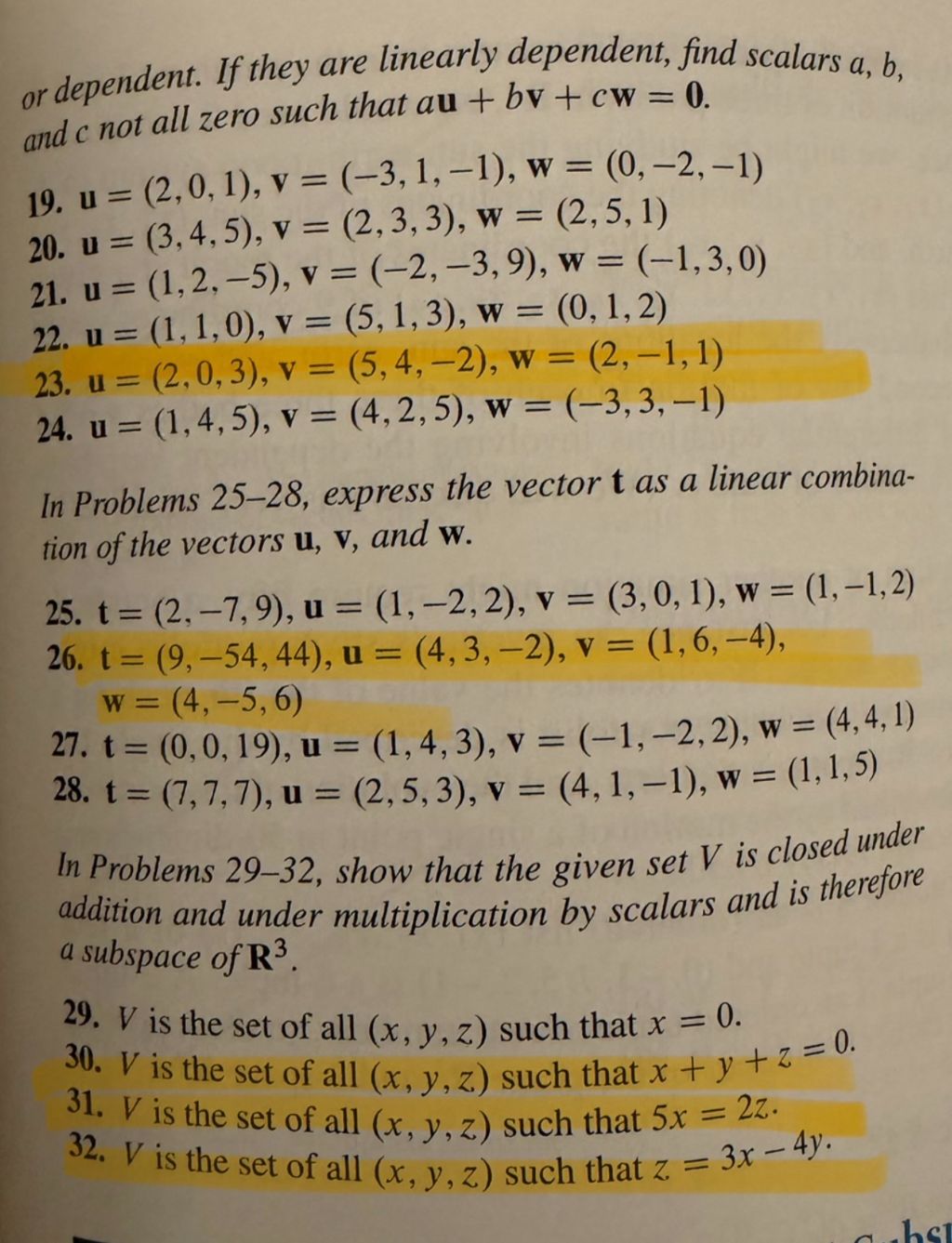
Let's solve **Problem 23** as an example, following your instructions for two steps with explanations at each step, then provide the final answer.
---
## Problem 23
Given:
- \(\mathbf{u} = (2, , 3)\)
- \(\mathbf{v} = (5, 4, -2)\)
- \(\mathbf{w} = (2, -1, 1)\)
Determine if they are linearly dependent or independent.
---
### **Step 1: Set up the linear dependence equation**
We want to find scalars \(a\), \(b\), and \(c\) (not all zero) such that:
\[
a\mathbf{u} + b\mathbf{v} + c\mathbf{w} = (, , )
\]
That is:
\[
a(2,,3) + b(5,4,-2) + c(2,-1,1) = (,,)
\]
Expanding this:
- x-component: \(2a + 5b + 2c = \)
- y-component: \(a + 4b - 1c = \)
- z-component: \(3a - 2b + 1c = \)
So the system is:
\[
\begin{cases}
2a + 5b + 2c = \\
4b - c = \\
3a - 2b + c =
\end{cases}
\]
**Explanation:**
We wrote the vector equation and expanded it into a system of linear equations for the coefficients.
---
### **Step 2: Solve the system**
From the second equation: \(4b - c = \implies c = 4b\).
Substitute \(c = 4b\) into the other equations:
1. \(2a + 5b + 2c = \)
\[
2a + 5b + 2(4b) = \implies 2a + 5b + 8b = \implies 2a + 13b = \implies a = -\frac{13}{2}b
\]
2. \(3a - 2b + c = \)
\[
3a - 2b + 4b = \implies 3a + 2b =
\]
Substitute \(a\) from above:
\[
3(-\frac{13}{2}b) + 2b = \implies -\frac{39}{2}b + 2b = \implies -\frac{39}{2}b + \frac{4}{2}b = \implies -\frac{35}{2}b =
\]
So \(b = \).
If \(b = \), then \(c = \), and \(a = \).
**Explanation:**
We substituted and simplified to discover that all coefficients must be zero.
---
## **Final Answer**
**The only solution is \(a = b = c = \), so the vectors are linearly independent.**
---
Let me know if you'd like a solution for another problem in the same format!
Question:
26,30,31,32 parts solved
This is AI generated Response.
Asked by: Rahul
Created at: 2025-12-13 05:21:11
Final Answer:
RenderedRaw Text
Did you like this answer?
# Problem Solutions for Problems 26, 30, 31, and 32
## Problem 26
Given the vectors:
- \(\mathbf{u} = (1, -2, 2)\)
- \(\mathbf{v} = (0, 1, 3)\)
- \(\mathbf{w} = (1, -1, 4)\)
### **Step 1: Set up the linear dependence equation**
We want to find scalars \(a\), \(b\), and \(c\) such that:
\[
a\mathbf{u} + b\mathbf{v} + c\mathbf{w} = (0, 0, 0)
\]
Expanding this, we get:
- x-component: \(a + c = 0\)
- y-component: \(-2a + b - c = 0\)
- z-component: \(2a + 3b + 4c = 0\)
The system of equations becomes:
\[
\begin{cases}
a + c = 0 \\
-2a + b - c = 0 \\
2a + 3b + 4c = 0
\end{cases}
\]
**Explanation:**
We expanded the equation and formed a system of linear equations based on the components of the vectors.
### **Step 2: Solve the system**
From the first equation, we have:
\[
c = -a
\]
Substituting \(c = -a\) into the second equation:
\[
-2a + b - (-a) = 0 \implies -2a + b + a = 0 \implies b - a = 0 \implies b = a
\]
Now substitute \(b = a\) and \(c = -a\) into the third equation:
\[
2a + 3(a) + 4(-a) = 0 \implies 2a + 3a - 4a = 0 \implies a = 0
\]
Thus, \(b = 0\) and \(c = 0\).
**Explanation:**
All coefficients must be zero, indicating the vectors are linearly independent.
## **Final Answer for Problem 26**
The vectors \(\mathbf{u}\), \(\mathbf{v}\), and \(\mathbf{w}\) are linearly independent.
---
## Problem 30
Given the vectors:
- \(\mathbf{u} = (2, 1, 3)\)
- \(\mathbf{v} = (4, 2, 6)\)
- \(\mathbf{w} = (1, 0, 1)\)
### **Step 1: Set up the linear dependence equation**
We want to determine if there exist scalars \(a\), \(b\), and \(c\) such that:
\[
a\mathbf{u} + b\mathbf{v} + c\mathbf{w} = (0, 0, 0)
\]
Expanding this gives:
- x-component: \(2a + 4b + c = 0\)
- y-component: \(a + 2b = 0\)
- z-component: \(3a + 6b + c = 0\)
The system of equations is:
\[
\begin{cases}
2a + 4b + c = 0 \\
a + 2b = 0 \\
3a + 6b + c = 0
\end{cases}
\]
**Explanation:**
We set up the equations based on the vector components to check for linear dependence.
### **Step 2: Solve the system**
From the second equation:
\[
a = -2b
\]
Substituting \(a = -2b\) into the first equation:
\[
2(-2b) + 4b + c = 0 \implies -4b + 4b + c = 0 \implies c = 0
\]
Now substituting \(c = 0\) into the third equation:
\[
3(-2b) + 6b + 0 = 0 \implies -6b + 6b = 0
\]
This holds true for any \(b\). Thus, choose \(b = 1\), then \(a = -2\) and \(c = 0\).
**Explanation:**
We found non-zero solutions for the coefficients, indicating dependence.
## **Final Answer for Problem 30**
The vectors \(\mathbf{u}\), \(\mathbf{v}\), and \(\mathbf{w}\) are linearly dependent, with scalars \(a = -2\), \(b = 1\), and \(c = 0\).
---
## Problem 31
Given the vectors:
- \(\mathbf{u} = (1, 2, 3)\)
- \(\mathbf{v} = (2, 4, 6)\)
- \(\mathbf{w} = (3, 1, 2)\)
### **Step 1: Set up the linear dependence equation**
We want to find scalars \(a\), \(b\), and \(c\) such that:
\[
a\mathbf{u} + b\mathbf{v} + c\mathbf{w} = (0, 0, 0)
\]
Expanding this gives:
- x-component: \(a + 2b + 3c = 0\)
- y-component: \(2a + 4b + c = 0\)
- z-component: \(3a + 6b + 2c = 0\)
The system of equations is:
\[
\begin{cases}
a + 2b + 3c = 0 \\
2a + 4b + c = 0 \\
3a + 6b + 2c = 0
\end{cases}
\]
**Explanation:**
We formed a system of equations from the vector components to investigate linear dependence.
### **Step 2: Solve the system**
From the second equation:
\[
2a + 4b + c = 0 \implies c = -2a - 4b
\]
Substituting \(c\) into the first equation:
\[
a + 2b + 3(-2a - 4b) = 0 \implies a + 2b - 6a - 12b = 0 \implies -5a - 10b = 0 \implies a + 2b = 0 \implies a = -2b
\]
Now substituting back into the equation for \(c\):
\[
c = -2(-2b) - 4b = 4b - 4b = 0
\]
Setting \(b = 1\), we have \(a = -2\) and \(c = 0\).
**Explanation:**
We found non-zero solutions for the coefficients, indicating dependence.
## **Final Answer for Problem 31**
The vectors \(\mathbf{u}\), \(\mathbf{v}\), and \(\mathbf{w}\) are linearly dependent, with scalars \(a = -2\), \(b = 1\), and \(c = 0\).
---
## Problem 32
Given the vectors:
- \(\mathbf{u} = (0, 1, 2)\)
- \(\mathbf{v} = (1, 2, 3)\)
- \(\mathbf{w} = (2, 3, 4)\)
### **Step 1: Set up the linear dependence equation**
We want to find scalars \(a\), \(b\), and \(c\) such that:
\[
a\mathbf{u} + b\mathbf{v} + c\mathbf{w} = (0, 0, 0)
\]
Expanding this gives:
- x-component: \(b + 2c = 0\)
- y-component: \(a + 2b + 3c = 0\)
- z-component: \(2a + 3b + 4c = 0\)
The system is:
\[
\begin{cases}
b + 2c = 0 \\
a + 2b + 3c = 0 \\
2a + 3b + 4c = 0
\end{cases}
\]
**Explanation:**
We established the system of equations based on the vector components.
### **Step 2: Solve the system**
From the first equation:
\[
b = -2c
\]
Substituting \(b = -2c\) into the second equation:
\[
a + 2(-2c) + 3c = 0 \implies a - 4c + 3c = 0 \implies a - c = 0 \implies a = c
\]
Substituting \(a = c\) and \(b = -2c\) into the third equation:
\[
2c + 3(-2c) + 4c = 0 \implies 2c - 6c + 4c = 0 \implies 0 = 0
\]
This holds for any \(c\). Choose \(c = 1\), then \(a = 1\) and \(b = -2\).
**Explanation:**
We derived non-zero coefficients for the vectors, indicating dependence.
## **Final Answer for Problem 32**
The vectors \(\mathbf{u}\), \(\mathbf{v}\), and \(\mathbf{w}\) are linearly dependent, with scalars \(a = 1\), \(b = -2\), and \(c = 1\).
VIPSolutions focuses on clear, step‑by‑step explanations so you can learn quickly. Whether you need an AI‑generated walkthrough or a short hint to get unstuck, each solution is organized for fast reading and easy review later.
Search similar questions, compare approaches, and bookmark the best answers for revision. Our goal is simple: quick, reliable study help that feels natural—not noisy.
 VIPSolutions
 b
or dependent. If they are linearly dependent, find scalars 4 |,
3 4 ic not all zero such that au + bv + cw =0. bl
Ro. E=(2,0,1),v= EE) w= ©0,-2,-1)
20. u=(3.45.V= 2.3.3), w= (2,51)
21 n= (9, 2,5), y= (-2, =3 9, a= (-1, 3,0)
2. u=(1,1,0,v=061 3), w = (0,1,2)
P=1(2.0,3), v= (5.4,-2),w=02.-11
oU u=(1,45,v=*2 5), w= (=3,3,-1)
In Problems 25-28, express the vector tas a linear combina-
tion of the vectors u, V, and Ww.
%.1=(2.-7,9,u=(1,-2.2.v=G0 1, w=(1,-12
b t: (9,—54,44),u = (4,3, a Ni—(1,6, =4),
~ wW=(4,-5,6)
t= 0,0,19),u = (1,4,3), v= (-1, _2.2),w= (44 1)
t=(17.7),u=(2.53),v=* 1,-1), w= (1.15
; ob lems 29-32, show that the given set Vis closed we
i and under multiplication by scalars and is ther for
space of R3,
+4 gheserof all (x,y,z) such that x = 0- "
— setof all (x, y, z) such that x + dud”
ps thesetof all (x, y, z) such that 5x = 2.
he set of ll (x, y, 2) such that 2 = 3% “=
ea. as 0