VIPSolutions logo ✨ VIPSolutions

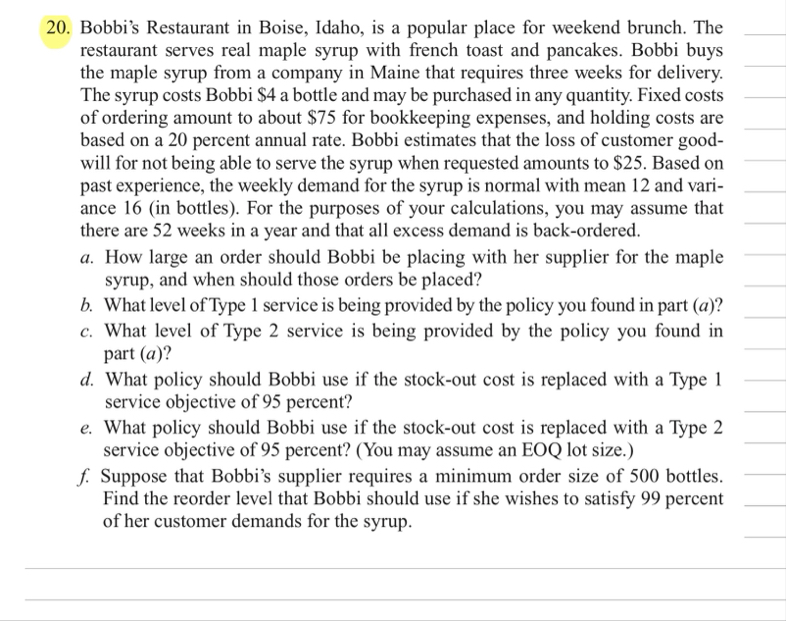
20. Bobbi's Restaurant in Boise, Idaho, is a popular place for weekend brunch. The restaurant serves real maple syrup with french toast and pancakes. Bobbi buys the maple syrup from a company in Maine that requires three weeks for delivery. The syrup costs Bobbi \( \$ 4 \) a bottle and may be purchased in any quantity. Fixed costs of ordering amount to about \( \$ 75 \) for bookkeeping expenses, and holding costs are based on a 20 percent annual rate. Bobbi estimates that the loss of customer goodwill for not being able to serve the syrup when requested amounts to \( \$ 25 \). Based on past experience, the weekly demand for the syrup is normal with mean 12 and variance 16 (in bottles). For the purposes of your calculations, you may assume that there are 52 weeks in a year and that all excess demand is back-ordered. a. How large an order should Bobbi be placing with her supplier for the maple syrup, and when should those orders be placed? b. What level of Type 1 service is being provided by the policy you found in part (a)? c. What level of Type 2 service is being provided by the policy you found in part (a)? d. What policy should Bobbi use if the stock-out cost is replaced with a Type 1 service objective of 95 percent? \( e \). What policy should Bobbi use if the stock-out cost is replaced with a Type 2 service objective of 95 percent? (You may assume an EOQ lot size.) f. Suppose that Bobbi's supplier requires a minimum order size of 500 bottles. Find the reorder level that Bobbi should use if she wishes to satisfy 99 percent of her customer demands for the syrup.20. Bobbi's Restaurant in Boise, Idaho, is a popular place for weekend brunch. The restaurant serves real maple syrup with french toast and pancakes. Bobbi buys the maple syrup from a company in Maine that requires three weeks for delivery. The syrup costs Bobbi $4 a bottle and may be purchased in any quantity. Fixed costs of ordering amount to about $75 for bookkeeping expenses, and holding costs are based on a 20 percent annual rate. Bobbi estimates that the loss of customer good- will for not being able to serve the syrup when requested amounts to $25. Based on past experience, the weekly demand for the syrup is normal with mean 12 and vari- ance 16 (in bottles). For the purposes of your calculations, you may assume that there are 52 weeks in a year and that all excess demand is back-ordered. a. How large an order should Bobbi be placing with her supplier for the maple syrup, and when should those orders be placed? bh. What level of Type 1 service is being provided by the policy you found in part (a)? ¢. What level of Type 2 service is being provided by the policy you found in part (a)? d. What policy should Bobbi use if the stock-out cost is replaced with a Type 1 service objective of 95 percent? e. What policy should Bobbi use if the stock-out cost is replaced with a Type 2 service objective of 95 percent? (You may assume an EOQ lot size.) /. Suppose that Bobbi's supplier requires a minimum order size of 500 bottles. Find the reorder level that Bobbi should use if she wishes to satisfy 99 percent of her customer demands for the syrup.
Question:

20. Bobbi's Restaurant in Boise, Idaho, is a popular place for weekend brunch. The restaurant serves real maple syrup with french toast and pancakes. Bobbi buys the maple syrup from a company in Maine that requires three weeks for delivery. The syrup costs Bobbi \( \$ 4 \) a bottle and may be purchased in any quantity. Fixed costs of ordering amount to about \( \$ 75 \) for bookkeeping expenses, and holding costs are based on a 20 percent annual rate. Bobbi estimates that the loss of customer goodwill for not being able to serve the syrup when requested amounts to \( \$ 25 \). Based on past experience, the weekly demand for the syrup is normal with mean 12 and variance 16 (in bottles). For the purposes of your calculations, you may assume that there are 52 weeks in a year and that all excess demand is back-ordered. a. How large an order should Bobbi be placing with her supplier for the maple syrup, and when should those orders be placed? b. What level of Type 1 service is being provided by the policy you found in part (a)? c. What level of Type 2 service is being provided by the policy you found in part (a)? d. What policy should Bobbi use if the stock-out cost is replaced with a Type 1 service objective of 95 percent? \( e \). What policy should Bobbi use if the stock-out cost is replaced with a Type 2 service objective of 95 percent? (You may assume an EOQ lot size.) f. Suppose that Bobbi's supplier requires a minimum order size of 500 bottles. Find the reorder level that Bobbi should use if she wishes to satisfy 99 percent of her customer demands for the syrup.Uploaded Image20. Bobbi's Restaurant in Boise, Idaho, is a popular place for weekend brunch. The restaurant serves real maple syrup with french toast and pancakes. Bobbi buys the maple syrup from a company in Maine that requires three weeks for delivery. The syrup costs Bobbi $4 a bottle and may be purchased in any quantity. Fixed costs of ordering amount to about $75 for bookkeeping expenses, and holding costs are based on a 20 percent annual rate. Bobbi estimates that the loss of customer good- will for not being able to serve the syrup when requested amounts to $25. Based on past experience, the weekly demand for the syrup is normal with mean 12 and vari- ance 16 (in bottles). For the purposes of your calculations, you may assume that there are 52 weeks in a year and that all excess demand is back-ordered. a. How large an order should Bobbi be placing with her supplier for the maple syrup, and when should those orders be placed? bh. What level of Type 1 service is being provided by the policy you found in part (a)? ¢. What level of Type 2 service is being provided by the policy you found in part (a)? d. What policy should Bobbi use if the stock-out cost is replaced with a Type 1 service objective of 95 percent? e. What policy should Bobbi use if the stock-out cost is replaced with a Type 2 service objective of 95 percent? (You may assume an EOQ lot size.) /. Suppose that Bobbi's supplier requires a minimum order size of 500 bottles. Find the reorder level that Bobbi should use if she wishes to satisfy 99 percent of her customer demands for the syrup.

This is AI generated Response.
Asked by: chandu
Created at: 2026-03-05 01:47:33

Thought Process:

Rendered Raw Text
**Solving inventory control** I'm addressing an inventory control problem using a continuous review (Q,R) system with normal demand during a 3-week lead time. The cost parameters include a purchase cost of $4 per bottle and an ordering fixed cost of $75. The holding cost is calculated at 20% annually, equating to about $0.015 per bottle per week. The weekly demand has a mean of 12 and a variance of 16, leading to a standard deviation of 4. Over the lead time, the demand mean reaches 36, with a variance of 48.**Determining EOQ and backorder policy** I'm calculating the Economic Order Quantity (EOQ) without uncertainty, using the formula Q* = sqrt(2DK/h). For annual demand, D is 12 bottles per week multiplied by 52, resulting in 624 bottles. The annual holding cost (h) is $0.80. Plugging in the numbers gives me Q* = sqrt(2 * 624 * 75 / 0.80), which results in approximately 343 bottles. Now, about backorders: if there's a cost of $25 per backordered unit, assuming all excess demand is back-ordered, I should consider this penalty in my continuous-review model for stockouts.**Analyzing stockout costs and safety stock** Here, the loss of customer goodwill for not serving syrup is $25. I wonder if that's the cost per stockout occurrence or per unit, possibly per customer? In a (Q,R) system with backorders, it usually involves a per-unit shortage cost (p) or a per stockout instance, often following a newsvendor-like penalty for balancing costs and determining safety stock. There's a standard approach for (Q,R) systems under normally distributed demand during lead time, where I should select a safety factor (z) that satisfies G(z) = (hQ)/(pD). This G(z) represents the expected shortage per cycle.**Recalling inventory formulas** I'm reviewing some formulas for a continuous review (Q,R) system with backorders and normally distributed demand during lead time. The reorder point (R) is calculated as R = μ_L + zσ_L. The expected shortage per cycle (ES(z)) is expressed as σ_L * L(z), with L(z) often representing the standard normal loss function. The expected shortage, E[S], equals σ_L * L(z). There’s also the average backorders, which I need to clarify. The cost function typically balances holding costs and shortage costs, with average on-hand inventory deriving from safety stock. For continuous review, average on-hand inventory becomes (Q/2) + (R - μ_L), adjusted for shortages.**Recalling inventory formulas and calculating costs** I'm reviewing the formulas for average on-hand inventory without backorders, which is I = (Q/2) + (R - μ_L) + (σ_L^2)/(Q) f(R). For a (Q,R) model, I note that the expected number of backorders is related to the expected shortage E[S(R)], which occurs at the time of replenishment. The average backorder level seems to tie into the expected shortage per cycle. When establishing the reorder point (R), I must factor in the shortage cost of $25 per stockout occurrence. I’ll calculate the total cost, balancing holding costs, shortage costs, and backorders, while also optimizing for service level.**Calculating reorder point and service levels** I'm working through the inventory policy details related to reorder points and expected shortages. The expected total annual cost must balance holding and shortage costs. I found that increasing the reorder point (R) reduces expected shortages, which relates to the probability of stockouts. Calculating R with z values, I determine that an optimized R is about 51 bottles based on the service level and expected shortage per cycle. The fill rate appears very high at around 99.99%. However, if we shift to a 95% service level, I need to adjust R again without changing the order quantity (Q). For the Type 2 service objective, I realize the expected shortages might need more revision since such high shortages seem unrealistic.**Calculating reorder levels and service objectives** In this section, I'm figuring out the L(z) function for negative z-values, realizing that as z becomes larger negatively, L(z) approaches -z since the tail probability remains high. For instance, when estimating for z = -1, I found L(-1) to be 1.083. Moving on, I calculate reorder points (R) based on optimizing the expected shortage for different service levels. Eventually, for a 99% fill rate objective with a minimum order size of 500, I compute the reorder point to be approximately 32 bottles, ensuring I meet customer demands effectively while keeping shortages manageable.**Calculating order quantities and reorder points** I’m working on determining Bobbi's order sizes and the timing for those orders. For the economic order quantity (EOQ), I calculate the demand and holding costs, resulting in an approximate Q* of 343 bottles. I also derive the reorder point (R) around 51, ensuring consistency in unit measurements. Next, I compute service levels, finding Type 1 service provides around 98.2% and Type 2 service at 99.99%. For optimal stockouts, I suggest R=33 based on a fill rate of 99%. Orders should be placed when inventory hits that reorder point as lead time is three weeks.**Finalizing calculations for reorder points** In part (d) and (e), I’ll keep the order quantity (Q) at the EOQ of 343 for now. The parameters are set: cost per unit is $4, setup cost is $75, holding cost is 0.8 per unit per year, and annual demand is 624. For part (a), the reorder point (R) is calculated at approximately 51 when the inventory hits that level. The Type 1 service level is around 98.2%, and the fill rate hits about 99.99%. In part (e), with a 95% fill rate, the reorder point rounds to 19. For a minimum order size of 500 and a 99% fill rate, I find R to be around 33.

Final Answer:

Rendered Raw Text
Did you like this answer?
Given - Unit cost c = $4 - Order/setup cost K = $75 - Annual holding-rate i = 20% → h = i c = 0.20 × 4 = $0.80 per bottle per year - Delivery lead time L = 3 weeks - Weekly demand ~ N(μw, σw2) with μw = 12, σw2 = 16 → σw = 4 - All excess demand is back-ordered - Weeks/year = 52 → annual mean demand D = 12 × 52 = 624 bottles - Lead-time demand X ~ N(μL, σL2) with μL = 3×12 = 36 and σL2 = 3×16 = 48 → σL = √48 ≈ 6.928 Useful formulas - EOQ: Q* = √(2 D K / h) - Reorder point R = μL + z σL - With per-unit backorder penalty p and continuous review (Q, R), the optimal z satisfies 1 − Φ(z) = h Q / (p D) (Φ is the standard normal cdf) - Type 1 (cycle) service level CSL = Φ(z) - Expected shortage per cycle E[S] = σL L(z), where L(z) = φ(z) − z[1 − Φ(z)] (φ is the standard normal pdf) - Type 2 (fill rate) β = 1 − E[S]/Q a) Economic lot size and reorder point with stockout penalty p = $25 - EOQ: Q* = √(2 × 624 × 75 / 0.80) ≈ √117000 ≈ 343 bottles - z from penalty trade-off: 1 − Φ(z) = (0.80 × 343) / (25 × 624) ≈ 0.0176 → z ≈ 2.11 - R = 36 + 2.11 × 6.928 ≈ 50.6 → about 51 bottles Policy: Order about 343 bottles whenever the inventory position drops to about 51 bottles. b) Type 1 service level under (a) CSL = Φ(2.11) ≈ 0.982 → about 98.2%. c) Type 2 service level under (a) - L(2.11) ≈ 0.0060 → E[S] = 6.928 × 0.0060 ≈ 0.041 bottles/cycle - β = 1 − 0.041/343 ≈ 0.99988 → about 99.99% fill rate. d) Policy for a Type 1 service objective of 95% - Keep EOQ lot size Q ≈ 343 - For CSL = 0.95, z = 1.645 → R = 36 + 1.645 × 6.928 ≈ 47.4 → use about 47–48 bottles (round up to 48 to ensure ≥95%). e) Policy for a Type 2 service objective of 95% (assume EOQ lot size) - Q ≈ 343, need β = 0.95 → E[S] = (1 − β)Q = 0.05 × 343 = 17.15 - L(z) = E[S]/σL = 17.15 / 6.928 ≈ 2.47 → z ≈ −2.47 - R = 36 + (−2.47) × 6.928 ≈ 18.9 → about 19 bottles. f) If supplier imposes a minimum order size Q = 500 and Bobbi wants 99% of demand satisfied (Type 2 = 99%) - E[S] = 0.01 × 500 = 5 - L(z) = 5 / 6.928 ≈ 0.721 → z ≈ −0.53 - R = 36 + (−0.53) × 6.928 ≈ 32.3 → set R ≈ 33 bottles (round up to ensure ≥99% fill rate). Summary - (a) Q ≈ 343; R ≈ 51 - (b) Type 1 service ≈ 98.2% - (c) Type 2 service ≈ 99.99% - (d) With CSL = 95%: Q ≈ 343; R ≈ 48 - (e) With fill rate = 95%: Q ≈ 343; R ≈ 19 - (f) With Q = 500 and fill rate = 99%: R ≈ 33

📢 Instructions:

  • Ask anything relatd to above question only.
  • For new Question goto :

Study Help, Fast Answers

VIPSolutions focuses on clear, step‑by‑step explanations so you can learn quickly. Whether you need an AI‑generated walkthrough or a short hint to get unstuck, each solution is organized for fast reading and easy review later.

Search similar questions, compare approaches, and bookmark the best answers for revision. Our goal is simple: quick, reliable study help that feels natural—not noisy.