1
.
The bulk of the sediment that makes up Cape Cod and the Islands was deposited:
a
.
during the last Ice Age
2
0
0
million years ago
b
.
around
1
4
,
0
0
0
years ago
c
.
by rising ocean waters at the end of the last Ice Age
d
.
by Ice Age winds
Letter:
2
.
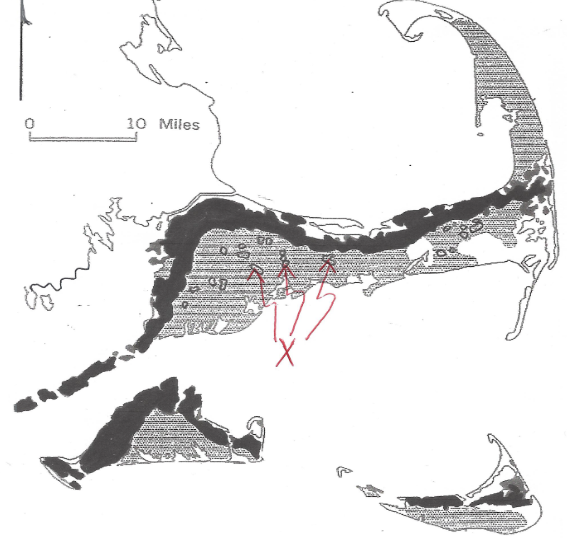
The map above shows the distribution of TWO types of glacial deposits found on Cape Cod.
a
.
What type of glacial deposits are found in the blackened areas?
b
.
What type of glacial deposits are found in the stippled
(
shaded
)
areas?
3
.
Which of the above deposits could be classified as till?
4
.
Which of the above deposits have been influenced by the depositional effects of running water?
5
.
Briefly describe the difference in the TEXTURES of the sediments found in the two deposits.
blackened areas:
stippled
(
shaded
)
areas:
6
.
What features are identified by the letter X on the above map?
Explain how these features were formed. Give step-by-step explanation0 10 ites | {
Question:
1
.
The bulk of the sediment that makes up Cape Cod and the Islands was deposited:
a
.
during the last Ice Age
2
0
0
million years ago
b
.
around
1
4
,
0
0
0
years ago
c
.
by rising ocean waters at the end of the last Ice Age
d
.
by Ice Age winds
Letter:
2
.
The map above shows the distribution of TWO types of glacial deposits found on Cape Cod.
a
.
What type of glacial deposits are found in the blackened areas?
b
.
What type of glacial deposits are found in the stippled
(
shaded
)
areas?
3
.
Which of the above deposits could be classified as till?
4
.
Which of the above deposits have been influenced by the depositional effects of running water?
5
.
Briefly describe the difference in the TEXTURES of the sediments found in the two deposits.
blackened areas:
stippled
(
shaded
)
areas:
6
.
What features are identified by the letter X on the above map?
Explain how these features were formed. Give step-by-step explanation0 10 ites | {
This is AI generated Response.
Asked by: coochbehar
Created at: 2025-07-01 21:53:44
Final Answer:
RenderedRaw Text
Did you like this answer?
Let's answer your questions step by step, using the map and what we know about Cape Cod's glacial history:
---
**1. The bulk of the sediment that makes up Cape Cod and the Islands was deposited:**
- **Correct answer:**
**b. around 14,000 years ago**
Cape Cod and the Islands were formed mostly from glacial deposits left at the end of the last Ice Age, about 14,000–16,000 years ago.
---
**2. The map above shows the distribution of TWO types of glacial deposits found on Cape Cod.**
**a. What type of glacial deposits are found in the blackened areas?**
- **Answer:**
**Moraine deposits** (unsorted glacial till deposited directly by a glacier, forming ridges).
**b. What type of glacial deposits are found in the stippled (shaded) areas?**
- **Answer:**
**Outwash plain deposits** (sorted sediments deposited by meltwater streams in front of the glacier).
---
**3. Which of the above deposits could be classified as till?**
- **Answer:**
**The moraine deposits** (blackened areas) are made of till, which is unsorted material deposited directly by the glacier.
---
**4. Which of the above deposits have been influenced by the depositional effects of running water?**
- **Answer:**
**The outwash plain deposits** (stippled/shaded areas) have been sorted and deposited by meltwater streams.
---
**5. Briefly describe the difference in the TEXTURES of the sediments found in the two deposits.**
- **Blackened areas (moraine/till):**
**Texture:** Poorly sorted, mix of clay, silt, sand, gravel, and boulders. Angular particles.
- **Stippled (shaded) areas (outwash plain):**
**Texture:** Well sorted, mostly sand and gravel. Rounded particles due to water transport.
---
**6. What features are identified by the letter X on the above map? Explain how these features were formed.**
**Feature:**
The X marks the **kettle holes** (or kettle lakes).
**Step-by-step explanation of formation:**
1. **Retreating Glacier:** As the glacier that covered Cape Cod began to melt and retreat, blocks of ice broke off and became buried in glacial outwash (sand and gravel deposited by meltwater).
2. **Buried Ice Melts:** Over time, these large chunks of ice melted.
3. **Collapse:** As the ice melted, the overlying sediment collapsed into the empty space left behind, forming depressions.
4. **Kettle Holes/Lakes:** These depressions, known as **kettle holes**, sometimes fill with water to become **kettle lakes**.
---
**Summary Table:**
| Area Type | Deposit Name | Sorting | Particle Size | Formation Agent |
|----------------------|---------------|-------------|-----------------|---------------------|
| Blackened | Moraine (till)| Poorly | Mixed | Directly by glacier |
| Stippled/Shaded | Outwash plain | Well | Sand/Gravel | Meltwater streams |
If you need more details or have any other questions, let me know!
VIPSolutions focuses on clear, step‑by‑step explanations so you can learn quickly. Whether you need an AI‑generated walkthrough or a short hint to get unstuck, each solution is organized for fast reading and easy review later.
Search similar questions, compare approaches, and bookmark the best answers for revision. Our goal is simple: quick, reliable study help that feels natural—not noisy.
 VIPSolutions
 0 10 ites | {