This is AI generated Response.
Asked by: Veera manikanta
Created at: 2025-09-16 19:55:01
Final Answer:
RenderedRaw Text
Did you like this answer?
## Answer Analysis
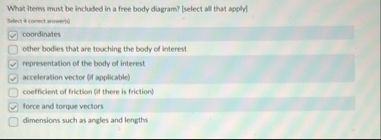
The question asks which items **must** be included in a free body diagram (FBD). Let's review each option:
### Must be included:
- **Representation of the body of interest**: YES — You must show the object being analyzed.
- **Force and torque vectors**: YES — All external forces (and torques, if relevant) acting on the body must be shown.
- **Other bodies that are touching the body of interest**: YES — *But* in the form of the forces they exert, not as detailed objects themselves. Usually, only the forces are drawn, not the other bodies.
### Sometimes included (optional based on context):
- **Acceleration vector (if applicable)**: OPTIONAL — Sometimes shown to clarify direction of motion, but not required for a FBD.
- **Coordinates**: OPTIONAL — Sometimes axes are added for clarity, but not always required.
- **Coefficient of friction (if there is friction)**: OPTIONAL — Usually, the frictional force is shown, not the coefficient itself.
- **Dimensions such as angles and lengths**: OPTIONAL — Only if needed for problem-solving, not a strict requirement.
---
## Correct Choices (Must Include)
- **Representation of the body of interest**
- **Force and torque vectors**
*Other options are either not required or only included if helpful for problem-solving.*
---
## Free Body Diagram Essentials
A proper free body diagram must include:
1. **The isolated body/object** (representation of the body of interest).
2. **All external forces (and torques, if applicable)** acting on the body, shown as arrows.
3. Optionally, a **coordinate system**, **acceleration vector**, or **dimensions** if needed for clarity.
---
### **Summary Table**
| Item | Must Include? |
|------------------------------------------------|---------------|
| Representation of the body of interest | Yes |
| Force and torque vectors | Yes |
| Other bodies touching the body (as objects) | No (show forces instead) |
| Acceleration vector (if applicable) | Optional |
| Coordinates | Optional |
| Coefficient of friction (if there is friction) | Optional |
| Dimensions such as angles and lengths | Optional |
Question:
1. Introduction:
Provide the necessary conceptual background and introduction required to understand and answer the given question. Include all relevant concepts, theories, or definitions essential for comprehending the problem. At the end of the introduction, add an Explanation block that concisely elaborates on the introduction by providing relevant supporting statements and clarifying the context.
Explanation: Clearly elucidate the introductory concepts, supporting the narrative with necessary statements that establish the context and relevance of these concepts in answering the question. This explanation should reinforce how the introduction aids in understanding and solving the problem.
2. Identifying the Correct Option Among the Choices:
Identify the correct choice from the provided options.
Explanation: Provide a comprehensive justification for why this option is correct. Enhance the explanation with detailed reasoning, incorporating relevant concepts, theories, or formulas as necessary to substantiate the correctness of this choice.
3. Analysis of Why Other Options Are Incorrect:
List the options that are incorrect.
Explanation: Offer a detailed analysis of why each of these options does not satisfy the question's requirements. Support each explanation with logical reasoning or highlight conceptual discrepancies that render these options incorrect.
Conclusion:
Provide a complete, simple, and clear summary of the solution using lucid language. The conclusion should be concise yet comprehensive, encapsulating the main points, methodologies employed, and the final outcome of the solution. Ensure that the summary effectively reinforces the understanding of how the problem was addressed and how the solution resolves the question.
Guidelines for Answering the Question:
1. Professional and Impersonal Tone:
· Maintain a professional and impersonal tone throughout the response.
· Avoid using personal pronouns such as 'I', 'we', 'you', etc.
2. Accuracy and Adherence to Concepts:
· Ensure utmost accuracy and strict adherence to the necessary concepts and correct textbook-based formulas.
· Provide accurate and relevant information required to solve the question.
3. Explanation Blocks:
· Include an Explanation block at the end of each section or step.
· Provide context and clarify the methodology used by including necessary supporting statements.
4. Direct and Complete Answer:
· Focus solely on delivering a well-explained, direct, and complete answer to the question without additional guidance or extraneous content.
5. Specified Format:
· Strictly follow the specified format.
· Ensure that each section, especially the introduction and each step of the solution, is accompanied by a detailed and relevant supporting statement in the explanation.
6. Detailed Comprehensive Solution:
· Provide an exact, detailed, and comprehensive step-by-step answer.
· Include explanations for each step with the required supporting statements.
· Do not skip any steps or omit any part of the solution.
7. Correctness and Completeness:
· Always provide a correct, complete, detailed, and well-explained solution.
· Avoid any errors in the solution.
8. No Errors:
· Ensure there are no typographical, formulaic, calculation, programming, or grammatical errors in the solution.
· Perform calculations and simplifications step-by-step vertically (downward), not horizontally (to the right side).
9. Graphs/Diagrams/Tables/Charts:
· Include correct graphs, diagrams, tables, or charts whenever required in the solution.
10. Units and Notations:
· Ensure there are no errors in units or notations in the solution.
· Use standard units and notations consistently throughout the solution.
11. Vital Parts:
· Avoid missing any vital part of the solution.
· Ensure every part of the solution is included and well-explained.
This is AI generated Response.
Asked by: Veera manikanta
Created at: 2025-09-16 19:58:49
Final Answer:
RenderedRaw Text
Did you like this answer?
# Free Body Diagram Essentials
## 1. Introduction
A free body diagram (FBD) is a graphical representation used in physics and engineering to visualize the forces acting on a body. It isolates the object of interest, allowing for the analysis of the forces and torques that influence its motion. The essential components of an FBD include:
- **Representation of the body**: The object being analyzed is depicted as a simple shape.
- **Forces and torques**: All external forces acting on the body are represented as arrows, indicating both magnitude and direction.
- **Contact interactions**: Forces from other bodies that are in contact with the object of interest.
Understanding these components is crucial for accurately constructing an FBD and solving problems related to dynamics and statics.
### Explanation
The introduction establishes the fundamental aspects of free body diagrams, highlighting their importance in simplifying complex physical interactions. By isolating an object and clearly illustrating the forces at play, an FBD provides a clear framework for applying Newton's laws of motion and solving for unknowns such as acceleration, tension, or friction.
## 2. Identifying the Correct Option Among the Choices
The correct choices that must be included in a free body diagram are:
- **Representation of the body of interest**
- **Force and torque vectors**
### Explanation
These components are critical for a comprehensive FBD. The representation of the body provides a clear visual reference, while the force and torque vectors convey the external influences acting on the body. This information is essential for conducting further analysis, such as applying Newton's second law (\( F = ma \)).
## 3. Analysis of Why Other Options Are Incorrect
The options that do not need to be included in a free body diagram are:
- **Coordinates**: While helpful for clarity, they are not essential for the FBD itself.
- **Acceleration vector (if applicable)**: Not required; FBDs focus on forces, not motion.
- **Coefficient of friction (if there is friction)**: It is not depicted in the FBD; the frictional force itself is illustrated instead.
- **Dimensions such as angles and lengths**: These are not necessary unless they are needed for specific calculations.
### Explanation
Each of these options is either optional or related to additional calculations rather than the fundamental purpose of an FBD. An FBD's primary role is to depict forces acting on a body, and additional contextual information may be provided as required for specific problems.
## Conclusion
In summary, a free body diagram must include a representation of the body of interest and the force and torque vectors acting on it. Options such as coordinates, acceleration vectors, coefficients of friction, and dimensions are not mandatory but may enhance clarity in specific contexts. Understanding these requirements ensures the effective use of free body diagrams in problem-solving within physics and engineering.
VIPSolutions focuses on clear, step‑by‑step explanations so you can learn quickly. Whether you need an AI‑generated walkthrough or a short hint to get unstuck, each solution is organized for fast reading and easy review later.
Search similar questions, compare approaches, and bookmark the best answers for revision. Our goal is simple: quick, reliable study help that feels natural—not noisy.
 VIPSolutions
 FERN ok be Ichabod ne body dapat botct of ht yt]
Gown |
re ——————
5) resentation eb of emt. ”
JZ pe———— J
©) mensions such a anges sd rth