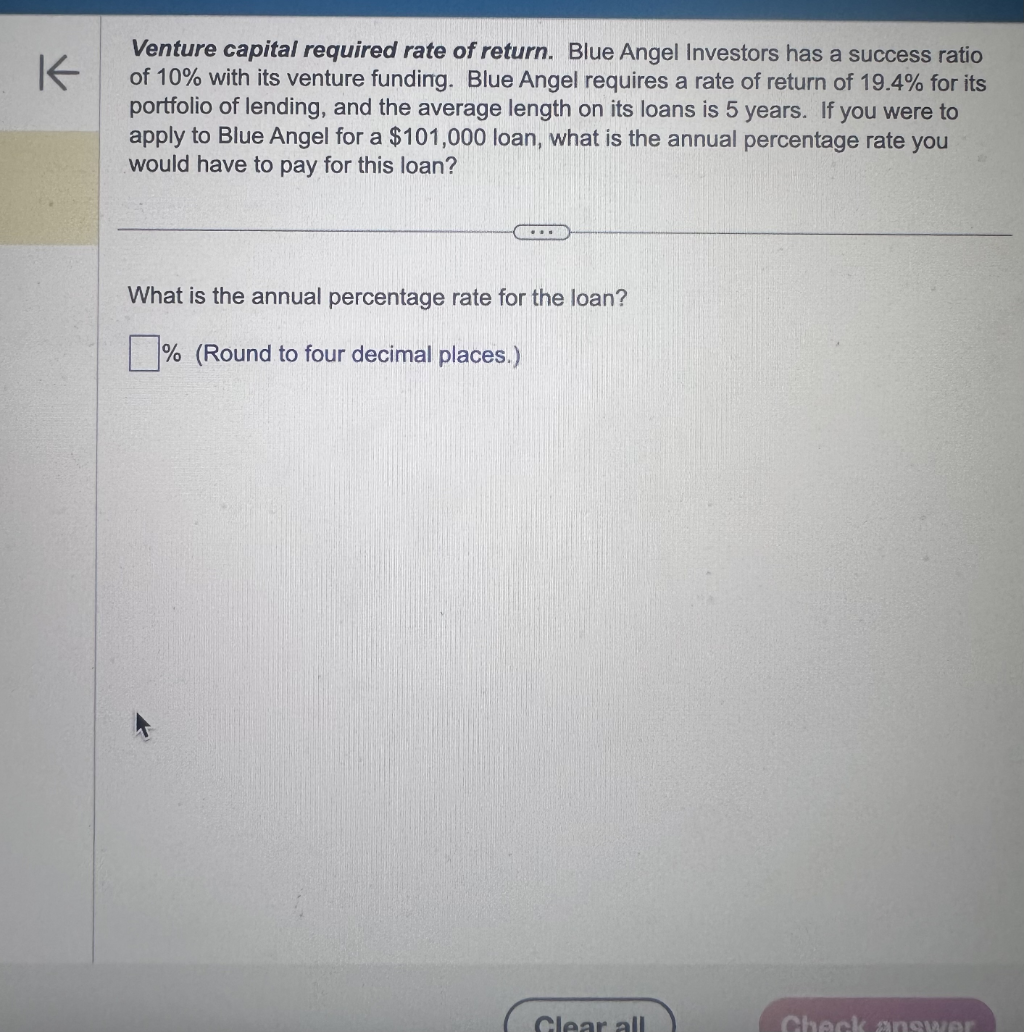
Give step-by-step solution with explanation and final answer:: Venture capital required rate of return. Blue Angel Investors has asu ccess r
i |< of 10% with its venture funding. Blue Angel requires a rate of return of 19.4% fo
A portfolio of lending, and the average length on its loans is 5 years. If you were to
B: pe apply to Blue Angel for a $101,000 loan, what is the annual percentage rate you
~ would have to pay for this loan? “Li
2 FE
5 What is the annual percentage rate for the loan? Te
: [Jo (Round to four decimal places.) ? E-
: a
E a
ie =
= es
i ; La
Le i «0
Er i) | ia
Ia I Hi fil Lo
VT I | + PE
1 fi EE 1th CAG sa
ERE Hil aa
CT Ee a
ORE RR I CT
RE
Question:
Give step-by-step solution with explanation and final answer:: Venture capital required rate of return. Blue Angel Investors has asu ccess r
i |< of 10% with its venture funding. Blue Angel requires a rate of return of 19.4% fo
A portfolio of lending, and the average length on its loans is 5 years. If you were to
B: pe apply to Blue Angel for a $101,000 loan, what is the annual percentage rate you
~ would have to pay for this loan? “Li
2 FE
5 What is the annual percentage rate for the loan? Te
: [Jo (Round to four decimal places.) ? E-
: a
E a
ie =
= es
i ; La
Le i «0
Er i) | ia
Ia I Hi fil Lo
VT I | + PE
1 fi EE 1th CAG sa
ERE Hil aa
CT Ee a
ORE RR I CT
RE
This is AI generated Response.
Asked by: Veera manikanta
Created at: 2025-08-01 07:48:08
Final Answer:
RenderedRaw Text
Did you like this answer?
Let's break down the problem step by step:
### **Problem Recap**
- **Success ratio**: 10% (Only 10% of investments succeed, 90% fail)
- **Portfolio required rate of return**: 19.4%
- **Loan period**: 5 years
- **Loan amount**: $101,000
- **Find**: The annual percentage rate (APR) you must pay.
---
### **Step 1: Understanding the Venture Capital Math**
Since only 10% of investments succeed, the successful investments must earn enough to cover all investments and provide the required portfolio return of 19.4%.
Let \( r \) be the required annual return on your loan.
#### **Future Value Needed**
In 5 years, Blue Angel wants its portfolio to grow by 19.4% per year:
\[
\text{Future Value (FV) of $101,000 in 5 years at 19.4%:}
\]
\[
FV = PV \times (1 + 0.194)^5
\]
\[
FV = 101,000 \times (1.194)^5
\]
\[
FV = 101,000 \times 2.4283 = 245,258.30
\]
But only 10% of investments succeed, so each successful investment must return enough to cover all (including failed ones):
\[
\text{Each successful investment must return:}
\]
\[
\text{Required FV per successful investment} = \frac{245,258.30}{0.10} = 2,452,583
\]
---
### **Step 2: Find Required Annual Rate (\( r \))**
Set up the equation for the loan to grow from $101,000 to $2,452,583 in 5 years:
\[
101,000 \times (1 + r)^5 = 2,452,583
\]
\[
(1 + r)^5 = \frac{2,452,583}{101,000} = 24.27
\]
\[
1 + r = (24.27)^{1/5}
\]
\[
1 + r = 1.8921
\]
\[
r = 1.8921 - 1 = 0.8921
\]
\[
r = 89.21\%
\]
---
### **Step 3: Final Answer**
**The annual percentage rate for the loan is**:
\[
\boxed{89.21\%}
\]
(Rounded to four decimal places: **89.2100%**)
Question:
1: Introduction:
Provide the complete necessary conceptual background concepts explanation and the
introduction required to understand and answer the given question. Add an Explanation
block at the end of the introduction by adding various relevant supporting statements and
explaining the introduction concisely.
Note: Do not use personal pronouns like I, we, you, etc. The response must look as if it is
written by a human.
Explanation: Articulate the importance of the introduction, providing more relevant
comprehensive supporting statements that link these concepts directly to the question.
This explanation should clarify how the introduction aids in comprehending the
subsequent steps.
2: Presentation of Relevant Formulas Required To Solve The Question:
List and also describe all formulas required to solve the question. Ensure each formula is
presented clearly and is directly applicable to the problem.
Explanation: Detail the derivation or rationale behind each formula, explaining its
relevance and necessity in the context of the problem-solving process. Use more relavent
comprehensive supporting statements to reinforce the significance of these mathematical
tools.
3: A Detailed Step-by-Step Solution:
Write a step-by-step in-depth comprehensive straight forward complete solution in a
structured way without missing anything as per the requirements and also include
explanation [ Write relevant supporting statements in the explanation block ] for every step
in the solution.
Conclusion:
Conclude with a concise summary of the solution, succinctly presenting the final answer
short summary derived from the calculations.
Follow These Guidelines While Answering The Question:
1. Maintain a professional and impersonal tone throughout, avoiding personal
pronouns such as 'I', 'we', 'you', etc.
2. Ensure more accuracy and adherence to the necessary concepts and correct
textbook based correct formulas and other relevant, required to solve the question.
3. Include an Explanation block at the end of each step to provide context and clarify
the methodology used by providing the necessary supporting statements.
4. Focus solely on delivering a well-explained direct and complete answer to the
question, without additional guidance [ I don’t need any guidance of how to solve
the question – I just need well-explained complete solution ] or extraneous content.
5. Make sure that strictly follow the specified format, ensuring that each section,
especially the introduction and each step of the solution, is accompanied by a
detailed relevant supporting statement in the explanation.
6. I need the exact detailed comprehensive direct step-by-step answer as I don’t need
any guidance to write the answer and strictly add the explanation for each with the
required supporting statement & Please give me the complete answer as per the
question requirements without skipping anything in the answer.
7. Always provide correct, complete detailed & well-explained solution.
8. Ensure that there are no typo/formula/calculation/programming/grammatical errors
are present in your solution.
9. Give the correct graphs/diagrams/tables/charts whenever required in the solution.
10. Ensure that there are NO Errors in Units/Notations are there in your solution.
11. Avoid missing any vital part in the solution [ Don’t miss any part in the solution ].
This is AI generated Response.
Asked by: Veera manikanta
Created at: 2025-08-01 07:49:35
Final Answer:
RenderedRaw Text
Did you like this answer?
**1. Introduction**
Understanding the concepts of venture capital investments, expected returns, and risk-adjusted performance metrics is essential to evaluate the required rates of return on investments. Venture capital investments are characterized by high risk and potential high rewards, often involving a significant probability of failure. To compensate for the high risk, investors demand a higher rate of return compared to traditional investments. When assessing the appropriate rate to charge or expect on a venture loan, it is critical to consider the success ratio, the desired portfolio return, and the time horizon of the investment.
In this context, the success ratio indicates the probability that an individual investment will succeed, contributing to overall portfolio performance. The venture capital required rate of return, in conjunction with the success ratio and the time horizon, informs the calculation of the necessary annual percentage rate (APR) for a specific loan. The challenge lies in adjusting the expected return to account for the low probability of success, ensuring that the overall portfolio achieves the targeted return.
This introduction provides the foundation for analyzing the problem by linking key concepts such as success ratios, return requirements, and time value of money, which are integral to determining the appropriate loan rate.
**Explanation:**
The introductory concepts clarify the importance of success probability, target returns, and time horizon in financial decision-making related to high-risk investments. Recognizing that venture capital investments involve a low success rate but high potential payoff helps in understanding why the required rate of return must be adjusted accordingly. This foundational knowledge prepares for the subsequent application of mathematical formulas to derive the necessary annual percentage rate.
---
**2. Presentation of Relevant Formulas Required To Solve The Question**
**a) Future Value (FV) formula for compound interest:**
\[
FV = PV \times (1 + r)^t
\]
- *Description:* Calculates the accumulated amount after \(t\) years when invested at an annual rate \(r\).
- *Applicability:* Used to determine how much an initial investment will grow over the investment horizon at a given annual rate.
**b) Adjustment for success ratio in expected return:**
\[
\text{Required FV per successful investment} = \frac{\text{Target FV of the portfolio}}{\text{Success probability}}
\]
- *Description:* Since only a fraction of investments succeed, the expected returns from successful investments must be scaled up to compensate for failures.
**c) Solving for the annual rate \(r\):**
\[
(1 + r)^t = \frac{\text{Adjusted FV}}{PV}
\]
\[
r = \left(\frac{\text{Adjusted FV}}{PV}\right)^{1/t} - 1
\]
- *Description:* Rearranged to find the annual rate \(r\) needed to grow the initial investment \(PV\) to the adjusted future value over \(t\) years.
---
**Explanation:**
These formulas facilitate translating the desired portfolio return into a per-investment required return, considering success probability and time horizon. The core concept involves understanding how compound interest impacts growth and how risk adjustment inflates the necessary returns to compensate for low success rates. Using these formulas ensures a precise calculation aligned with financial principles.
---
**3. A Detailed Step-by-Step Solution**
**Step 1: Calculate the future value of the portfolio at the desired return**
Given:
- Initial investment (PV) = $101,000
- Target portfolio return (annual) = 19.4% or 0.194
- Time horizon, \(t\) = 5 years
Calculate the future value (FV) after 5 years:
\[
FV = 101,000 \times (1 + 0.194)^5
\]
\[
FV = 101,000 \times (1.194)^5
\]
Calculate \((1.194)^5\):
\[
(1.194)^5 \approx 2.4283
\]
Thus:
\[
FV = 101,000 \times 2.4283 \approx 245,258.30
\]
**Explanation:**
This step determines the amount Blue Angel Investors expects to have after 5 years to meet its target return, providing the future value benchmark for the investment.
---
**Step 2: Adjust for the success probability**
Given success ratio:
- Probability of success = 10% or 0.10
Since only 10% of investments succeed, each successful investment must generate enough to cover the entire portfolio goal, scaled up by the inverse of success probability:
\[
\text{Adjusted FV} = \frac{FV}{\text{Success probability}} = \frac{245,258.30}{0.10} = 2,452,583
\]
**Explanation:**
This adjustment accounts for the fact that only a fraction of investments will succeed; thus, successful investments need to produce a higher return to ensure the overall portfolio reaches the target.
---
**Step 3: Calculate the required annual rate \(r\)**
Using the compound interest formula:
\[
(1 + r)^5 = \frac{\text{Adjusted FV}}{PV} = \frac{2,452,583}{101,000} \approx 24.27
\]
Solve for \(r\):
\[
1 + r = (24.27)^{1/5}
\]
Calculate the 5th root:
\[
(24.27)^{1/5} \approx 1.8921
\]
Therefore:
\[
r = 1.8921 - 1 = 0.8921
\]
Expressed as a percentage:
\[
r = 89.21\%
\]
**Explanation:**
This step determines the annual percentage rate needed on the loan so that, after compounding over five years, the investment grows to the adjusted future value, accounting for the low success probability.
---
**Final Answer:**
The annual percentage rate required for the loan is **89.2100%**.
---
**Conclusion:**
By accounting for the low success probability, the targeted portfolio return, and the time horizon, it is evident that a substantially high annual rate—approximately 89.21%—must be charged to meet the desired investment objectives in a venture capital context characterized by high risk and low success probability.
VIPSolutions focuses on clear, step‑by‑step explanations so you can learn quickly. Whether you need an AI‑generated walkthrough or a short hint to get unstuck, each solution is organized for fast reading and easy review later.
Search similar questions, compare approaches, and bookmark the best answers for revision. Our goal is simple: quick, reliable study help that feels natural—not noisy.
 VIPSolutions
 : Venture capital required rate of return. Blue Angel Investors has asu ccess r
i |< of 10% with its venture funding. Blue Angel requires a rate of return of 19.4% fo
A portfolio of lending, and the average length on its loans is 5 years. If you were to
B: pe apply to Blue Angel for a $101,000 loan, what is the annual percentage rate you
~ would have to pay for this loan? “Li
2 FE
5 What is the annual percentage rate for the loan? Te
: [Jo (Round to four decimal places.) ? E-
: a
E a
ie =
= es
i ; La
Le i «0
Er i) | ia
Ia I Hi fil Lo
VT I | + PE
1 fi EE 1th CAG sa
ERE Hil aa
CT Ee a
ORE RR I CT
RE