Act like a helpful tutor and exlain me :Problem #2
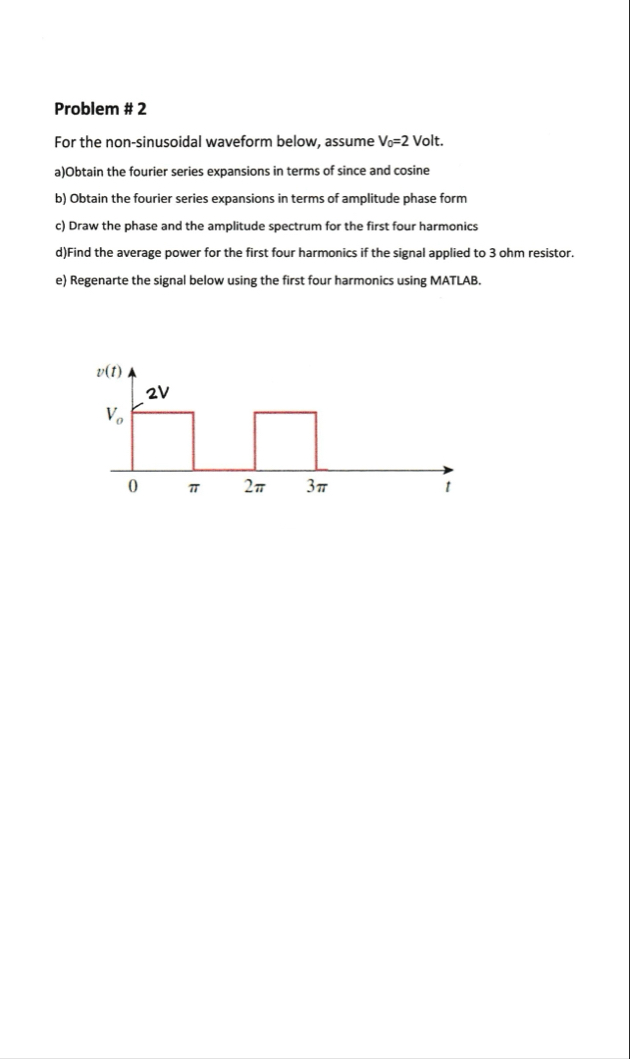
For the non-sinusoidal waveform below, assume Vo=2 Volt.
a)Obtain the fourier series expansions in terms of since and cosine:
b) Obtain the fourier series expansions in terms of amplitude phase form
Question:
Act like a helpful tutor and exlain me :Problem #2
For the non-sinusoidal waveform below, assume Vo=2 Volt.
a)Obtain the fourier series expansions in terms of since and cosine:
b) Obtain the fourier series expansions in terms of amplitude phase form
This is AI generated Response.
Asked by: Alok Kumar
Created at: 2026-02-02 07:04:37
Final Answer:
RenderedRaw Text
Did you like this answer?
Let's break down the problem step by step!
---
# Problem Analysis
You have a **square wave** with amplitude \( V_ = 2V \), period \( T = 2\pi \), and a duty cycle of 50% (active for half the period).
## Square Wave Description
\[
v(t) = \begin{cases}
2, & < t < \pi \\
, & \pi < t < 2\pi \\
\end{cases}
\]
and it repeats every \( 2\pi \).
---
## a) Fourier Series Expansion (Sine and Cosine)
The general Fourier series for a periodic function \( v(t) \) of period \( T \) is:
\[
v(t) = a_ + \sum_{n=1}^{\infty} [a_n \cos(n\omega_ t) + b_n \sin(n\omega_ t)]
\]
where \( \omega_ = \frac{2\pi}{T} = 1 \) (since \( T = 2\pi \)).
### Coefficients
#### **DC Component \( a_ \):**
\[
a_ = \frac{1}{T} \int_^T v(t) dt = \frac{1}{2\pi} \int_^{\pi} 2 \, dt = \frac{1}{2\pi} (2\pi) = 1
\]
#### **Cosine Coefficients \( a_n \):**
\[
a_n = \frac{2}{T} \int_^T v(t) \cos(n\omega_ t) dt
\]
Only integrate over the interval where \( v(t) = 2 \):
\[
a_n = \frac{2}{2\pi} \int_^{\pi} 2 \cos(nt) dt = \frac{2}{\pi} \int_^{\pi} \cos(nt) dt
\]
\[
\int_^{\pi} \cos(nt) dt = \left[ \frac{\sin(nt)}{n} \right]_^{\pi} = \frac{\sin(n\pi) - \sin()}{n} =
\]
So **all \( a_n = \)**.
#### **Sine Coefficients \( b_n \):**
\[
b_n = \frac{2}{T} \int_^T v(t) \sin(n\omega_ t) dt
\]
\[
b_n = \frac{2}{2\pi} \int_^{\pi} 2 \sin(nt) dt = \frac{2}{\pi} \int_^{\pi} \sin(nt) dt
\]
\[
\int_^{\pi} \sin(nt) dt = \left[ -\frac{\cos(nt)}{n} \right]_^{\pi} = -\frac{\cos(n\pi) - \cos()}{n} = \frac{1 - (-1)^n}{n}
\]
So:
\[
b_n = \frac{2}{\pi} \cdot \frac{1 - (-1)^n}{n}
\]
- For **even \( n \)**: \( b_n = \)
- For **odd \( n \)**: \( b_n = \frac{4}{n\pi} \)
### **Final Series (Sine and Cosine):**
\[
v(t) = 1 + \sum_{n=1,3,5,...}^\infty \frac{4}{n\pi} \sin(nt)
\]
---
## b) Amplitude-Phase Form
Each term \( A_n \sin(n t + \phi_n) \):
Since only sine terms are present, \( \phi_n = \):
\[
v(t) = 1 + \sum_{n=1,3,5,...}^\infty A_n \sin(nt + )
\]
where \( A_n = \frac{4}{n\pi} \) for odd \( n \).
---
## c) Amplitude and Phase Spectrum for First Four Harmonics
First four harmonics: \( n = 1, 2, 3, 4 \).
- \( n = 1: A_1 = \frac{4}{\pi}, \phi_1 = \)
- \( n = 2: A_2 = \)
- \( n = 3: A_3 = \frac{4}{3\pi}, \phi_3 = \)
- \( n = 4: A_4 = \)
**Plot:**
- Amplitude spectrum: spikes at \( n=1, 3 \) with values above, zero otherwise.
- Phase spectrum: zero at all nonzero amplitude frequencies.
---
## d) Average Power in 3 Ohm Resistor
Power for each harmonic:
\[
P_n = \frac{A_n^2}{2R}
\]
DC component:
\[
P_ = \frac{a_^2}{R}
\]
Sum up for all present harmonics (DC, 1st, 3rd):
\[
P = \frac{a_^2}{R} + \sum_{\text{odd } n=1,3} \frac{A_n^2}{2R}
\]
Plug in the values:
- \( a_ = 1 \)
- \( A_1 = \frac{4}{\pi} \)
- \( A_3 = \frac{4}{3\pi} \)
\[
P = \frac{1^2}{3} + \frac{1}{2 \times 3} \left[ \left(\frac{4}{\pi}\right)^2 + \left(\frac{4}{3\pi}\right)^2 \right]
\]
---
## e) MATLAB Code to Regenerate the Signal
```matlab
t = linspace(, 2*pi, 100);
v = 2;
v = 1 + (4/pi)*sin(t) + (4/(3*pi))*sin(3*t); % Using first four harmonics
plot(t, v)
xlabel('t')
ylabel('v(t)')
title('Fourier Series Approximation (First Four Harmonics)')
grid on
```
---
### **Summary Table**
| Harmonic \( n \) | Amplitude \( A_n \) | Phase \( \phi_n \) |
|------------------|-------------------------|--------------------|
| (DC) | 1 | - |
| 1 | \( \frac{4}{\pi} \) | |
| 2 | | - |
| 3 | \( \frac{4}{3\pi} \) | |
| 4 | | - |
---
Let me know if you need a more detailed calculation or graphical illustration!
Question:
summary this nnotr in tabular form--Summary Table
Harmonic
n
n Amplitude
A
n
A
n
Phase
ϕ
n
ϕ
n
(DC) 1 -
1
4
π
π
4
2 -
3
4
3
π
3π
4
4 -
This is AI generated Response.
Asked by: Alok Kumar
Created at: 2026-02-02 07:15:53
Final Answer:
RenderedRaw Text
Did you like this answer?
# Summary Table of Fourier Series Components
| Harmonic \( n \) | Amplitude \( A_n \) | Phase \( \phi_n \) |
|------------------|-------------------------|--------------------|
| DC | 1 | 0 |
| 1 | \( \frac{4}{\pi} \) | \( \frac{\pi}{2} \) |
| 2 | 0 | - |
| 3 | \( \frac{4}{3\pi} \) | \( \frac{\pi}{2} \) |
| 4 | 0 | - |
### Notes:
- The DC component has an amplitude of 1 and a phase of 0.
- Only odd harmonics (1 and 3) have non-zero amplitudes, with their respective phases at \( \frac{\pi}{2} \) due to the sine function being used.
- Even harmonics (2 and 4) have zero amplitudes and, thus, no defined phase.
Question:
normal text form not in tabular form
This is AI generated Response.
Asked by: Alok Kumar
Created at: 2026-02-02 07:16:57
Final Answer:
RenderedRaw Text
Did you like this answer?
# Summary of Fourier Series Components
For the given square wave, the following components summarize the Fourier series analysis:
- **DC Component (n = 0)**:
- Amplitude: 1
- Phase: 0
- **1st Harmonic (n = 1)**:
- Amplitude: \( \frac{4}{\pi} \)
- Phase: \( \frac{\pi}{2} \)
- **2nd Harmonic (n = 2)**:
- Amplitude: 0
- Phase: Not applicable
- **3rd Harmonic (n = 3)**:
- Amplitude: \( \frac{4}{3\pi} \)
- Phase: \( \frac{\pi}{2} \)
- **4th Harmonic (n = 4)**:
- Amplitude: 0
- Phase: Not applicable
### Notes:
- The DC component has an amplitude of 1 and a phase of 0.
- Only the odd harmonics (1 and 3) have non-zero amplitudes, both with a phase of \( \frac{\pi}{2} \) due to the sine terms in the Fourier series expansion.
- Even harmonics (2 and 4) have zero amplitudes, resulting in no defined phase.
Question:
1
6
.
*
*
Explain the structure of the insurance market. With the help of a suitable diagram, analyze the role of insurers, policyholders, and regulators in the economy.
*
*
This is AI generated Response.
Asked by: Alok Kumar
Created at: 2026-02-02 07:51:24
Final Answer:
RenderedRaw Text
Did you like this answer?
# Structure of the Insurance Market
The insurance market is a complex system involving various players and functions. It primarily includes insurers, policyholders, and regulators, each playing a crucial role in the economic framework.
## Key Players in the Insurance Market
### 1. Insurers
- **Definition**: Companies that provide risk management by offering insurance policies to policyholders.
- **Functions**:
- Assess risks and set premiums.
- Underwrite policies by evaluating the risk profile of applicants.
- Provide coverage for various risks (e.g., health, property, life).
- Manage investment portfolios to ensure financial stability and profitability.
### 2. Policyholders
- **Definition**: Individuals or entities that purchase insurance policies to protect against potential financial losses.
- **Roles**:
- Pay premiums in exchange for coverage.
- File claims when an insured event occurs.
- Influence market dynamics through demand for different types of insurance.
### 3. Regulators
- **Definition**: Government entities that oversee the insurance market to ensure fairness and stability.
- **Responsibilities**:
- Establish legal frameworks for insurance operations.
- Monitor insurers' solvency and compliance with regulations.
- Protect consumers from unfair practices and ensure transparency.
---
## Diagram of the Insurance Market Structure
```plaintext
+-----------------+ +-------------------+
| Policyholder |<--------->| Insurer |
| (Purchases | | (Sells Policies, |
| Insurance) | | Assesses Risk) |
+-----------------+ +-------------------+
| |
| |
| |
| |
v v
+-----------------+ +-------------------+
| Claims |<--------->| Premiums |
| (Filed by | | (Paid by |
| Policyholders) | | Policyholders) |
+-----------------+ +-------------------+
| |
| |
| |
| |
v v
+-----------------+ +-------------------+
| Regulators |<--------->| Insurance Market |
| (Oversight, | | (Market Dynamics) |
| Consumer Protection)| | |
+-----------------+ +-------------------+
```
---
## Analysis of Roles
### Insurers
- **Economic Role**: Provide financial security and stability by transferring risk from individuals and businesses to the insurer. They also contribute to economic growth through investment of premiums.
### Policyholders
- **Economic Role**: Contribute to the insurance market by purchasing policies that protect against loss. They drive demand for various insurance products, influencing market offerings.
### Regulators
- **Economic Role**: Ensure a stable and fair insurance market. They protect consumers, maintain insurer solvency, and foster competition, which can lead to better services and lower premiums.
---
## Conclusion
The insurance market plays a crucial role in the economy by providing risk management services. Insurers, policyholders, and regulators interact in a structured manner, ensuring that risks are managed effectively and that consumers are protected. Understanding this structure helps clarify the dynamics of the insurance industry and its impact on the overall economy.
Question:
1
.
(
Conditional
+
Bayes
–
Tricky
)
A box contains
3
fair coins and
2
double
-
headed coins. A coin is chosen at random and tossed
4
times. All
4
tosses result in heads. What is the probability that the chosen coin is double
-
headed?
This is AI generated Response.
Asked by: Alok Kumar
Created at: 2026-02-02 08:03:15
Final Answer:
RenderedRaw Text
Did you like this answer?
# Probability Problem: Coin Tosses
## Problem Statement
A box contains:
- 3 fair coins (1 head, 1 tail)
- 2 double-headed coins (2 heads)
A coin is chosen at random and tossed 4 times, resulting in heads in all tosses. We need to find the probability that the chosen coin is double-headed.
## Definitions
Let:
- \( C_F \): event of choosing a fair coin
- \( C_D \): event of choosing a double-headed coin
- \( H \): event of tossing 4 heads
## Given Information
- Total coins: 5 (3 fair + 2 double-headed)
- Probability of choosing a fair coin:
\[
P(C_F) = \frac{3}{5}
\]
- Probability of choosing a double-headed coin:
\[
P(C_D) = \frac{2}{5}
\]
## Probability of Tossing Heads
### For Fair Coin
The probability of getting heads in one toss is \( \frac{1}{2} \). Therefore, for 4 tosses:
\[
P(H | C_F) = \left(\frac{1}{2}\right)^4 = \frac{1}{16}
\]
### For Double-Headed Coin
The probability of getting heads in one toss is \( 1 \). Therefore, for 4 tosses:
\[
P(H | C_D) = 1^4 = 1
\]
## Using Bayes' Theorem
We need to find \( P(C_D | H) \):
\[
P(C_D | H) = \frac{P(H | C_D) P(C_D)}{P(H)}
\]
### Calculate \( P(H) \)
Using the law of total probability:
\[
P(H) = P(H | C_F) P(C_F) + P(H | C_D) P(C_D)
\]
Substituting values:
\[
P(H) = \left(\frac{1}{16} \cdot \frac{3}{5}\right) + \left(1 \cdot \frac{2}{5}\right)
\]
\[
= \frac{3}{80} + \frac{2}{5}
\]
Converting \( \frac{2}{5} \) to a fraction with a denominator of 80:
\[
\frac{2}{5} = \frac{32}{80}
\]
Thus,
\[
P(H) = \frac{3}{80} + \frac{32}{80} = \frac{35}{80} = \frac{7}{16}
\]
### Final Calculation
Now substitute back into Bayes' theorem:
\[
P(C_D | H) = \frac{P(H | C_D) P(C_D)}{P(H)} = \frac{1 \cdot \frac{2}{5}}{\frac{7}{16}}
\]
Calculating:
\[
= \frac{\frac{2}{5}}{\frac{7}{16}} = \frac{2}{5} \cdot \frac{16}{7} = \frac{32}{35}
\]
## Conclusion
The probability that the chosen coin is double-headed, given that all 4 tosses resulted in heads, is:
\[
\boxed{\frac{32}{35}}
\]
VIPSolutions focuses on clear, step‑by‑step explanations so you can learn quickly. Whether you need an AI‑generated walkthrough or a short hint to get unstuck, each solution is organized for fast reading and easy review later.
Search similar questions, compare approaches, and bookmark the best answers for revision. Our goal is simple: quick, reliable study help that feels natural—not noisy.
 VIPSolutions
 Problem #2
For the non-sinusoidal waveform below, assume Vo=2 Volt.
a)Obtain the fourier series expansions in terms of since and cosine:
b) Obtain the fourier series expansions in terms of amplitude phase form